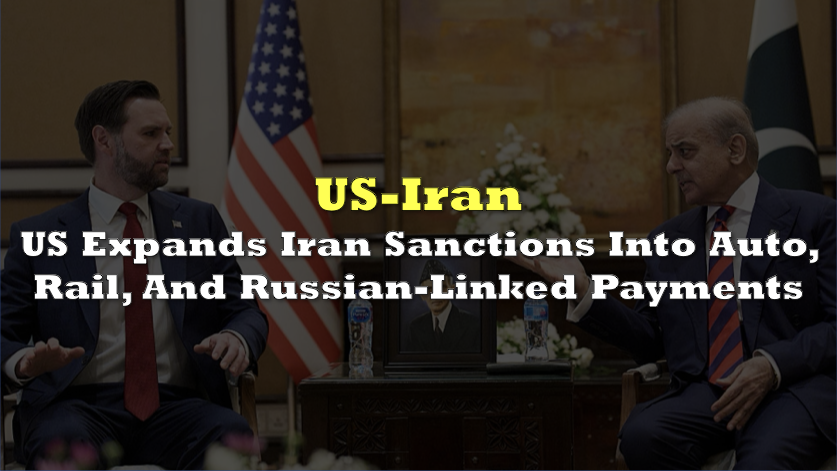

The US has widened its Iran sanctions architecture into two of the country’s largest domestic transport industries while separately targeting a Russia-linked payment network that Washington alleges helped Tehran move funds outside conventional financial channels.
The Treasury Department published a new sectoral determination covering Iran’s automotive and rail industries under Executive Order 13902. Effective immediately, the measure allows the Office of Foreign Assets Control to sanction people and companies determined to operate in either sector.
Treasury simultaneously designated Iran Khodro Company and SAIPA Iranian Automobile Manufacturing Company, Iran’s two dominant automakers. The department said the companies account for more than 90% of Iran’s domestic automobile market and together produce nearly 1.5 million vehicles annually.
 Sponsored · Cambria Gold Mines
The action also covers Iran Khodro Diesel, Pars Khodro, Zamyad, and two Niroo Motor companies. Five overseas suppliers based in Indonesia, the UAE, Turkey, and Hong Kong were sanctioned over Treasury allegations that they supplied components to Iranian manufacturers.
The rail designations reach the state-owned Islamic Republic of Iran Railway Company, Raja Passenger Trains Company, and Railway Transportation Company, a private freight operator. Treasury said Iran has increasingly relied on rail for petroleum, freight, and regional commerce as US maritime restrictions have constrained seaborne trade.
The same action also designated companies and individuals connected to manufacturing, mining, steel, and overseas trading networks. Property belonging to designated parties that falls under US jurisdiction is blocked, while entities owned at least 50% by blocked persons are generally blocked as well.
In a separate action, Treasury targeted the A7 Network, a Russia-linked cross-border payments system. OFAC designated the network as a significant transnational criminal organization, while FinCEN proposed restrictions on fund transfers involving A7 sub-agents.
Treasury alleged that A7-linked companies used third-country entities and falsified trade documentation to disguise sanctioned transactions. FinCEN said A7 sub-agents processed more than $17 billion between January 2025 and June 2026.
The department further alleged that parts of the network facilitated Iranian oil sales and weapons procurement, including nearly $140 million received from entities involved in Iranian sanctions evasion.
A7 disputed the allegations, telling Reuters it “categorically rejects any allegations that it has worked with Iran or terrorist organisations.” The company said its network handles legitimate Russian import and export transactions.