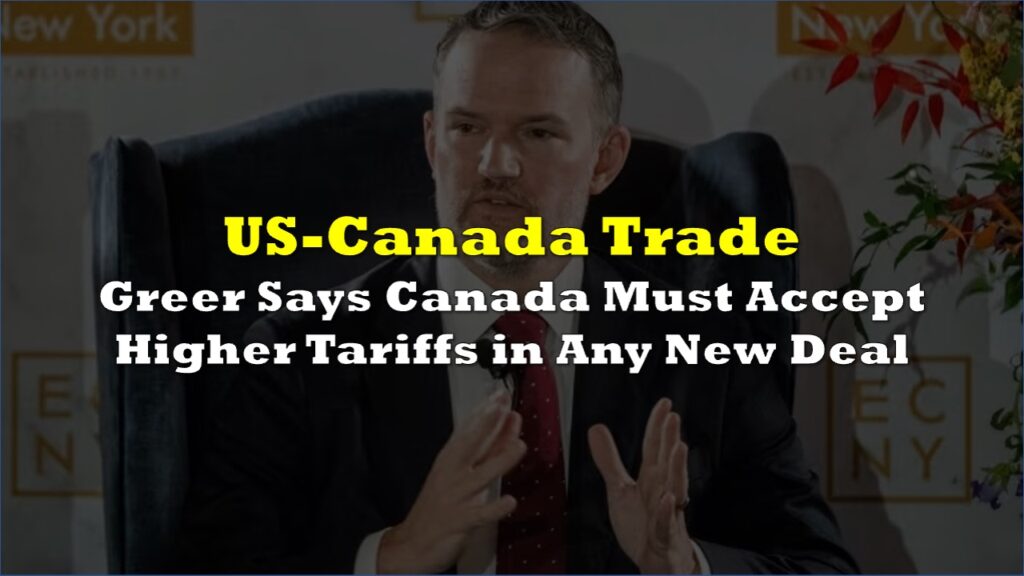

US Trade Representative Jamieson Greer has published a “non-exhaustive” list of issues he says must be resolved for the CUSMA Joint Review to succeed, putting Canada’s dairy market access and digital laws in the same bucket as Mexico energy disputes, rules-of-origin tightening, and new regional “economic security” tools.
Greer anchored the review process to statutory milestones ahead of the July 1, 2026 joint review.
On agriculture, Greer summarized comment themes as dairy access in Canada and Canada’s exports of certain dairy products, split views on seasonal-produce restrictions aimed at Mexico, split views on reinstating mandatory country-of-origin labeling for beef, and a push to keep trade duty-free while maintaining science-based sanitary and phytosanitary rules.
On industry, rules of origin surfaced as the central lever, with calls ranging from tightening downstream specialty metals and strengthening automotive rules of origin to incentivize North American-sourced critical minerals, while other stakeholders argued the rules are working in most cases.
On economic security, Greer highlighted concerns about non-market policies, industrial overcapacity, and allegations that Mexico can be used as a staging ground to evade US tariffs and enforcement, alongside proposals to restrict certain duty-exemption or drawback programs and create a new critical-minerals “international commodity agreement” annex.
On labor and environment, Greer cited praise for the Rapid Response Mechanism as an “excellent tool” paired with proposals to expand or streamline it, plus ideas to add an RRM-like enforcement mechanism for environmental commitments. 
For Canada, the US list starts with dairy: ensuring the market access Canada committed to provide under CUSMA and addressing Canada’s exports of certain dairy products.
Greer also flagged Canada’s Online Streaming Act and Online News Act as problems for US digital service providers, alongside provincial bans on distributing US alcohol beverages, “discriminatory” procurement measures in Ontario, Quebec, and British Columbia, “complicated” customs registration for Canadian recipients of US exports, and “Alberta’s unfair treatment” of electrical power distribution providers in Montana.
These are the main trade issues with Canada that the United States wants to resolve as part of the CUSMA review. The USTR, Jamieson Greer published his full address to the Congressional committee online.
— Brian Lilley (@brianlilley) December 18, 2025
Dealing with these issues should not be hard.https://t.co/eTanvd2kUx pic.twitter.com/UFXEESbmUG
For Mexico, Greer’s list spans policies promoting third-country content that “erode” U.S. supply chains, labor-law enforcement changes including sanction authority for the Federal Center for Conciliation and Labor Registration, and environmental enforcement tied to fisheries management, illegal fishing, and illegal wildlife trade. 
The list also includes concerns about Mexican energy policies and practices, EU protection of meat and cheese terms that the US argues threatens producers’ market access, the methodology for an annual spectrum-use fee, equal treatment for U.S. electronic payment suppliers to process domestic transactions on proprietary networks, restrictions on customs brokers, and seasonal-produce impacts on US growers.
Greer’s assessment pairs performance claims with an explicit refusal to “rubberstamp” renewal: he said CUSMA has been “successful to a certain degree,” citing US exports of goods and services to Canada and Mexico up 56% since 2020 to $960 billion in 2024 from $617 billion in 2020, Mexico nominal manufacturing wages rising to $4.2 per hour in September 2025 from $2.3 per hour in January 2020, and Mexico capturing about 25% of the reduction in the U.S. bilateral trade deficit with China.
Information for this briefing was found via the sources mentioned. The author has no securities or affiliations related to this organization. Not a recommendation to buy or sell. Always do additional research and consult a professional before purchasing a security. The author holds no licenses.