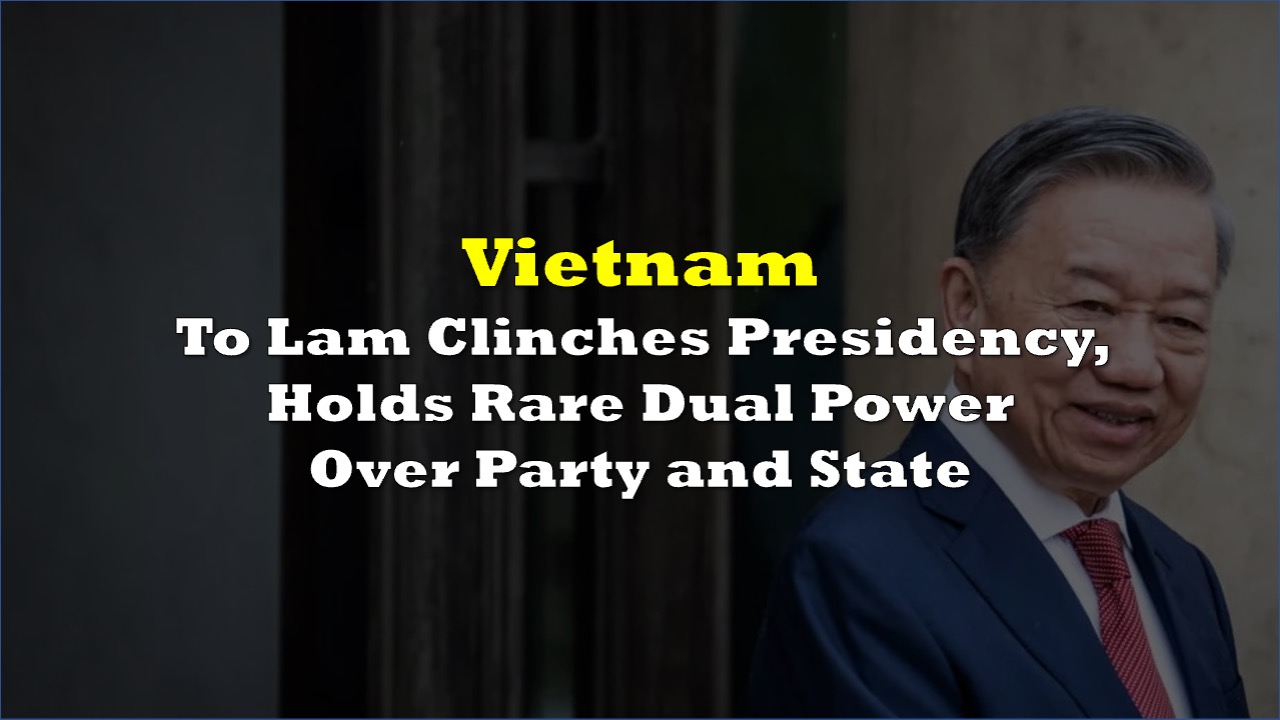

Vietnam’s National Assembly unanimously elected Communist Party General Secretary Tô Lâm as state president on Tuesday, granting him a dual mandate that breaks from the country’s tradition of collective leadership and mirrors governance structures in China and neighboring Laos.
Lawmakers acted on a Communist Party nomination locked in at an internal meeting in late March. A career security official who once led the Ministry of Public Security, Lâm had already secured a second term as general secretary in January, making him the most powerful Vietnamese leader since Hanoi launched market reforms in the 1980s.
Addressing the National Assembly after the vote, Lâm called for “a new growth model with science, technology, innovation, and digital transformation as the primary driving forces,” pledging self-reliance in defence and stability as top priorities.
The move merges two of Vietnam’s traditional ‘four pillars’ — the party chief and the president — roles that have historically been held by different people to distribute power across the top of the state.
“The opportunity is obvious. Faster decision-making, greater policy coherence, and a better chance of pushing difficult reforms at a pivotal moment. But the risk is that concentration of power can move faster than institutional reform,” said Nguyen Khac Giang of Singapore’s ISEAS-Yusof Ishak Institute.
Le Hong Hiep, a senior fellow at the same institute, warned the consolidation “could pose risks to Vietnam’s political system, such as increased authoritarianism,” even as it could enable faster, more effective policymaking.
Alexander Vuving of the Asia-Pacific Center for Security Studies went further. “The combination of the two roles will shift Vietnam’s domestic politics to a new normal where most of the old assumptions about Vietnam’s politics, including those about collective leadership, are no longer valid,” he said.
Lâm has staked his tenure on an economic ambition few Vietnamese leaders have publicly declared: double-digit annual growth sustained through 2030.
The economy posted 7.8% annualized growth in the first quarter of 2026 — an improvement on last year’s 7.1% but short of the 9.1% official target, with global energy markets rattled by the war in Iran adding further headwinds.
The assembly next moved to elect a new prime minister to replace Pham Minh Chinh.
Information for this story was found via the sources and companies mentioned. The author has no securities or affiliations related to the organizations discussed. Not a recommendation to buy or sell. Always do additional research and consult a professional before purchasing a security. The author holds no licenses.