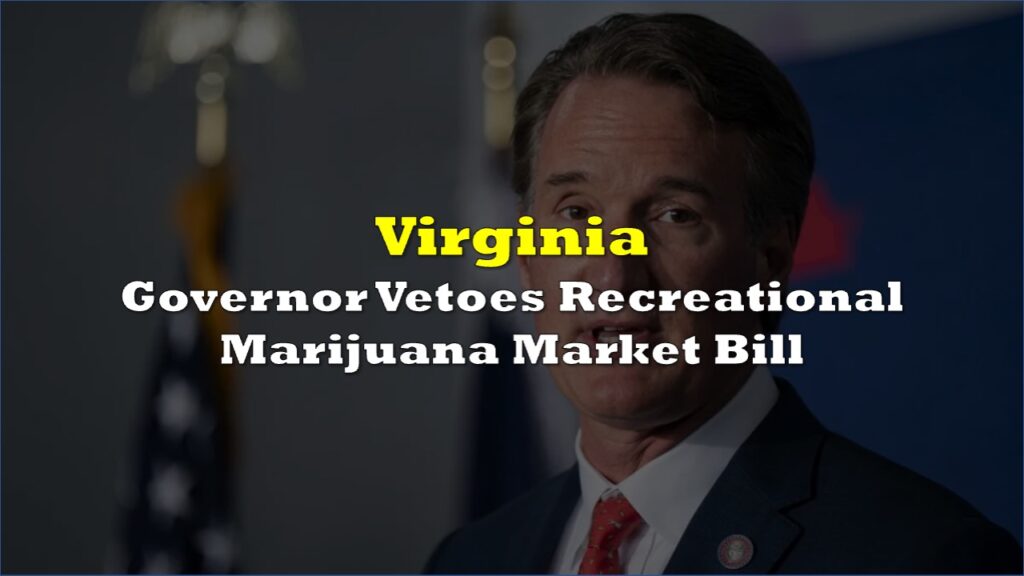

Virginia Gov. Abigail Spanberger vetoed the bills that would have finally opened a regulated retail marijuana market in the commonwealth, wiping out a projected $400 million annual revenue stream and pushing any new attempt to the 2027 legislative session — all while a government shutdown deadline closes in on June 30.
The veto followed the General Assembly’s flat rejection of every amendment Spanberger had proposed to SB 542 and HB 642, sponsored by Sen. Lashrecse Aird, D-Henrico, and Del. Paul Krizek, D-Fairfax. She had asked lawmakers to push back the original Jan. 1 retail sales start date by six months, raise the sales tax from 6% to 8% effective July 1, 2029, and cut the permitted number of retail stores from 350 to 200. The legislature passed on all three.
Her proposed changes reached deeper than store counts and tax rates. Spanberger wanted to make transporting more than 50 pounds of marijuana across the Virginia border a Class 2 felony, a charge that can carry a life sentence. She also sought to reclassify first-offense public consumption from a $25 civil fine to a Class 4 misdemeanor, and to replace the bill’s $25 fine and substance abuse education requirement for underage possession with a mandatory minimum $500 fine and a Class 1 misdemeanor charge.
 Sponsored · Altamira Gold Corp.
Spanberger said she had consulted governors of other states with adult-use markets before landing on those revisions. “It is critical that we incorporate lessons learned by other states and ensure that our regulatory framework is fully prepared to provide strong oversight from day one,” she said. “That includes clear enforcement authority and sufficient resources for compliance, testing, and inspections, and robust tools to crack down on bad actors who continue to profit from the illicit market.”
The bill’s sponsors pushed back hard. “The Governor’s veto ignores the reality that cannabis is already being sold everyday across Virginia,” Aird and Krizek wrote in a joint statement. “The only question is whether we as leaders will finally ensure those sales occur within a legal, regulated market or continue turning a blind eye to a booming illicit market.”
The timing sharpens the stakes. Virginia faces a June 30 at 11:59 p.m. deadline to pass a budget or trigger a government shutdown, and the $400 million in projected annual cannabis revenue is now gone as a planning assumption heading into those negotiations.
Virginia legalized personal possession and home cultivation in 2021, but has never stood up a retail sales framework. Former Gov. Glenn Youngkin vetoed two earlier attempts to build one. Spanberger’s decision stretches that gap to at least four years.
“Five years ago, Virginia legalized cannabis in recognition that the War on Drugs has caused disproportionate harm to Black families and communities,” Krizek said. Aird was more direct: “The governor’s decision leaves the commonwealth exactly where we have been since 2021: with an unchecked illicit market, hurting our communities, harming our youth and putting adults at risk.”
Lawmakers who want a retail market will need to file new legislation in 2027.
Information for this story was found via the sources and companies mentioned. The author has no securities or affiliations related to the organizations discussed. Not a recommendation to buy or sell. Always do additional research and consult a professional before purchasing a security. The author holds no licenses.