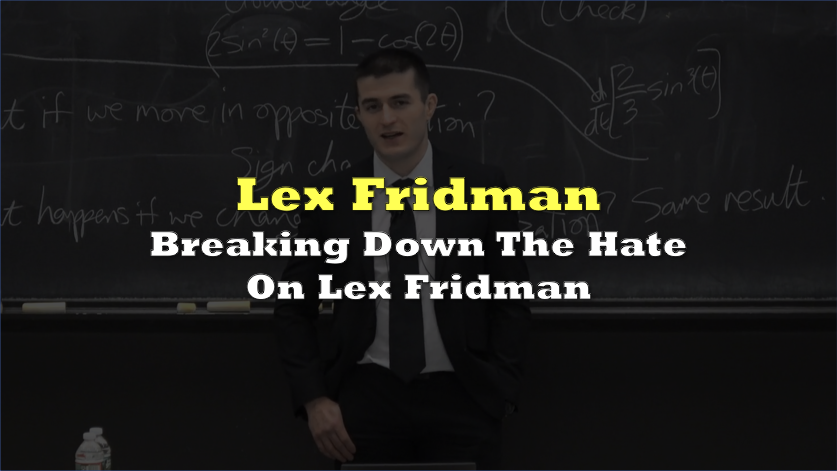

Lex Fridman’s problem is not that people suddenly discovered he is soft-spoken, earnest, or online-cringe. He has grown into a media figure large enough to interview presidents, prime ministers, billionaires, and wartime leaders while still presenting himself as a curious outsider whose main tools are empathy, long-form conversation, and “love.” That gap between scale and self-image is where much of the backlash now lives.
Critics do not just dislike his tone. They increasingly argue that his style gives powerful people prestige, intimacy, and narrative control without imposing the accountability expected of a journalist or even a hard-nosed interviewer.
Flawed human
Fridman’s recent post was framed like an apology, but it was more accurately a hybrid of confession, grievance, and recommitment. He wrote that after his “world leader convos” he gets “attacked intensely by all sides,” that the backlash has led to “really low points” mentally, and that he would “do better” while continuing to pursue such interviews.
“Oh and I’m sorry if I fuck things up sometimes. I’m a flawed human. But I promise to do whatever I can to try to add some more understanding and love to this world,” he wrote.
He also defended his process, saying he sometimes does “100+ hours” of research for a conversation, even if he deliberately avoids sounding overly performative or combative once the interview begins.
Fridman’s post did not specify a concrete error, retract a claim, or concede that any particular interview failed on the merits. Instead, it argued that he is flawed, under fire, and still trying. That is consistent with a pattern noted by Columbia Journalism Review, which wrote that Fridman often presents himself as surprised when criticism lands even as he increasingly moves into overtly political terrain.
This life is fucking amazing. I'm so grateful to be alive, with all of you on this miracle of a planet.
— Lex Fridman (@lexfridman) April 7, 2026
Oh and I'm sorry if I fuck things up sometimes. I'm a flawed human. But I promise to do whatever I can to try to add some more understanding and love to this world.
After…
Is Fridman free?
Fridman is a computer scientist, MIT research scientist, and host of his eponymous podcasr whose public persona blends technical credibility with a philosophical, almost devotional interview style. MIT’s LIDS directory currently lists him as a research scientist, and his MIT research page says he has held that role since 2015, with work focused on human-AI interaction, robotics, and machine learning.
Drexel University materials also identify him as a three-time alumnus, having earned his BS, MS, and PhD there.
One recurring internet attack on Fridman is that he somehow fabricated his MIT affiliation or falsely claimed to have studied there. The more defensible criticism is not that he invented MIT, but that “MIT researcher” became a powerful branding shortcut for his authority in a public career that later expanded far beyond his academic lane.
Currently, Fridman hosts one of the largest long-form interview podcasts in the English-speaking internet, featuring figures from science, technology, business, entertainment, and increasingly geopolitics. His official podcast page says the show explores topics ranging from AI and engineering to politics, religion, and the human condition.
But in practice, the program has evolved from a tech- and AI-centered show into a wide-ranging platform for major public figures, including President Donald Trump, President Volodymyr Zelenskyy, Prime Minister Narendra Modi, Prime Minister Benjamin Netanyahu, Jeff Bezos, Elon Musk, and others.
The shift is central to the controversy. A host can ask dreamy questions about consciousness and still be judged lightly when the guest is a scientist or engineer. The standard changes when the guest is a wartime leader, a presidential candidate, or a head of government trying to shape global opinion.
Reuters reported that Zelenskyy used Fridman’s show as part of an effort to make Ukraine’s case to an American audience, while Modi used the platform to discuss Trump, tariffs, China, Pakistan, and diplomacy.
In other words, these are no longer niche podcast chats. They are political media events.
Hating Lex
At the very least, Fridman’s conduct is polarizing. Take for instance his interviewing style: his admirers see patience and openness but his critics see passivity and prestige-laundering in the same videos.
Bloomberg wrote in 2024 that tech CEOs see podcast hosts like Fridman as friendlier alternatives to traditional interviews, while The Verge described him as a “softball interviewer.”
Columbia Journalism Review called his approach “anti-journalistic,” arguing that his affect of openness and intellectual humility often sidesteps the normal press function of testing claims and imposing friction on power. Those critiques became much sharper once his guest list moved from coders and scientists to Trump, Modi, Netanyahu, and other consequential figures.
The Atlantic further argued that he does not maintain even a thin veneer of journalistic detachment from his subjects.
His neutrality is also put into question. Business Insider argued in 2023 that his show had become a “safe space” for an anti-woke elite and that the podcast’s political drift was real, not imagined. Critics point to a repeated pattern: powerful guests appear on his show because they can expect a warmer, less adversarial environment than they would get from traditional reporting outlets.
Fridman’s 2019 rise was accelerated by a study on Tesla Autopilot that drew attention from Elon Musk and helped turn him from a relatively niche host into a much larger one. But that work was not peer-reviewed, and critics argued that it was methodologically weak and over-read as evidence of Autopilot safety. The Drive wrote that the study came with “massive caveats” and fell well short of showing that safety concerns were unfounded.
Business Insider later reported that the study and another Tesla-related study were removed from MIT’s website without explanation.
On a more recent concern, his Zelenskyy interview became a flashpoint because it showed both the upside and downside of his style. Reuters and The Washington Post both treated the interview as politically significant, with Zelenskyy using it to reach US audiences, especially those outside traditional media. But critics argued that Fridman’s framing of peace, forgiveness, and dialogue can flatten moral asymmetries in situations where one side is the invader and the other is defending itself.
Some online commentary goes much further, accusing Fridman of being a stooge, an intelligence asset, or a fake academic. There is no credible evidence to support those harder claims. The stronger, evidence-backed critique is narrower: he is a real MIT-affiliated researcher and a real Drexel PhD, but he has built a giant media platform that many observers believe treats powerful guests too gently and overstates the seriousness of “neutrality” as a substitute for scrutiny.
The hate stems from Fridman siting in an unstable middle. He is too influential to be judged like a hobbyist podcaster, too personal to be judged like a conventional journalist, too credentialed to escape scrutiny, and too soft-spoken to satisfy audiences that now want confrontation.
His fans still hear empathy. His critics hear reputation management. That gap is the whole story.
The reactions to his recent post followed the exact fracture lines that now define Fridman’s audience. The supportive side treated the post as proof of sincerity. Musk replied with a heart. Steven Bartlett, Liv Boeree, Taylor Otwell, Brian Keating, and other public figures framed Fridman as open-hearted, curious, and unusually willing to be imperfect in public. In that reading, the backlash is the predictable tax of interviewing polarizing leaders and refusing to act like a prosecutor.
The hostile side made the opposite case. Several replies accused Fridman of “humanizing” authoritarians, giving soft treatment to powerful figures, and then retreating into the language of love, humility, and self-blame when criticism lands.
In the end, the backlash around Fridman is less about one awkward post or one soft interview than about a larger credibility test he may no longer be able to dodge. As his platform expands from tech circles into global politics and war, the stakes of his style rise with it. The same traits that built his audience — patience, openness, humility, and emotional sincerity — are now being read by critics as softness, branding, and a shield against accountability. Whether Fridman is a rare long-form humanist or simply a flattering conduit for powerful people is the argument now driving the hate, and it is one his next interviews will only make harder to outrun.
Caleb Hammer asks why the internet decided to hate on Lex Fridman pic.twitter.com/hASzxYFOqn
— yeet (@Awk20000) April 6, 2026
Information for this briefing was found via the sources mentioned. The author has no securities or affiliations related to this organization. Not a recommendation to buy or sell. Always do additional research and consult a professional before purchasing a security. The author holds no licenses.