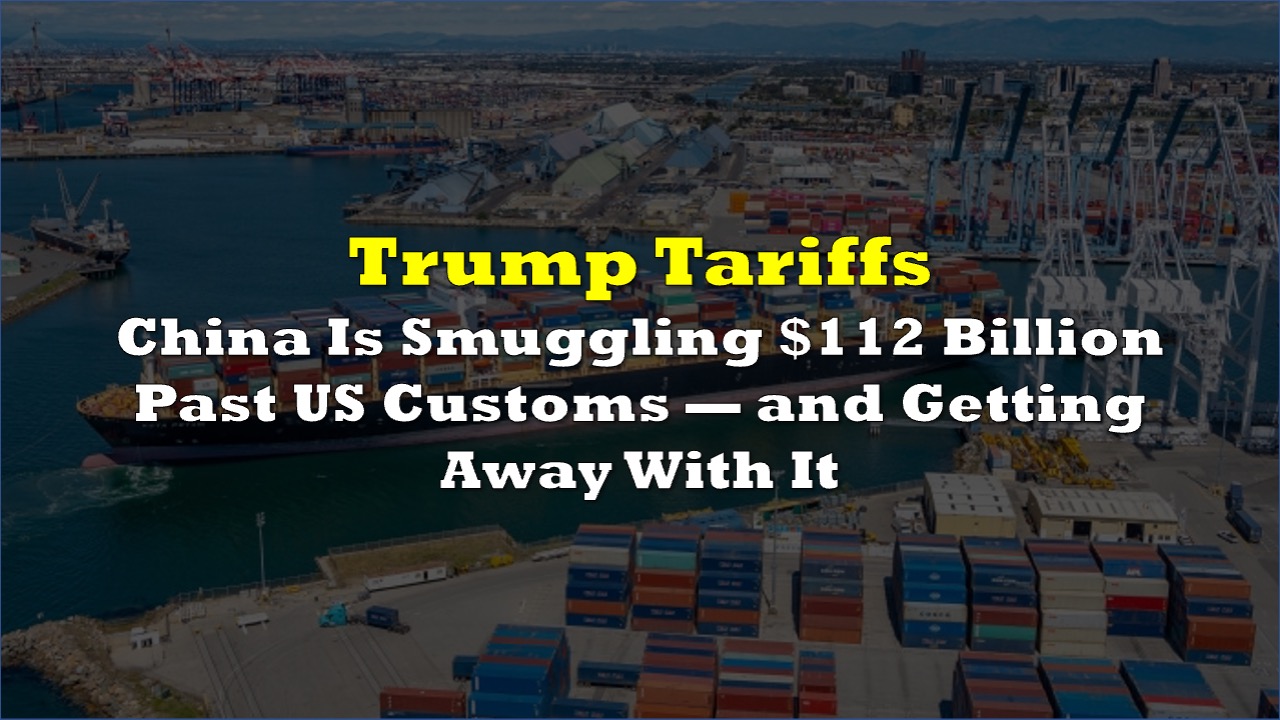

New trade figures show a record $112 billion mismatch between China’s reported exports to the US and the volume US Customs and Border Protection logged as actually clearing American ports last year — a discrepancy that points to roughly a quarter of Chinese shipments evading applicable tariffs entirely.
The gap is not new, but its scale and direction are. Data from China’s General Administration of Customs and the US Census Bureau show that before Trump’s first-term tariffs took hold, the US consistently recorded more imports from China than Beijing reported sending. That relationship inverted around 2020 and has widened sharply each year since, reaching its largest margin on record in 2025 — a trajectory that tracks directly with escalating US duties.
New trade data from Bloomberg is raising serious concerns about the effectiveness of US tariffs
— WION (@WIONews) February 26, 2026
A record $112 billion gap between China’s reported exports and US Customs’ recorded imports suggests widespread tariff evasion@BislaDiksha tells you more about this pic.twitter.com/jrFulOm7CM
Fraudulent operators target US importers through WhatsApp and email, advertising all-in shipping rates from China — duties included — at prices trade experts say are mathematically impossible without customs fraud. The operations run through shell companies that misclassify or undervalue cargo on import filings, then shut down before investigators can act.
#tariffs – fueled by aggressive #Chinese logistics tactics and the highest duties in a century, the suspected #evasion is blunting Trump’s #trade agenda while penalizing compliant companies, chart @markets https://t.co/aa4bctPFBW pic.twitter.com/iQqLq6e4Tv
— ACEMAXX ANALYTICS (@acemaxx) February 26, 2026
Michael Kersey, president of the American Lawn Mower Company, said the solicitations represent a direct threat to his century-old firm, which pays duties as high as 45% on goods it imports from China.
“Tariff cheating is much, much worse than tariffs for us,” he told Bloomberg.
The Trump administration assembled a multiagency task force in August 2025 to pursue criminal cases against evaders and opened a whistleblower program; CBP separately brought in AI vendors to flag suspicious shipments before they clear customs.
The measures have not kept pace with the problem. At a January 2026 webinar, a CBP staffer told trade professionals that once a complaint is filed, the process that follows “may take several years to complete.”
“CBP is aware of such schemes and has heightened its enforcement of use of Importer of Record accounts associated with companies registered in China, Hong Kong, and other countries,” a spokesperson said.
Bloomberg Economics estimated the gap has cost the US government roughly $3.5 billion in uncollected tariff revenue since February 2025.
The findings also complicate claims of meaningful US-China decoupling. While total Chinese imports have declined in official figures since 2022, the widening unreported gap suggests the actual volume of Chinese goods entering the US remains considerably higher than the data shows.
At his State of the Union address on Wednesday, President Donald Trump defended the tariff policy, saying he believes duties will “substantially replace the modern-day system of income tax.”
Related: Supreme Court rules Trump tariffs illegal
Information for this story was found via Bloomberg, and the sources and companies mentioned. The author has no securities or affiliations related to the organizations discussed. Not a recommendation to buy or sell. Always do additional research and consult a professional before purchasing a security. The author holds no licenses.