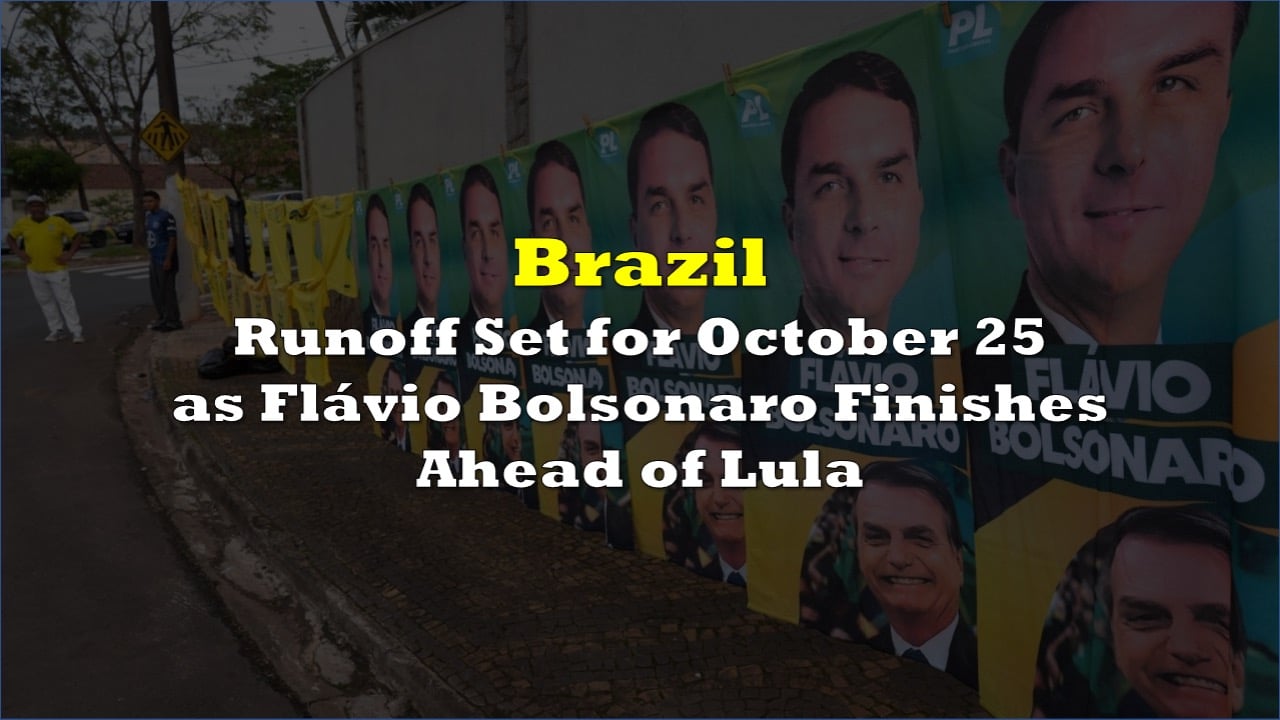

Flávio Bolsonaro, a conservative senator and the son of former President Jair Bolsonaro, finished first in Brazil’s presidential election on Sunday and will face President Luiz Inácio Lula da Silva in a runoff on October 25.
After Brazil’s Superior Electoral Court had tallied 99.96% of polling stations, Bolsonaro held 47.04% of valid votes to Lula’s 45.15%. He finished about 2.25 million votes ahead, and neither candidate cleared the 50% threshold. Bolsonaro topped the count in 15 states and Lula in 12.
The Datafolha October 2 and 3 poll had Lula ahead 45% to 42% among valid votes, and Bolsonaro finished about two points in front. The survey’s runoff numbers showed Lula ahead 47% to 46%, within the two-point margin of error. Analysts said Bolsonaro drew protest votes from voters opposed to Lula, a bloc many had expected to hold back until the runoff.
 Sponsored · Selkirk Copper Mines
The next three finishers are all right-wing, giving Bolsonaro a ready bloc of voters in the runoff. “Brazil wants change, that’s the reading of what happened today,” Bolsonaro said. Lula, 80, who is running for a fourth term, called the outcome “unexpected.” He said he had expected to win in the first round, that a fresh campaign begins Monday, and that Bolsonaro would bring uncertainty to Brazil.
Bolsonaro has vowed to pardon his father, who was sentenced to 27 years for plotting to overturn the 2022 election result and remains under house arrest. He has also promised to mend ties with Washington, proposed labeling some criminal groups terrorist organizations, an idea Lula opposes, and committed to relocating Brazil’s embassy to Jerusalem.
Bolsonaro’s Liberal Party was heading toward the biggest bloc in the Chamber of Deputies and picking up Senate seats. Michelle Bolsonaro, the former president’s wife, took a Senate seat representing the Federal District, and Carlos Bolsonaro, another of his sons, won in Santa Catarina. Conservative lawmakers already dominate both chambers, and Lula would face an even less friendly legislature if voters give him another term.
Brazil refused visas to two US State Department officials in late July over what Lula’s government called an attempt to interfere in the election. Lula has accused the US of interference, and Washington rejects the claims. Before the vote, Brazilian intelligence officials also gave a French and German delegation a briefing on alleged interference by the US and Russia.
The winner takes office on January 1, 2027.