
Canada’s Chinese EV opening is not large enough to flood its auto market but it seems it may still be large enough to test whether Washington sees Ottawa as a partner in North American industrial policy or a weak point in the tariff wall around it.
That is the deeper risk behind Prime Minister Mark Carney’s 49,000-vehicle import arrangement with China. The quota gives Chinese-made electric vehicles access to Canada at a 6.1% tariff, far below the 100% surtax Canada imposed on China-made EVs in 2024. In return, Beijing moved to reduce steep tariffs on Canadian canola and other agricultural products.
READ: Ottawa Courts Chinese JVs To Build Canadian EVs
 Sponsored · Selkirk Copper Mines
On paper, the deal is tightly limited. Against Canada’s 1.87 million new motor vehicle registrations in 2025, a 49,000-unit annual quota would amount to roughly 2.6% of the market.
The problem is that trade disputes are rarely measured only by import volume.
For the US, the question is not whether 49,000 Chinese EVs can overwhelm Canada. It is whether Canada has shifted from a shared exclusion strategy to a managed-entry strategy just as the CUSMA head toward another fight over the future of North American trade rules.
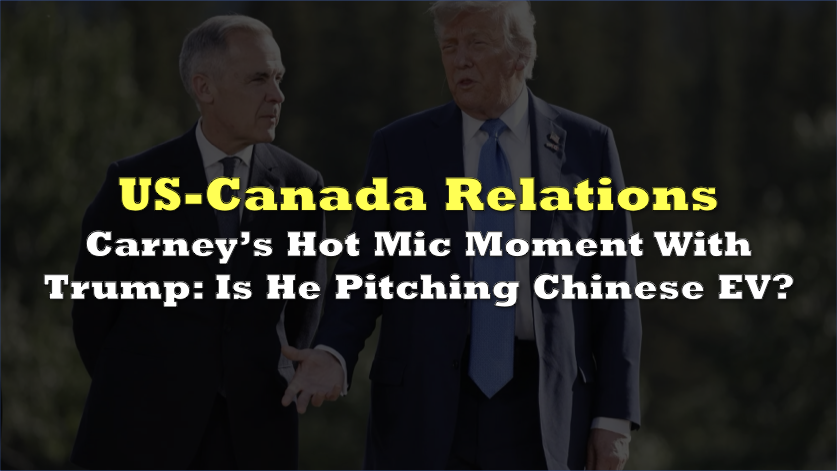
That is why a hot microphone at the G7 mattered. AP reported that Carney privately framed the policy to President Donald Trump as a capped system, stressing that it was a hard limit. Trump responded approvingly, saying he liked it.
 Sponsored · Altamira Gold Corp.
“It’s a cap, we capped, a hard line,” Carney said. “I thought you’d actually like that.”
Trump responded: “That’s good, I like it.”
Canada’s China Surtax Order imposed a 100% surtax on EVs made in China and imported into Canada, effective October 1, 2024. The measure aligned Ottawa with Washington’s broader push to keep Chinese EVs out of the North American market, citing unfair competition and state-directed overcapacity.
Carney’s January arrangement changed the model. It did not remove control, but it converted a near-blockade into a quota: China gained limited EV access, Canada gained agricultural relief, and North American automakers gained a new uncertainty.
Reuters reported that the quota begins at 49,000 vehicles and is expected to rise to about 70,000 over five years. China, in turn, agreed to reduce tariffs on Canadian canola seed from 84% to about 15% and remove barriers affecting other farm exports.
The agricultural payoff is material. Ottawa said the canola change would improve market access for roughly $4 billion in Canadian canola seed exports to China annually. China later cut its anti-dumping duty on Canadian canola to 5.9%, bringing the combined tariff to 14.9% when added to the standard 9% import tariff.
The Wall Street Journal reported that Colin Bird, Canada’s consul general in Detroit, defended the policy at an auto industry conference by emphasizing the small scale of the quota, about 3% of Canada’s annual auto sales. The same report said the move had stirred concern across the North American auto industry, particularly in the US.
That shift comes as Canada is trying to balance three goals that do not naturally fit together: protect domestic auto jobs, diversify trade away from US dependence, and keep US confidence in Canada as a North American production partner.
Transport Canada data showed electric vehicles held 12.1% of Canada’s new light-duty vehicle market in Q4 2025, including 8.0% battery-electric vehicles and 4.1% plug-in hybrids.
Canada has spent years pitching itself as a trusted EV and battery platform tied to US demand, critical minerals and North American supply security. Chinese EV access, even through a quota, complicates that pitch because it gives critics an easy line: Canada wants Washington’s market and Beijing’s cars.
That is the bet inside the hot-mic moment. Carney was not just explaining a car quota to Trump. He was testing whether a cap can be sold as control before Washington decides it looks like an opening.
Information for this story was found via the sources and companies mentioned. The author has no securities or affiliations related to the organizations discussed. Not a recommendation to buy or sell. Always do additional research and consult a professional before purchasing a security. The author holds no licenses.