

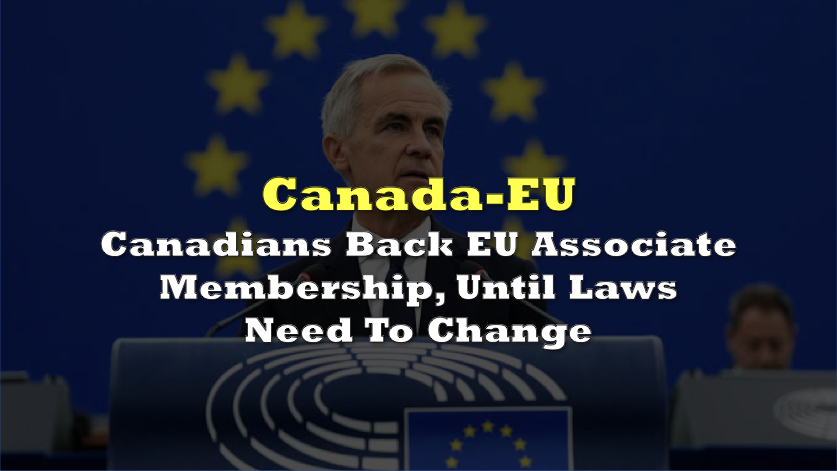

A large majority of Canadians support the idea of Canada becoming an associate member of the EU, but new polling suggests that enthusiasm becomes more conditional when closer ties involve changing Canadian laws and regulations.
A Leger survey released Thursday found 70% of respondents supported associate membership, compared with 13% who opposed it and 18% who were unsure, The Canadian Press reports.
The more consequential finding may be how respondents reacted to the possible terms of a future agreement. When asked whether changing some Canadian laws or regulations to align with the EU would affect their support, 25% said it would make them more supportive, while 30% said it would make them less supportive.
 Sponsored · Altamira Gold Corp.
Other potential elements of closer integration tested considerably better. More than half of respondents were receptive to greater defence collaboration and expanded opportunities for Canadians and Europeans to live, work, and travel across the Atlantic. Greater mutual market access received more than 60% support in every region except Manitoba and Saskatchewan, where support was 44%.
Support for associate membership was also strongest among older Canadians, approaching 80% among seniors. More than 70% of respondents in both Ontario and Quebec supported the concept. In Manitoba and Saskatchewan, more than one-quarter opposed it, while roughly another quarter were uncertain.
The poll arrives eight days after European Commission President Ursula von der Leyen formally proposed opening the door for Canada to become the EU’s first associate member as part of an “Alliance for the Future.” The Commission has identified deeper integration in economic security, technology, and defence as possible components, but the structure and legal obligations of the arrangement have not been finalized.
Carney welcomed the proposal in a September 17 address to the European Parliament, calling for deeper cooperation in critical minerals, defence manufacturing, artificial intelligence, energy, financial services, research, and youth mobility. He said the precise model would be developed jointly with Europe.
The regulatory issue highlighted by Leger also overlaps with Conservative Leader Pierre Poilievre’s criticism of the proposal. At a September 20 rally in Brantford, Ontario, Poilievre said Canada would “never be the 28th state of the European Union” and objected to importing European laws, taxes, and immigration policies.
The online poll surveyed 1,533 Canadians between September 19 and 21.
Carney has separately said Canada is not seeking full EU membership. Further details on the proposed relationship are expected to be discussed as Canada and the EU work toward their next summit in Montreal in October.






One Response
We have already a trade deal with the EU so there is no need for more because we can not afford it and mark carny does not have a mandate to do so he has a minority government ge did not get in with the majority of canadian and where are you getting those pole I am totally against for any type of membership with the EU carny should concentrate on getting a deal with the US mark carny can not be trusted