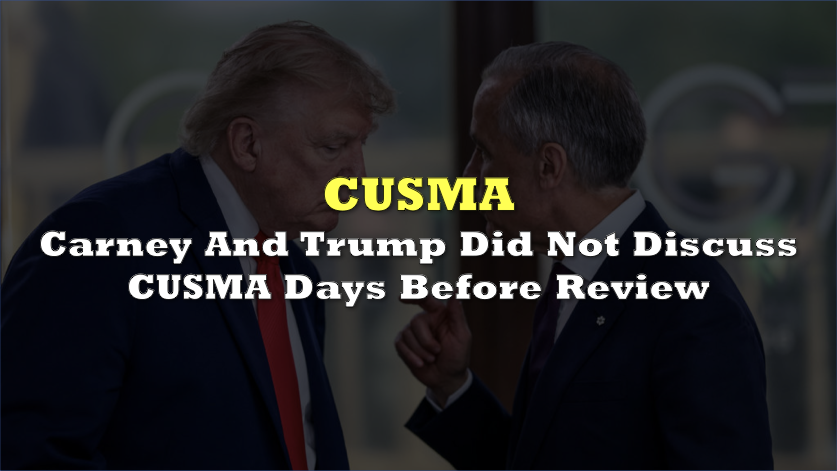

Days away from the July 1 review of CUSMA, there’s still no clear sign that parties are ready to ink a deal. And it seems Prime Minister Mark Carney is not in a hurry. In a recent press conference, Carney confirmed that the pact did not come up during his call with President Donald Trump, even as US Ambassador Pete Hoekstra had just warned that Canada and the US were not close to a deal.
“We didn’t discuss CUSMA yesterday,” Carney said.
The admission is not proof of a failed negotiation but it does expose the central tension in Canada’s approach. Ottawa is building a whole-of-government trade position through ministers, premiers, negotiators, ambassadors and industry consultations. Washington is signaling that the decisive moment may belong exclusively to Trump.
 Sponsored · Selkirk Copper Mines
“We operate a little differently,” Carney said. “We’re very team-oriented here in Canada, so it matters. Madame [Janice] Charette, Monsieur Dominic LeBlanc, Ambassador [Mark] Wiseman, the provincial premiers feeding in, the Advisory Council that we have… discussions with a broad range of stakeholders. All of that feeds into our preparations for this.”
Carney’s answer suggested he accepts that reality, but is not ready to force it. He said a breakthrough would likely happen at the leader level, while arguing that Canada first needs to know what it wants and what it will reject.
The July 1 review is often framed like a deadline. Legally, it is more complicated.
CUSMA’s review clause says the agreement terminates 16 years after entering into force unless Canada, the US, and Mexico confirm they want to extend it for a new 16-year term. The same clause requires a joint review on the sixth anniversary of the pact, which falls on July 1, 2026.
 Sponsored · Altamira Gold Corp.
If the three governments agree to extend, the pact gets a longer runway. If one does not, the agreement does not vanish immediately. Instead, the parties move into annual reviews for the rest of the pact’s term.
A failed extension would not necessarily shut down cross-border commerce. It would turn CUSMA into a recurring political event, making investment planning harder for sectors that depend on predictable North American rules.
Carney’s defense is that Canada should not confuse speed with success.
“What I have seen with the president is that you’re not close to make a deal and then you make a deal. I’ve seen that in different [times],” he said. Doesn’t mean the deals are good deals, but it means being prepared, having done the work, knowing what you want. So both things can be true.”
That argument may reassure domestic stakeholders who fear Canada could concede too much to remove uncertainty before July 1. It is less useful for companies that need to decide where to build, source and hire.
Hoekstra’s warning that the two countries are not close matters in that context. It suggests the gap is not merely technical. It is about who gets to define the terms of certainty.
Carney is trying to avoid buying stability at the wrong price. But if July 1 passes without a path to extension, Canada may face a different bill: a trade agreement that remains in force, but with its predictability discounted.