
Nearly $2 trillion in North American trade is heading into a July 1 review without the political alignment needed for a clean extension, turning what Canada wants to treat as a stability exercise into a bargaining round over tariffs, autos, dairy, softwood lumber, and industrial supply chains.
The core tension is simple: Canada and Mexico want certainty. Washington wants concessions.
CUSMA entered into force on July 1, 2020. Its review clause requires Canada, the US, and Mexico to meet on the sixth anniversary of the agreement to review how the pact is working, consider recommendations, and decide whether to extend it for another 16 years. If all three governments confirm renewal, the agreement is automatically extended. If one does not, the pact moves into annual reviews for the rest of its term, with the current agreement otherwise set to run 16 years from entry into force.
 Sponsored · Selkirk Copper Mines
US Ambassador to Canada Pete Hoekstra has previously framed the talks as difficult. Reuters reported in March that Hoekstra said Washington wanted renewal but faced “headwinds,” citing a lack of substantive Canada-US discussions since October.
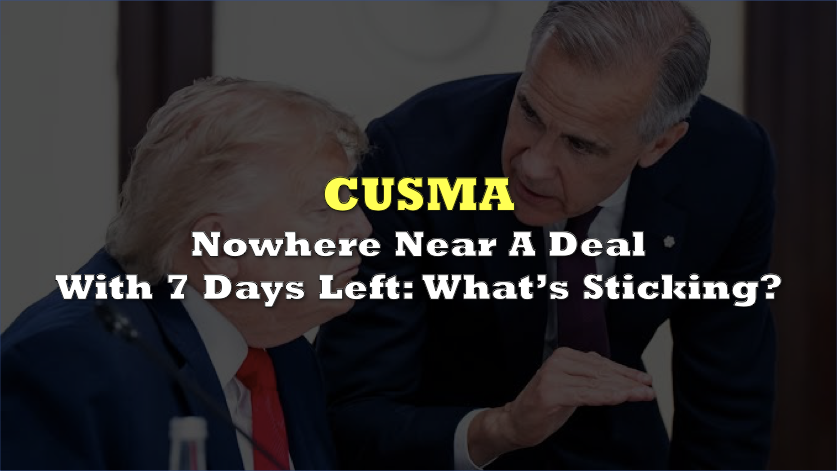
In a recent interview, he said that Canada and US are nowhere near a deal as the deadline approaches in seven days.
Canada has already made its formal ask. Trade Minister Dominic LeBlanc sent letters to US Trade Representative Jamieson Greer and Mexico’s Economy Secretary Marcelo Ebrard recommending a 16-year extension, according to the Associated Press. Mexico has also said it supports extending the pact for 16 years.
Washington is not there.
 Sponsored · Silver47 Exploration Inc.
READ: Carney Says Trump Officials Unwilling to Reopen USMCA’s Core Framework
The sticking points
President Donald Trump recently questioned the value of the agreement he himself signed in 2020, saying the US might do better without it. Reuters reported that Trump left open the possibility of signing a renewed agreement, but his comments landed as a warning that renewal could come with a price tag.
Tariffs are the immediate Canadian priority. Canada’s ambassador to Washington, Mark Wiseman, has said Ottawa is more focused on relief from US tariffs on steel, aluminum, and automobiles than on treating July 1 as the only decisive date.
Canada has already given the US part of what it wanted by rolling back billions of dollars in retaliatory duties, but the Trump administration is now signaling that even a revised North American trade deal may not restore the old bargain of tariff-free access.
Autos are the industrial flashpoint. Reuters reported that US-Mexico talks have focused on tighter automotive rules of origin, including a possible US-specific content requirement for vehicles built in Mexico. Current CUSMA rules require 75% of a vehicle’s value to be sourced from North America, with a separate high-wage content rule covering 40% of North American-built passenger car content.
That is not a technical tweak. A US-specific content rule would shift CUSMA from a North American sourcing framework toward a more explicitly America-first model. For Canada, the risk is getting squeezed between US-Mexico auto talks and US pressure for tariff relief. For Mexico, the risk is losing some of the nearshoring advantage that made it the top U.S. trading partner.
Dairy remains a US grievance. US agricultural and industry groups have pushed for expanded access to Canada’s dairy market as part of any renewal discussion. Canada’s supply-managed dairy system has been a recurring US target across NAFTA and CUSMA disputes.
Softwood lumber is still unresolved. Canadian officials have pointed to forestry products as part of broader trade discussions, while longstanding US duties on Canadian softwood lumber remain a major irritant. Reuters reported that Prime Minister Mark Carney said trade talks at the G7 included forestry products.
China is the shadow issue. USTR’s public consultation for the joint review explicitly sought input on compliance, implementation, proposed actions, and the investment climate in North America, including factors tied to US competitiveness and technological leadership. That gives Washington room to raise supply-chain security, Chinese content, and non-market economy concerns under the umbrella of CUSMA modernization.
Digital taxation is less central now, but it shows the leverage model. Canada rescinded its digital services tax in 2025 to support broader trade negotiations with the US after Trump threatened to halt talks. The tax had been aimed at large digital companies and had been a major irritant for US tech firms.
Seven days left
CUSMA’s Article 34.6 allows a party to withdraw with six months’ notice, while Article 34.7 sets out the review and extension process. Without unanimous renewal, the agreement can continue under annual reviews.
That structure gives Washington leverage without requiring immediate withdrawal. It can withhold renewal, keep tariffs and sectoral demands in play, and force Canada and Mexico into a recurring uncertainty cycle. However, CSIS has warned that annual reviews could weaken investor confidence and supply-chain integration because companies would have to plan around a trade pact whose future is repeatedly reopened.
The economic exposure is large. Canada, the US, and Mexico trade nearly $2 trillion in goods and services under the regional framework.
For Canada, the negotiation is now a sequencing problem. Ottawa wants tariff relief first, then a more predictable CUSMA renewal path. Washington appears to be using the review to reopen sectoral concessions. Mexico is already deeper into formal talks with the US on autos, leaving Canada at risk of joining a negotiation after the biggest manufacturing terms have begun to harden.
The July 1 meeting may therefore produce no dramatic collapse and no clean renewal. The more likely consequence is messier: CUSMA survives, but certainty gets downgraded.