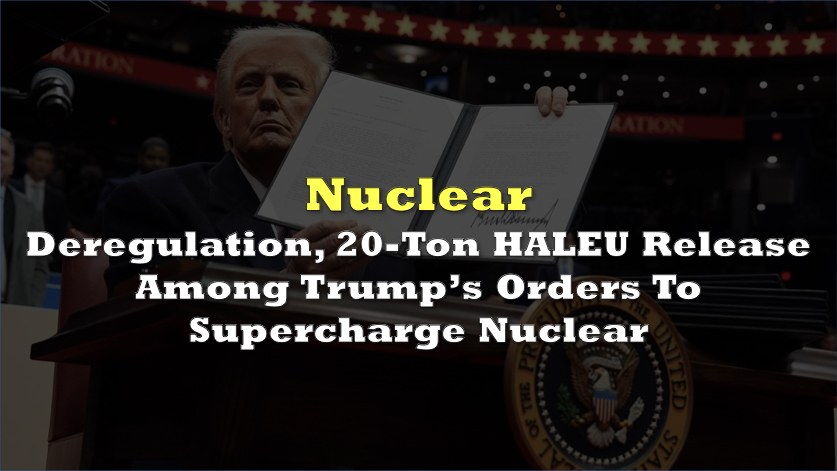

President Donald Trump signed four intertwined executive orders aimed at rebuilding America’s nuclear fuel cycle, slashing licensing timelines, and mobilizing federal resources to restore US leadership in advanced reactor technologies.
These directives respond to data showing that “87% of nuclear reactors installed worldwide since 2017 are based on designs from two foreign countries” and that it took “nearly 40 years for the United States to add the same amount of nuclear capacity as another developed nation added in 10 years.”
Key components of the four executive orders include:
 Sponsored · Selkirk Copper Mines
- “Reinvigorating the Nuclear Industrial Base”
- Release of at least 20 metric tons of high assay, low enriched uranium (HALEU) into a new fuel bank for private AI and defense projects within 90 days, while preserving strategic reserves for naval propulsion, tritium, and weapons.
- Mandate to expand domestic uranium conversion and enrichment capacity for LEU, HEU and HALEU within 120 days.
- DOE Loan Programs Office instruction to prioritize funding that supports 5 GW of uprates at existing plants and the construction of 10 new large reactors by 2030.
- Directive to DOE and SBA to, within 180 days, channel grants, loans and investment capital toward the most mature advanced-reactor companies.
- Comprehensive DOE report due in 240 days on spent-fuel management, advanced reprocessing and recycling pathways, legislative gaps, and permanent disposal solutions.
- Halt to the surplus-plutonium dilute-and-dispose program (aside from South Carolina obligations) and redirection of plutonium toward industry fuel fabrication.
- Authority for DOE to invoke the Defense Production Act within 30 days to forge voluntary procurement agreements with US nuclear firms, prioritizing those with DOE-approved safety designs or private financing.
- “Ordering the Reform of the Nuclear Regulatory Commission”
- Official repeal of nonbinding “generic milestone” schedules and replacement with enforceable timelines.
- Binding deadlines: 18 months max for new-reactor licenses; 12 months for renewals, enforced by caps on hourly fees.
- Requirement to establish an expedited pathway for DOE- or DOD-tested reactor designs, focusing review only on novel risks.
- Charge to develop a high-volume licensing process for microreactors and modular reactors, with standardized applications and general-license consideration.
- Directive to streamline public hearings, revise reactor-oversight and security rules, and set stringent thresholds for in-construction design changes.
- NEPA regulation overhaul in consultation with Council on Environmental Quality (CEQ), creating categorical exclusions or alternative procedures to eliminate or accelerate environmental reviews.
- Mandate to reorganize NRC staff and reduce Advisory Committee on Reactor Safeguards personnel to the statutory minimum, while creating a 20-member “innovation” team for new regulations.
- Reassessment of the linear no-threshold radiation model and “irrational” standards that demand protection below natural background levels.
- “Reforming Nuclear Reactor Testing at DOE”
- Definition of “qualified test reactors” due within 60 days to identify designs eligible for expedited review.
- DOE must, within 90 days, revise National Laboratory regulations, guidance and procedures to ensure advanced reactors can be operational at DOE-controlled sites within two years of application.
- Pilot program outside DOE labs to approve at least three reactors, targeting first criticality by July 4, 2026, spanning microreactors, SMRs and Gen IV designs.
- Creation of dedicated interdepartmental teams (including General Counsel and lab reps) to assist applicants and deconflict regulatory hurdles.
- Streamlining of NEPA compliance by June 30, 2025, through supplemental analyses, categorical exclusions, and reliance on existing site reviews.
- Integration with the DOE “DOGE Team” and OMB to implement expedited testing procedures and align with national energy emergency protocols.
- “Deploying Advanced Nuclear Reactor Technologies for National Security”
- Requirement for the Army to operate a DOE-regulated nuclear reactor on a US military installation by September 30, 2028.
- DOE to designate, within 90 days, AI data centers at DOE facilities as “defense-critical electric infrastructure.”
- Obligation for DOE and DOD to site, approve and authorize privately funded fuel recycling, reprocessing and fabrication facilities on agency lands to support both national security and commercial reactors.
- Release of DOE-held uranium and plutonium inventories for recycling into reactor fuel, ensuring a long-term HALEU supply via domestic fuel chains.
- Interagency NEPA coordination led by CEQ to apply or establish categorical exclusions and emergency permitting for defense-related reactor projects.
- Diplomatic charge for the Secretary of State to secure 20 new Section 123 Agreements for peaceful nuclear cooperation and to renegotiate expiring pacts.
- Directive for the Secretary of Energy, with State, Commerce and Defense, to approve or deny each export authorization within 30 days of a complete application.
- Strategy development for US export financing: leveraging the IDFC, Ex-Im Bank, US TDA and multilateral development banks to de-risk American nuclear projects abroad.
- Prioritization of DOE and DOD security clearances (“L,” “Q,” “SECRET,” “TS,” etc.) to accelerate workforce readiness and facility staffing.
At the Oval Office signing, Trump hailed nuclear power as “a hot industry” that has “become very safe and environmental.” Interior Secretary Doug Burgum called it “a rollback of over 50 years of overregulation,” and Defense Secretary Pete Hegseth reminded attendees, “Energy security is national security.”
Energy firms responded positively to the news, with Constellation Energy CEO Joe Dominguez echoing, “We’re wasting too much time on permitting… we need to do this for America.”
Information for this story was found via the sources mentioned. The author has no securities or affiliations related to the organizations discussed. Not a recommendation to buy or sell. Always do additional research and consult a professional before purchasing a security. The author holds no licenses.