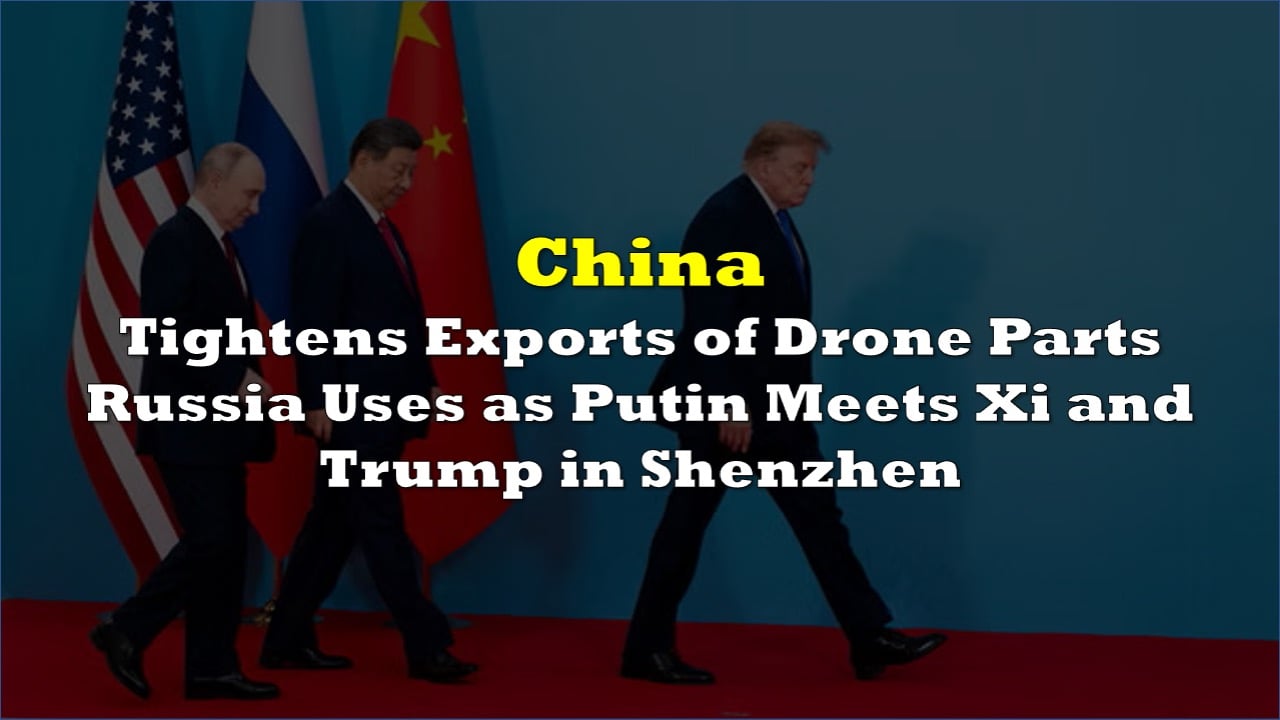

China’s new export license rules for drone components, including jet engines used in Russia’s Geran attack drones, took effect Wednesday.
That was the day Russian President Vladimir Putin arrived in Shenzhen. He met Chinese President Xi Jinping and US President Donald Trump there on Thursday, and the White House said beforehand that Ukraine would not be its focus. No source reviewed links the rules to the summit, and China announced them October 19, a month earlier.
Related: Did Xi Snub Putin in Shenzhen? What the Photo, Dinner, and Airport Show Before the Three-Way Summit
 Sponsored · PTX Metals Inc.
Exporters must now apply for licenses to ship items that meet technical thresholds. They include jet engines with at least 400 newtons of thrust, other drone engines above 16 kilowatts, radio modules with 30 dBm of output power or the ability to control more than 10 drones, high-power brushless motors, and electronic speed controllers. The Commerce Ministry, customs administration and the Central Military Commission’s Equipment Development Department issued the measures, which, to be clear, restrict exports but do not outright ban them.
Beijing’s announcement does not single out Russia. A Commerce Ministry spokesperson said China opposes illicit, non-peaceful uses of drones and backs lawful civilian trade, and that applications meeting the requirements will be approved. Eligible exporters can use simplified procedures.
Vladyslav Vlasiuk, Ukraine’s commissioner for sanctions policy, welcomed the move on social media, writing “We thank China for its new export controls on drone items.” He said the rules do not cover Geran-4 servos, Harxon antennas, gimbal cameras, navigation modules or the anti-jamming antennas on Geran-2s. Ukraine has shared information on the parts and their Chinese makers, he said, and expects strict enforcement.
Russia has been swapping Western components for Chinese ones. Its jet-powered Gerans fly faster than its older propeller-driven models, making them harder to shoot down, and most of Ukraine’s interceptors cannot match their speed.
Chinese companies were reported in May to be supplying Russia and Iran with microchips, fibre-optic cables, batteries, engines and other dual-use drone parts despite US sanctions. China’s Foreign Ministry says it follows its export control laws and international obligations on dual-use goods.