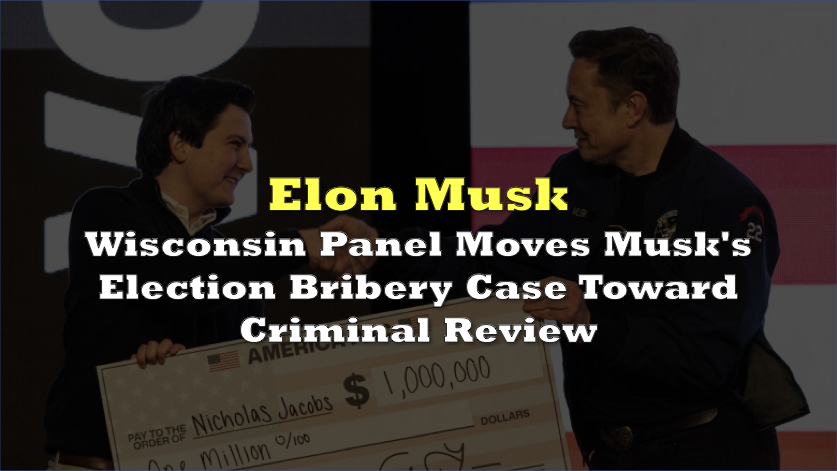

The bipartisan Wisconsin Elections Commission voted 5-1 to refer two complaints involving Elon Musk to the Brown County District Attorney, marking the first official finding by state regulators that his widely publicized $1 million giveaways may have crossed Wisconsin’s prohibition on offering something of value to influence voting.
The commission’s finding does not concern Musk’s campaign contributions or political spending. Instead, regulators focused on whether publicly offering $1 million to individuals connected to the Wisconsin Supreme Court election in 2025 constituted an unlawful inducement to vote.
According to ABC News reporting on the commission’s findings, regulators concluded there was probable cause that Musk violated Wisconsin’s election bribery statute by making a social media post offering $1 million “to induce” participation in the election. The finding addresses the nature of the incentive rather than Musk’s broader political activity.
 Sponsored · Altamira Gold Corp.
The district attorney now has 40 days under Wisconsin law to determine whether criminal charges should be pursued.
Musk became one of the highest-profile participants in Wisconsin’s Supreme Court race, spending more than $20 million supporting conservative candidate Brad Schimel, according to AP News. He also appeared in Green Bay, where he presented $1 million checks during the campaign. Despite that effort, liberal-backed candidate Susan Crawford won the election by roughly 10 percentage points.
The cash giveaways immediately drew legal scrutiny. Wisconsin Attorney General Josh Kaul previously sought to stop the payments before they were distributed, arguing they violated state election law. Courts ultimately declined to halt the event before the election proceeded, leaving the broader legal question unresolved until the Elections Commission completed its review.
The Wisconsin case could become an important test of how election laws apply to wealthy political actors who combine traditional campaign spending with direct financial incentives aimed at voters.
Federal courts have long distinguished protected political speech from conduct that constitutes vote buying or unlawful inducements. Wisconsin prosecutors, if they proceed, would likely need to show that the payments were intended to influence voting in a manner prohibited by state law rather than simply promote political engagement.
The outcome could influence future campaign strategies that rely on cash incentives, petition programs, or high-value promotional events conducted alongside elections.