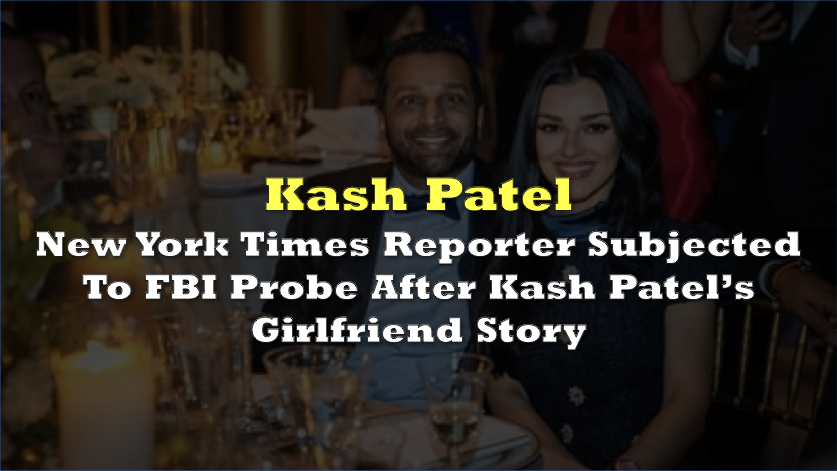

The FBI’s reported scrutiny of New York Times reporter Elizabeth Williamson after her February 28 story on Director Kash Patel’s use of bureau personnel for his girlfriend’s security and transportation adds a new data point to an expanding confrontation between the Trump administration and the press.
According to the Times, agents interviewed Patel’s girlfriend Alexis Wilkins, searched databases for information on Williamson, and recommended advancing the matter to determine whether her reporting could be treated as a violation of federal stalking laws. The FBI now says it is not pursuing a case.
The February 28 article described Patel’s reported use of FBI resources to provide Wilkins with a protective detail and transportation, including accompaniment to public appearances and personal appointments. In the statement the bureau gave at the time, the FBI defended the protection on the grounds of active death threats against Wilkins, but did not challenge the article’s accuracy.
 Sponsored · Selkirk Copper Mines
What appears to have changed the internal posture was a threatening email Wilkins received the same day the article was published. The FBI has said agents interviewed Wilkins in relation to that threat, which reportedly came from a sender in Boston and referenced Williamson’s article.
The bureau’s public position is that agents asked about the related reporting during that interview and, while concerned that the reporting methods may have crossed into stalking, took no further action.
The Times further said agents cited statutes involving stalking and threats to safety or reputation, combed bureau databases for information on Williamson, and recommended opening a preliminary investigation before meeting resistance at the Justice Department, where officials concluded there was no legal basis to proceed.
Williamson’s reported conduct, as described by the Times, fits ordinary accountability reporting rather than physical surveillance. She had one off-the-record phone call with Wilkins, exchanged emails before publication, and contacted people who knew or had worked with her. The Times says Williamson was never physically in Wilkins’ presence.
 Sponsored · Canadian Copper Inc.
“The F.B.I.’s attempt to criminalize routine reporting is a blatant violation of Elizabeth’s First Amendment rights and another attempt by this administration to prevent journalists from scrutinizing its actions,” Joseph Kahn, executive editor of the Times, said. “It’s alarming. It’s unconstitutional. And it’s wrong.”
The episode also lands inside a broader pattern that makes it harder to dismiss as an isolated dispute. In January, the FBI searched the Virginia home of Washington Post reporter Hannah Natanson and seized devices as part of a leak-related national security probe, even though her editors said she was not a target. In March, a federal judge blocked key Pentagon press restrictions that the Times had challenged, ruling they violated the First Amendment, pushing the agency in April to comply with that earlier ruling restoring access.
There is also the administration’s running fight with The Associated Press. Reuters reported in 2025 that the White House restricted AP access over its refusal to adopt “Gulf of America” in place of Gulf of Mexico, and AP said at the time it was barred from an Oval Office event over that editorial decision. Together, those fights show the pressure campaign has moved across access, litigation, source protection and now, if the Times’ reporting is accurate, scrutiny of standard reporting methods themselves.
Patel’s own public posture toward the press adds more weight. Before becoming FBI director, AP noted that Patel had described the media as “the most powerful enemy the United States has ever seen.” He recently filed a defamation lawsuit against The Atlantic over its reporting on his drinking.
Information for this story was found via the sources and companies mentioned. The author has no securities or affiliations related to the organizations discussed. Not a recommendation to buy or sell. Always do additional research and consult a professional before purchasing a security. The author holds no licenses.