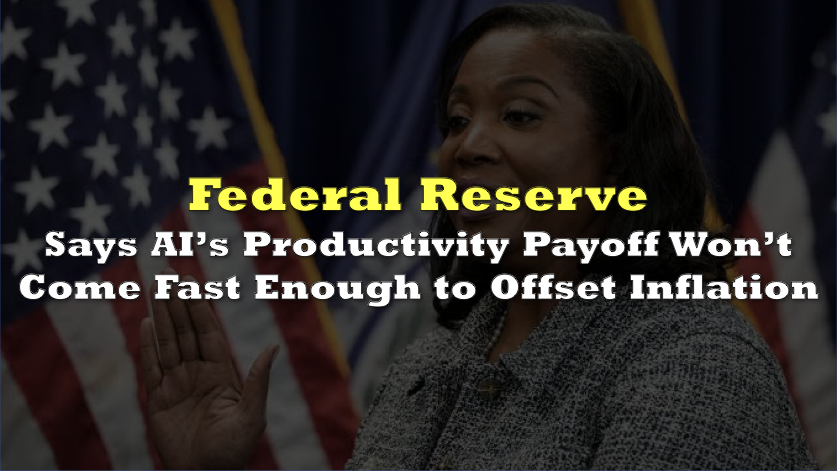

Federal Reserve Governor Lisa Cook is sharpening the central bank’s warning about the artificial intelligence investment boom, arguing that its promised productivity gains will not arrive quickly enough to neutralize the inflation generated by the buildout this year.
Cook said Monday that she expects continued inflation pressure from AI-related demand alongside higher oil prices and supply-chain disruptions tied to the Middle East conflict. More significantly, she said productivity improvements associated with AI should eventually become disinflationary, but not soon enough to offset near-term price increases.
Reuters reported that Cook also sees evidence that the effects are spreading beyond sectors directly tied to AI.
 Sponsored · Selkirk Copper Mines
The distinction complicates one of the economic arguments surrounding the AI investment cycle. AI can ultimately allow companies to produce more with fewer inputs, but building the infrastructure first requires enormous spending on chips, servers, power, construction, software, and specialized labor.
Cook has been warning about that first-stage inflationary effect for months. In May, she pointed to more than $1.5 trillion in announced data-center projects, only a fraction of which had been completed, while noting rising prices for chips, high-tech equipment, software, electricity, and water.
By July, Cook said AI-related capital spending had already caused “significant price increases” across chips, equipment, software, and utilities. In August, she said the investment wave was helping drive business investment, which had increased at roughly a 10% annual rate during the first half of 2026.
The September remarks take the argument a step further by connecting that spending more directly to the Fed’s immediate inflation problem.
Cook said inflation remained “too high for too long,” according to Reuters, putting total inflation at roughly 3.8% through August.
The figure is not yet an official Bureau of Economic Analysis reading. The latest released PCE data showed prices rising 3.7% year over year in July, while August PCE data are scheduled for September 30.
The Fed already raised its benchmark rate by 25 basis points on September 16 to 3.75%–4.00%, its first increase in three years. Policymakers’ September projections indicated another increase could follow before year-end.
Cook stopped short of committing to another hike, saying future adjustments would depend on incoming inflation and labor-market data. But she also said the labor market appears “well positioned to handle an increase in rates.”