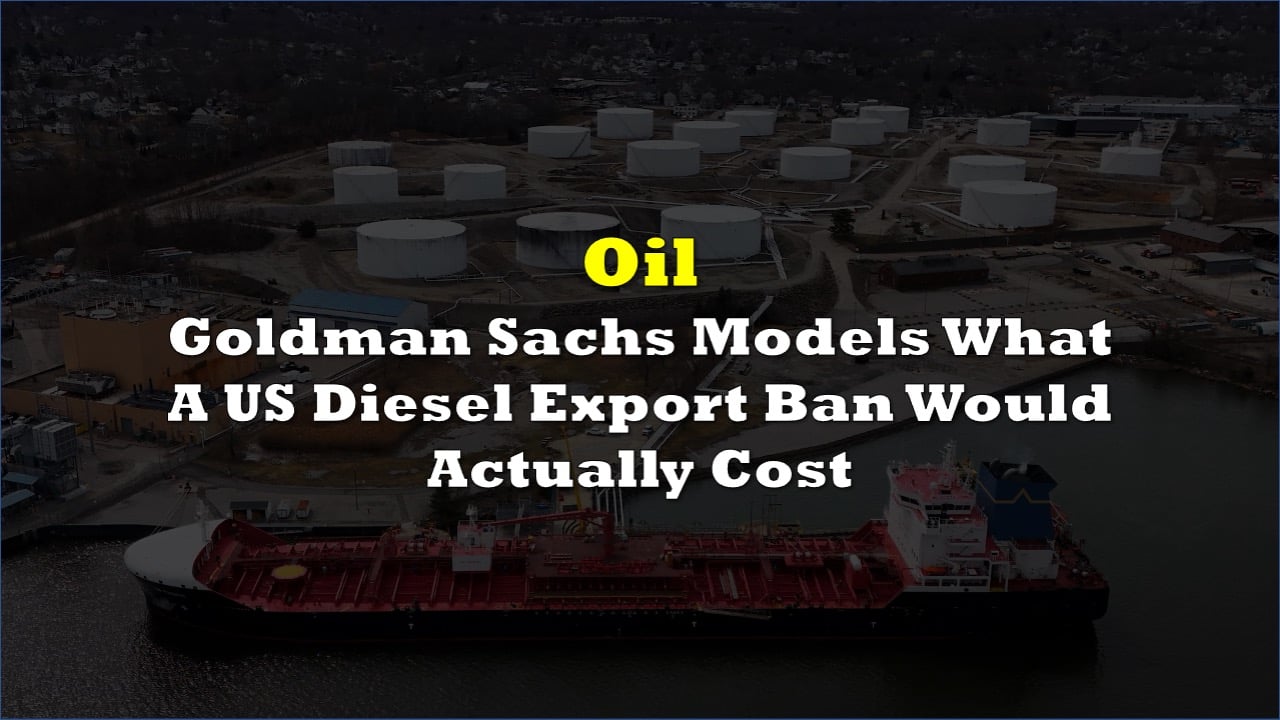

Goldman Sachs published a research note Saturday modeling the price effects of a potential US diesel export ban, calling it “a very plausible scenario, though not our base case.” Diesel would get temporarily cheaper, but the longer a ban lasted, the more it would push gasoline prices higher instead. Diesel prices have climbed 74% since the Iran war began on February 28.
Goldman’s model splits the impact into two phases. Retail diesel would get cheaper at first — the bank pegs the effect at roughly $0.25 a gallon for every week the ban holds while storage capacity lasts, knocking just under 4% off the current $6.50 average. That relief wouldn’t last.
Diesel, gasoline and jet fuel come largely from the same barrel of oil, so as storage fills toward capacity, refiners would face pressure to cut output across all three fuels. Once storage tops out, the pressure flips — Goldman says each additional week of a ban would instead add roughly $0.30 a gallon to retail gasoline prices.
 Sponsored · Selkirk Copper Mines
The effect wouldn’t stop at the US border. Goldman expects European wholesale diesel to climb roughly $3 a barrel, just under 2%, for every week a ban stays in force, though diesel releases from Europe’s own strategic reserve could cut that increase by about half. Ending the ban wouldn’t undo the damage either — US diesel prices would snap back in line with the rest of the world, rising again at home while easing abroad. Even after that adjustment, the bank thinks the hit to US refinery output during the ban would leave global refined product prices permanently a notch above where they’d have landed without any of it.
Goldman is using the analysis to reiterate a standing trade recommendation — long European gasoline. The bank cites three reasons. Gasoline supply is tightening fast. Any expansion of export restrictions to cover gasoline would tighten non-US supply further. And Europe holds only a quarter as much gasoline in strategic reserve as it does diesel.
US President Donald Trump first endorsed the idea on September 22 while speaking to reporters alongside Ukrainian President Volodymyr Zelensky at the UN General Assembly. “I’ve said let’s not send out the diesel… I’ve called for it,” he said.
The White House and Energy Secretary Chris Wright walked back the specifics the next day, with Wright saying “nobody was considering a flat ban on shipments.” The idea resurfaced the day after Goldman’s note, when Trump told a Fox News reporter at the Presidents Cup outside Chicago that a ban “can oftentimes lead to a little bit of an increase on gasoline for cars,” adding, “we’re looking at it very seriously — we may do it.”
National Economic Council Director Kevin Hassett, Treasury Secretary Scott Bessent and US Trade Representative Jamieson Greer are all examining the option, while Wright has floated voluntary export curbs with refiners as a softer alternative to an outright ban.
Trump is more eager to act than the people who’ve actually run his Energy Department. Dan Brouillette, who led it from 2019 to 2021, said the idea “sounds good on the surface, but when you dig into it, it makes very little economic sense.” “It’s a bad idea,” he added. “It’s not something you want to impose.” Wright himself has said outright that “the blunt tool of banning diesel exports definitely doesn’t work.”
Trump has said a decision would come “fast, one way or the other,” without giving a timeline.
Read: Energy Industry, Including Trump’s Usual Allies, Urges Him Against A Diesel Export Ban