
Hemlo Mining (TSX: HMMC) reported lower revenue and sharply higher unit costs in the second quarter, as a planned crusher rebuild and a change in mining sequence pulled output down from the pace set in the first three months of the year.
Revenue fell to $142.5 million from $186.3 million in the first quarter. Net income rose to $31.0 million, or $0.10 a share, from $22.1 million, or $0.07, though the improvement came from items outside of operations. On an adjusted basis, the company earned $27.3 million, or $0.09 a share.
EBITDA came in at $77.2 million, down from $86.6 million. The more notable move was in cash generation, with operating cash flow dropping to $35.6 million from $87.9 million, a decline steep enough to stand out even against a softer quarter.
 Sponsored · Altamira Gold Corp.
As for the balance sheet, cash rose to $130.2 million from $123.6 million, and net debt narrowed to $19.8 million from $26.4 million against total debt of $150 million. Working capital stood at $51.1 million.
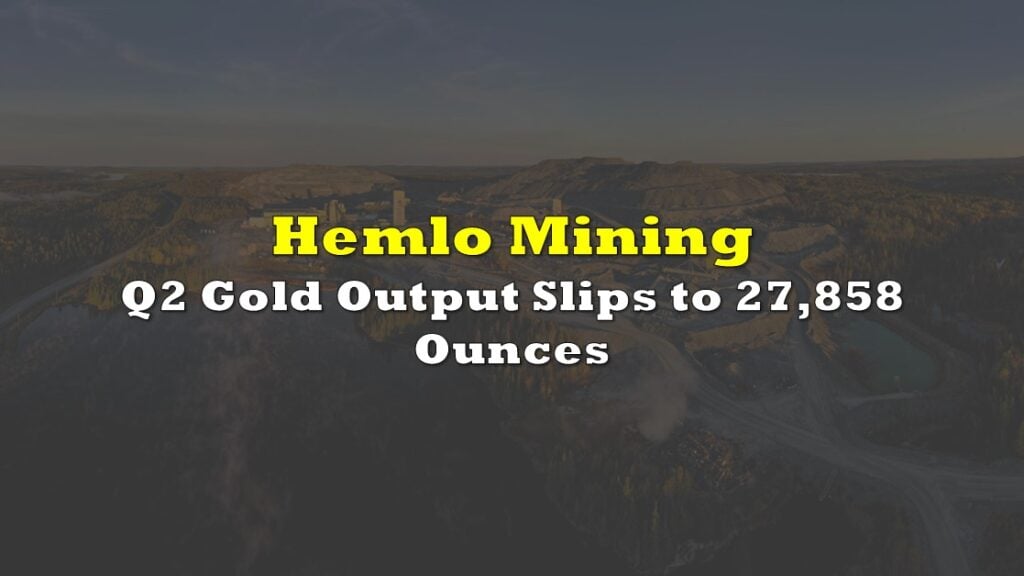
Attributable gold production totalled 25,188 ounces, down about 15% from 29,699 ounces in the first quarter. On a 100% basis, the mine produced 27,858 ounces. Management pointed to a planned rebuild of one of three underground crushers, which forced all tonnage through the remaining two, and a shift from top-down to bottom-up mining that temporarily delayed access to higher-grade stopes.
Attributable sales of 27,858 ounces outpaced production, with the company drawing down 2,670 ounces of finished inventory to bridge the gap.
Throughput itself was not the problem. The mill processed 344,000 tonnes, up 7% quarter over quarter, and set a single day record of 5,035 tonnes. Development metres climbed 42% and longhole drilling rose 65%, both consistent with a company building toward higher rates rather than harvesting the current ones. Recoveries eased to 94.3% from 95.6%.
Costs moved the wrong way however. Site cash costs reached $1,880 per ounce sold, up from $1,385, while all-in sustaining costs jumped 42% to $2,561 from $1,805. Fewer ounces across a largely fixed cost base explains much of it, as does capital spending of $24.4 million, split between $17.5 million sustaining and $6.9 million growth. The average realized price of $4,467 an ounce, down from $4,923, offered no offset.
Hemlo has not issued full-year production or cost targets, leaving the quarter without a benchmark to measure against. An updated mineral reserve estimate and life-of-mine plan are expected in the second half of 2027.
“Q2 demonstrated continued execution against our strategic priorities as we advanced our owner-operator transition and strengthened the operational foundations required to support higher long-term production rates,” Chief Executive Officer Jason Kosec said.
Hemlo Mining last traded at $6.85 on the TSX.