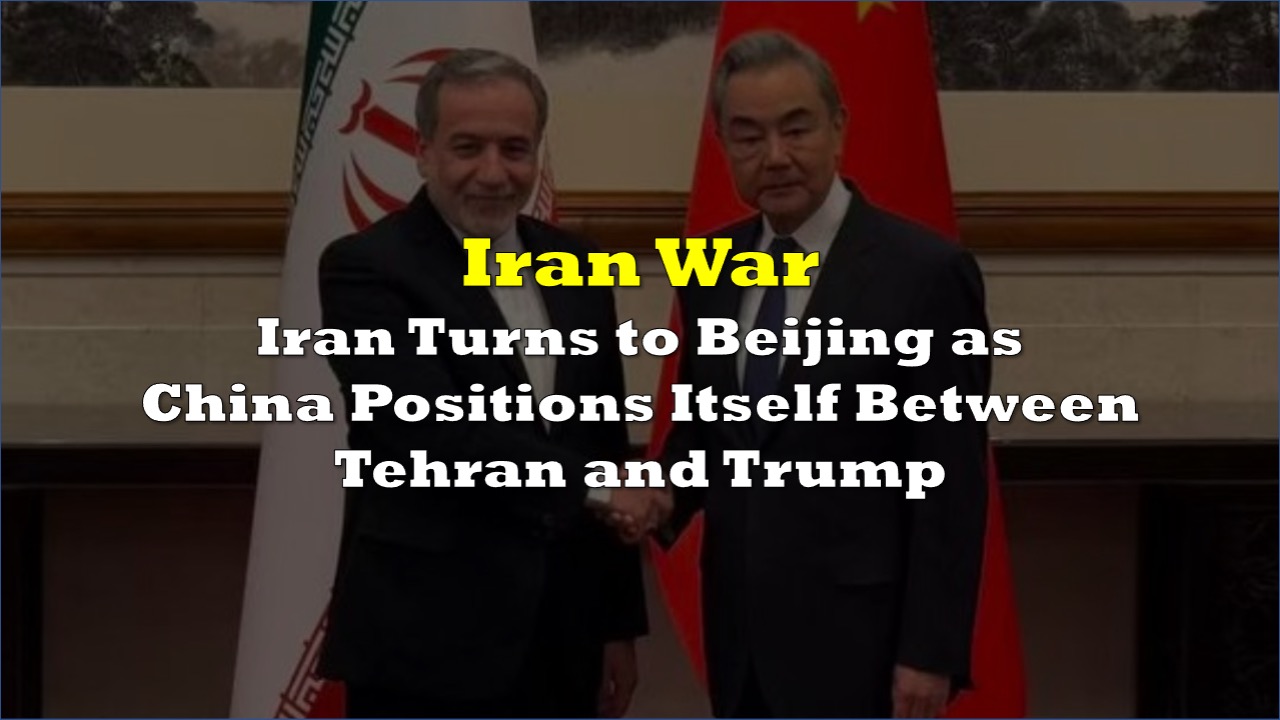

Iranian Foreign Minister Abbas Araghchi met his Chinese counterpart Wang Yi in Beijing on Wednesday in the first visit by Iran’s top diplomat to China since the war began — one week before President Trump flies to the Chinese capital for his summit with President Xi Jinping, and a clear signal that Tehran is actively courting Beijing as a diplomatic shield.
Iran arrived with three goals: conveying its position on the war, reaffirming ties with China before Trump’s arrival, and securing continued economic and diplomatic backing. China arrived with leverage — and an agenda of its own.
Wang opened the meeting bluntly. “We believe that a comprehensive ceasefire brooks no delay, a resumption of hostilities is inadvisable, and persisting with negotiations is particularly important,” he told Araghchi, according to footage released by Phoenix TV.
 Sponsored · Altamira Gold Corp.
China called for “a prompt resumption of shipping traffic through the Strait of Hormuz” — a point notably absent from Iran’s own readout of the meeting, underscoring the gap between what each side heard and what each chose to emphasize publicly.
Araghchi endorsed Xi Jinping’s four-point proposal for Middle East peace — a broad framework calling for peaceful coexistence, an immediate ceasefire, political dialogue, and adherence to the UN Charter — and said Iran “trusts China” to play an active role in ending the conflict.
“A political crisis cannot be solved through military means,” Araghchi said. Iran also signaled support for a new post-war regional architecture that can “coordinate development and security” — language that stops well short of committing to anything concrete on the Strait or the nuclear file.
Wang told Araghchi that China recognizes Iran’s right to the peaceful use of nuclear energy while appreciating its commitment not to develop nuclear weapons — threading the needle between Washington’s demands and Tehran’s red lines without endorsing either. China, alongside Russia, has vetoed US efforts at the UN Security Council to condemn Iran’s actions in the Strait.
 Sponsored · PTX Metals Inc.
Beijing has also instructed Chinese companies not to comply with US sanctions on Iranian oil purchases — a direct rebuff to Washington that sharpens the stakes ahead of the Trump-Xi summit.
Read: China Tells Teapot Refineries to Ignore US Sanctions Against Buying Iranian Oil
The visit took place at Beijing’s initiative. Some analysts noted that Iran’s foreign minister was effectively summoned. “It’s China exercising their leverage,” said Hoo Tiang Boon, a professor of Chinese foreign policy at Nanyang Technological University.
China absorbed more than 90% of Iran’s oil exports in 2025 — leverage Washington has been pressing Beijing to use. Secretary of State Marco Rubio said Tuesday he hoped China would push Iran to ease its chokehold on the Strait.
Whether Beijing acts on that leverage is a separate question. Danny Russel of the Asia Society Policy Institute said that “even if Trump believes the Chinese are just providing diplomatic cover while keeping Iran economically afloat, he is at a disadvantage.”
Analysts are broadly skeptical that China would press Iran hard enough to satisfy Washington without clear incentives in return — and Beijing’s own confrontation with Washington over trade, sanctions, and AI chips leaves it with little appetite to do the US a favor for free.
Tehran’s more immediate concern is what Xi tells Trump next week. Iran is seeking clarity on how far China will support it if it agrees to ease tensions in the Strait, and reassurance that Beijing will not make concessions to Washington that could unsettle Tehran’s negotiating position.
“If President Xi and President Trump can get something over the line, they can both appear to be winners and help drag the global economy back from the precipice,” said Chris Doyle of the Council for Arab-British Understanding. “But a lot of things can go wrong — huge tensions in the region, a lot of military hardware and precious little trust between all the parties.”
Related: Officials Say Saudi Arabia—Not Iran Talks—Is the Real Reason Project Freedom Was ‘Paused’
Iran is expected to deliver its formal response on Thursday to the US 14-point memorandum of understanding on ending the war. The Strait of Hormuz has been effectively sealed since Operation Epic Fury launched on February 28, with commercial traffic down more than 90% and 23,000 sailors stranded in the Persian Gulf.
Information for this story was found via the sources and companies mentioned. The author has no securities or affiliations related to the organizations discussed. Not a recommendation to buy or sell. Always do additional research and consult a professional before purchasing a security. The author holds no licenses.