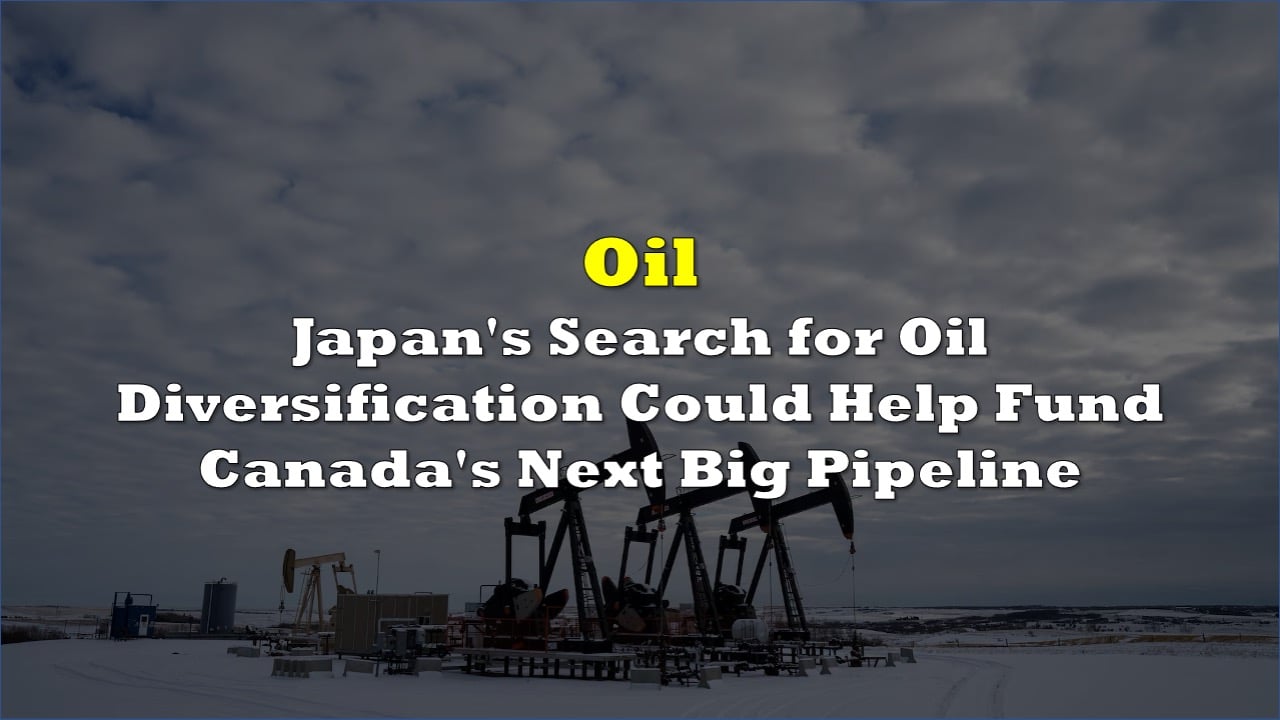

Japan’s ambassador to Canada is signaling real interest in Canadian crude, tied directly to Ottawa’s newest pipeline proposal. Ambassador Kanji Yamanouchi told CTV‘s Vassy Kapelos that Canada has “enormous potential” as a diversified oil supplier, speaking days after Carney referred Alberta’s newly proposed west coast pipeline to the federal Major Projects Office.
“Before these pipelines, there was not so much possibility that Japan imports Canadian crude oil because of lack of infrastructure,” Yamanouchi said. “But once you have the pipelines, you have the facility to export your oil to Asia, then that’s a totally different story.”
More than 90% of Japan’s oil imports currently come from the Middle East, and that supply’s reliability collapsed following the US-Israel war with Iran earlier this year, pushing Tokyo to look for alternatives. Yamanouchi said Japan now has to think differently about diversifying its crude sources, citing Canada’s reliability as a key part of that reassessment.
 Sponsored · Selkirk Copper Mines
Energy Minister Brian Jean told Reuters last month Alberta has offered to help fund a coker unit in Japan that would let Japanese refiners process Alberta’s heavy crude, and is exploring blending it with lighter synthetic oil to better match Japanese refinery specifications, a real technical obstacle given Japan’s refineries are largely built for lighter, low-sulfur crude rather than the heavy, high-sulfur oil produced in the oil sands.
Jean met with officials from Japan’s energy security agency, its export-import bank, and its trade ministry during a visit to Tokyo, along with Japanese refiners directly.
The pipeline cleared a major procedural step on July 2, when Carney formally referred Alberta’s proposal to the federal Major Projects Office, with a target of designating it a project of national interest by October 1, 2026. Carney and Alberta Premier Danielle Smith made the announcement jointly in Calgary, confirming a southern route running from Bruderheim, northeast of Edmonton, to the Roberts Bank terminal in Delta, BC, largely along the existing Trans Mountain corridor rather than Alberta’s originally preferred northern path to Prince Rupert.
Related: Ottawa and Alberta Pick Pipeline Route, BC Falls in Line
The roughly $35.2 billion to $43.7 billion project would be developed by the federally owned Trans Mountain Corporation alongside private partner Pembina Pipeline, with construction potentially starting as early as September 2027 and completion targeted for 2032 to 2034. The same week, Carney signed a separate cooperation agreement with British Columbia Premier David Eby that keeps the tanker ban on BC’s northern coast in place, part of why the route runs south rather than north.
Canada’s existing Pacific export capacity is already maxed out. The Trans Mountain expansion, completed in 2024, gave Canada its first real route to Asian markets, but that pipeline is now running near full capacity, and China, not Japan, has emerged as the largest Asian buyer of Canadian crude so far. Combined, the two pipelines could eventually move nearly 2 million barrels a day of Alberta crude to the coast for export.
A credible Asian buyer is also a financial prerequisite. Definitive agreements among the pipeline’s partners are targeted for September 2026, and demonstrated demand from a buyer like Japan is the kind of anchor commitment financiers typically look for before backing a project of this scale.
The pipeline is also tightly linked to a separate carbon-capture agreement, the Pathways Project, with a group of major oil sands companies, which Carney’s government has described as a prerequisite tied to the same broader push to position Canada as an “energy superpower.”