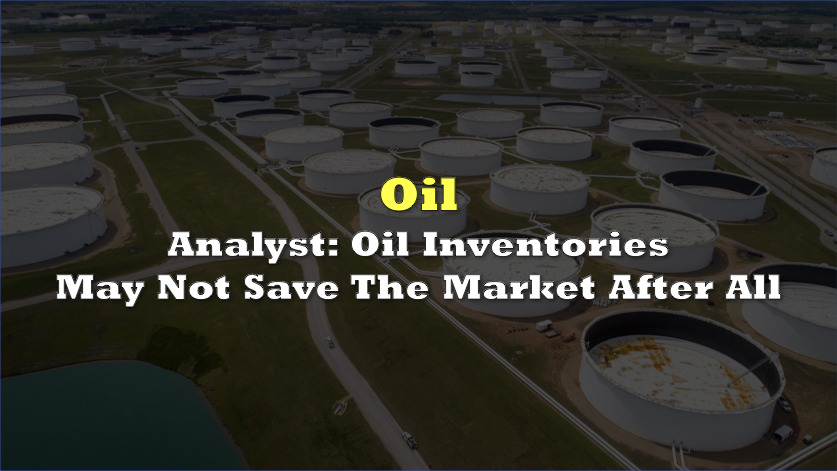

Global oil markets are leaning on an inventory buffer that looks large on paper but may become operationally fragile within months if the Strait of Hormuz remains closed.
JPMorgan’s latest oil analysis says the world entered 2026 with about 8.4 billion barrels in storage, a figure that appears healthy after global inventories rebuilt in 2024 and 2025.
The problem is accessibility. Of that total, the bank estimates only about 800 million barrels can be realistically drawn without pushing the system into operational stress.
 Sponsored · Altamira Gold Corp.
The warning comes as the US-Iran war and the effective closure of the Strait of Hormuz have turned inventories into the market’s main shock absorber. The strait handles roughly one-fifth of global oil flows, making the disruption a direct hit to the physical market rather than a normal price-driven demand cycle.
Reuters reported that Brent briefly touched $126.41 on April 30 before settling at $114.01, while WTI closed at $105.07, with oil still on track for a fourth straight monthly gain.
The inventory cushion is thinner than it looks
JPMorgan estimates that the 8.4 billion barrels include roughly 6.6 billion barrels held onshore and 1.8 billion barrels afloat. By type, about 5.2 billion barrels are crude and 3.2 billion barrels are refined products. Floating barrels are easier to redirect, while much of the onshore stockpile is constrained by pipeline fill, tank minimums, terminal operations, refining requirements, and strategic reserve rules.
The bank’s most important distinction is between headline inventories and usable inventories. Some barrels are in transit. Some are sanctioned Russian and Iranian crude sitting offshore. Some are strategic reserves controlled by governments. Others are technically counted as inventory but cannot be drawn without impairing the plumbing of the oil system.
 Sponsored · Cambria Gold Mines
JPMorgan says roughly 280 million barrels have already been consumed to cushion the conflict since April 23. On paper, that still leaves a large buffer. In practice, the bank says only a fraction can be tapped quickly, and about 800 million barrels of onshore inventories are readily accessible.
The drawdowns
The first layer is oil-on-water and floating commercial stocks. JPMorgan estimates inventories on water began the year at 1.8 billion barrels and have fallen by about 140 million barrels over the past two months, implying an average draw of 2.7 million barrels per day. The bank says the last cargo from Hormuz arrived on April 20, which means the headline draw rate should now start to moderate.
The second layer is commercial onshore storage at refineries, terminals, merchant storage hubs, and major pricing centers such as Cushing, ARA, and Singapore. JPMorgan says OECD commercial stocks recently began declining, drawing at about 2.2 million barrels per day in April after a modest 450,000 barrel-per-day draw in March. In absolute terms, OECD commercial inventories fell from 2.8 billion barrels in February to about 2.72 billion barrels today.
The third layer is strategic petroleum reserves. JPMorgan says current SPR releases are running at roughly 2.5 million barrels per day, with Japan and South Korea also drawing reserves. Since March 26, when Japan released its first strategic barrels, OECD strategic reserves have declined by 61 million barrels.
The fourth layer is demand destruction. JPMorgan estimates observed global oil demand fell by 2.8 million barrels per day in March and is tracking a larger 4.3 million barrel-per-day decline so far in April. Demand losses are expected to deepen to around 5.5 million barrels per day in May as high prices, disrupted supply, refinery slowdowns, weaker consumption, and economic drag force the adjustment.
Operational minimums
JPMorgan’s core warning is that inventories become less useful as they approach operational minimums. A market can still hold hundreds of millions of barrels and yet become fragile if those barrels are in the wrong locations, wrong grades, inaccessible tanks, strategic reserves, or pipeline systems that cannot be drained.
Historically, OECD product inventories, including commercial and strategic reserves, have rarely fallen below roughly 35 days of forward demand, or about 1.6 billion barrels. JPMorgan says that level represents a practical lower bound. The bank now expects OECD commercial inventories to approach operational stress levels by early June.
Under a prolonged disruption scenario, the bank estimates OECD commercial crude stocks could fall to operational floors by September if the Strait of Hormuz remains closed and demand destruction stabilizes at 5.5 million barrels per day.
Reuters separately reported that a US naval blockade has sharply reduced Iranian exports, with shipments dropping more than 80% in mid-April from March levels and millions of barrels stranded on tankers.
The International Energy Agency has described the disruption as the largest oil supply shock on record, according to Reuters and Al Jazeera reports.
Information for this briefing was found via the sources and the companies mentioned. The author has no securities or affiliations related to this organization. Not a recommendation to buy or sell. Always do additional research and consult a professional before purchasing a security. The author holds no licenses.