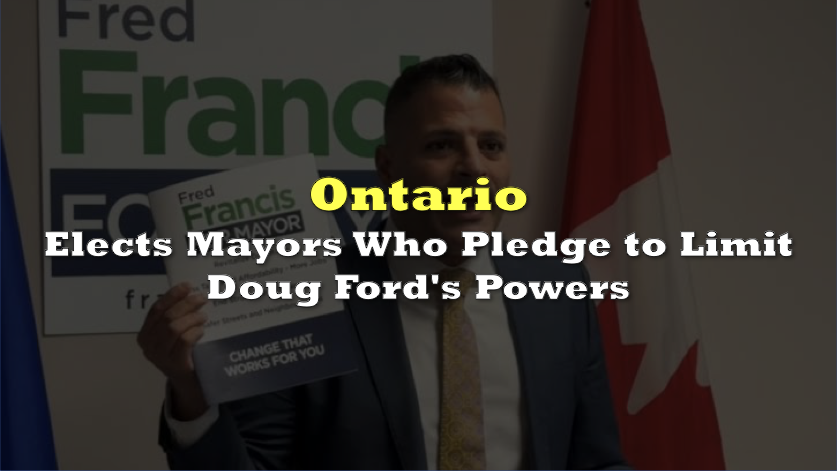

Three newly elected Ontario mayors have pledged to restrict the executive powers granted to their offices under Premier Doug Ford’s government, creating a new test of provincial-municipal authority as Queen’s Park prepares to install appointed regional leaders with similar powers.
The municipal elections delivered victories for Fred Francis in Windsor, Jeff Knoll in Oakville, and Nickolas Harper in Bradford West Gwillimbury. All three campaigned against concentrating decision-making authority in the mayor’s office.
In Windsor, Francis defeated incumbent Drew Dilkens after campaigning to eliminate strong-mayor powers. Francis told AM800 on October 22 that he would request their removal by the province and refrain from exercising them regardless of the government’s response.
 Sponsored · Silver47 Exploration Inc.
Oakville’s Knoll defeated longtime mayor Rob Burton, receiving 21,866 votes, or 36.31%, according to unofficial results reported by Oakville News. Knoll made a similar commitment in an October 17 response to local election questions.
“I won’t use strong mayor powers except where required by law,” he wrote.
His election also creates a direct provincial planning dispute. Knoll’s campaign called for Ontario to withdraw four minister’s zoning orders affecting Midtown Oakville and approve the municipality’s preferred development framework.
In Bradford West Gwillimbury, Harper won 4,579 votes against runner-up Peter Ferragine’s 4,229. Incumbent James Leduc finished fifth with 1,497. Harper identified returning authority to council and municipal staff, where legally permitted, among his immediate priorities, according to BradfordToday.
 Sponsored · Selkirk Copper Mines
Ontario’s strong-mayor framework permits designated municipal leaders to appoint senior administrators, reorganize departments, propose budgets, and veto certain bylaws affecting provincial priorities.
Some provincial-priority bylaws can pass with support from more than one-third of council members.
Mayors can delegate selected administrative powers, but they cannot independently remove the statutory framework. The legislation also requires mayors to propose municipal budgets under prescribed procedures.
The provincial government’s Better Regional Governance Act, enacted May 7, authorizes the municipal affairs minister to appoint leaders across eight upper-tier municipalities, including Peel, Halton, York, Durham, and Waterloo.
Those regional leaders will receive expanded powers resembling the strong-mayor framework. Relevant legislative changes take effect November 15.
The Ford government has defended these reforms as measures to streamline decisions and advance housing and infrastructure development.
The election results therefore create two competing approaches to municipal governance: newly elected mayors seeking greater collective decision-making and a provincial government expanding executive authority at the regional level.
In Mississauga, Alvin Tedjo defeated incumbent Carolyn Parrish and former mayor Bonnie Crombie, while Hamilton elected Keanin Loomis over Andrea Horwath. Milton’s George Minakakis also unseated Gordon Krantz, ending a 46-year mayoral tenure that began in 1980.
Incumbent mayors also lost their re-election bids elsewhere in Ontario. In Niagara Falls, Lori Lococo defeated Jim Diodati, while Kingston elected Conny Glenn over Bryan Paterson. Waterloo’s Shannon Weber unseated Dorothy McCabe, Cambridge’s Scott Hamilton defeated Jan Liggett, and Timmins elected Rob Knox over Michelle Boileau.
However, the turnover was not universal. Toronto Mayor Olivia Chow secured another term, alongside Ottawa’s Mark Sutcliffe, Brampton’s Patrick Brown, and Vaughan’s Steven Del Duca.