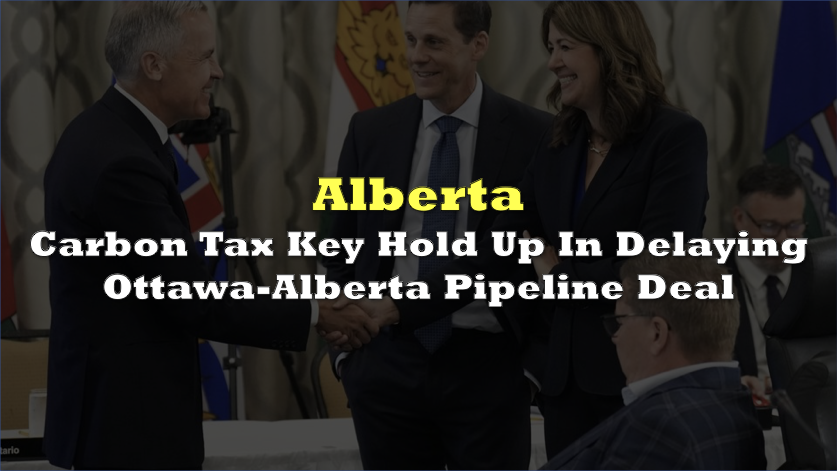

The unresolved industrial carbon price has become the central obstacle in Ottawa’s energy deal with Alberta, delaying an agreement that was supposed to clear the path for a new oil pipeline capable of moving another 1 million barrels per day to Asian markets.
Prime Minister Mark Carney and Alberta Premier Danielle Smith signed a memorandum of understanding in November that committed both governments to conclude an industrial carbon pricing agreement by April 1. That deadline has passed, and the biggest unresolved question is how Alberta’s Technology Innovation and Emissions Reduction system, known as TIER, will rise from its current $95-per-tonne price toward a $130-per-tonne minimum effective credit price.
Smith said Thursday that progress had been made, but that timing, stringency, and industry benchmarks remain unsettled.
 Sponsored · Selkirk Copper Mines
“It’s just a matter of how quickly we get there, and what the stringency will be and the benchmarking on the industry,” she said.
That has turned the pipeline deal into a three-way political fight. Alberta wants federal support for a new export pipeline to the West Coast. Ottawa wants a functioning industrial carbon market that preserves Canada’s climate framework.
The federal fuel charge was set to $0 effective April 1, 2025, but the federal Output-Based Pricing System for large industrial emitters remains in force.
Under the previous federal benchmark, carbon pricing was set to rise by $15 per year to reach $170 per tonne by 2030, while the Ottawa-Alberta MOU instead points Alberta toward a $130-per-tonne minimum effective credit price.
 Sponsored · Cambria Gold Mines
Oil and gas leaders warn the policy could weaken competitiveness just as Canada is trying to reduce dependence on the US
Steven Guilbeault, the former environment minister who resigned from cabinet the day Carney signed the Alberta agreement, warned in a Toronto Star opinion piece that Canada was at a “crossroads.” He argued industrial carbon pricing “must be reinforced, not weakened,” calling it a “pillar” of Canada’s climate strategy.
Asked about the timeline, Carney did not commit to a date. He said the objective is “to have an effective, functioning carbon market with respect to the competitiveness of our oil and gas sector,” while pointing to record Canadian oil production and the need to pivot exports away from the US.
Smith wants Ottawa to approve a new million-barrel-per-day pipeline from the oil sands to British Columbia’s coast, with Alberta expected to submit a proposal through Carney’s Major Projects Office. Reuters previously reported Alberta was working on a crude pipeline proposal to Prince Rupert, with Canada still exporting about 90% of its oil to the US.
But the route itself is now another flashpoint. Alberta prefers a northern path to Prince Rupert, citing access to deepwater shipping and a shorter trip to Shanghai. Federal officials have reportedly leaned toward a southern BC route to Vancouver, possibly alongside the existing Trans Mountain corridor, because they see fewer environmental and Indigenous opposition hurdles than a northern option.
Neither route has a private-sector builder publicly committed. BC Premier David Eby has criticized Alberta’s push, while First Nations along the northern coast have opposed both new pipeline construction and any lifting of the federal oil tanker moratorium.
Information for this story was found via the sources and companies mentioned. The author has no securities or affiliations related to the organizations discussed. Not a recommendation to buy or sell. Always do additional research and consult a professional before purchasing a security. The author holds no licenses.