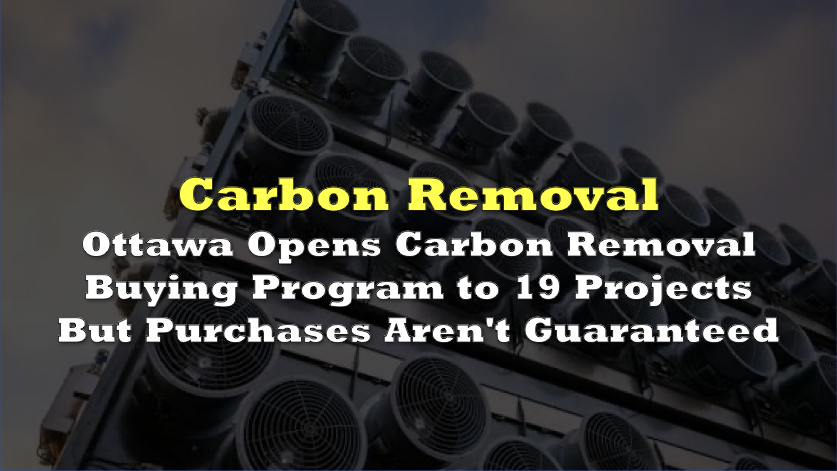

Ottawa has identified 19 carbon-removal projects eligible to sell credits to federal departments, but its latest climate procurement announcement leaves a central financial question unanswered: how much business, if any, is guaranteed to reach the selected suppliers?
The Treasury Board announced the national master standing offer on Thursday, describing a competitive purchasing channel for technologies that remove carbon dioxide from the atmosphere. The selected projects are spread across five categories, including direct air capture, biochar, biomass-based storage, and enhanced mineralization.
Under Canada’s procurement rules, however, a standing offer is not a contract. Federal organizations must issue individual call-ups before purchases become binding.
 Sponsored · Selkirk Copper Mines
The financial distinction is significant because the government’s underlying spending commitment is already two years old. Ottawa pledged on October 9, 2024, to buy at least $10 million in carbon-removal services by 2030.
Calgary-based Remova Carbon Systems said it received 50% of the potential purchasing dollars assigned to the bioenergy-with-carbon-capture category, one of three suppliers selected in that stream.
The company plans to produce credits from a proposed facility near Whitecourt, Alberta, targeting operations in 2028 and annual net removals of approximately 20,000 tonnes of carbon dioxide.
Remova separately announced an advance credit purchase through a program operated by MaRS, distinct from the federal standing offer.
 Sponsored · PTX Metals Inc.
Other selections include Deep Sky projects in Alberta and Quebec, North Star’s Saskatchewan project, and biochar and mineralization initiatives in several provinces. Although Ottawa lists 19 offers, the backgrounder names 17 distinct suppliers because Deep Sky and Cariboo Carbon Solutions each appear twice.
The full list includes:
1. Direct Air Capture and Permanent Storage (4 projects)
- Baie Minerals Inc. — Atlantic Carbon Mineral Hub, Newfoundland and Labrador
- Deep Sky Corporation — Deep Sky Alpha, Alberta
- Deep Sky Corporation — Deep Sky Black Lake, Quebec
- Skyrenu Technologies — Orford Project, Quebec
2. Bioenergy With Carbon Capture and Storage (3 projects)
- North Star — North Star Carbon Solutions LP, Saskatchewan
- pHathom Technologies Inc. — BECCMS, Nova Scotia
- Remova Carbon Systems — Remova Greenfield Forestry BECCS, Alberta
3. Biochar (5 projects)
- Anew Climate — Green Ventures Biochar Project, Ontario
- Carbon Lock Tech — Ritchot Biochar Project, Manitoba
- Carbonity Inc. — Carbonity Biochar Production Plant, Quebec
- Cariboo Carbon Solutions — Vancouver Island Biochar Carbon Removal Project, British Columbia
- Safi Enterprises — Salmon Arm Biochar Carbon Removal Project, British Columbia
4. Other Biomass Carbon Removal and Storage (4 projects)
- Cariboo Carbon Solutions — Vancouver Island Carbon Removal Project, British Columbia
- NULIFE Regen Renewables (NULIFE GreenTech) — Saskatoon Expansion Project, Saskatchewan
- Vaulted Deep — Alberta Biomass Carbon Removal and Storage Pilot Project, Alberta
- Pessamit Innu First Nation — Reducing Wildfire Risk and Storing Carbon from Forest Biomass, Quebec
5. Enhanced Mineralization (3 projects)
- UNDO Carbon Canada — Ontario Project, Ontario
- Arca — Project AMI (Activation Minérale Industrielle), Quebec
- Karbonetiq — Algoma CDR, Ontario
Treasury Board also disclosed that four successful applicants had previously received support from Natural Resources Canada’s Energy Innovation Program but it did not identify those applicants in the announcement.
The federal government intends the credits to address emissions that remain difficult to eliminate from its operations, including military aircraft and marine fleets. The standing offers can be used through March 31, 2029, with an option to extend through March 31, 2031.