

Canada’s news industry is not facing a simple trust crash. It is facing a split market.
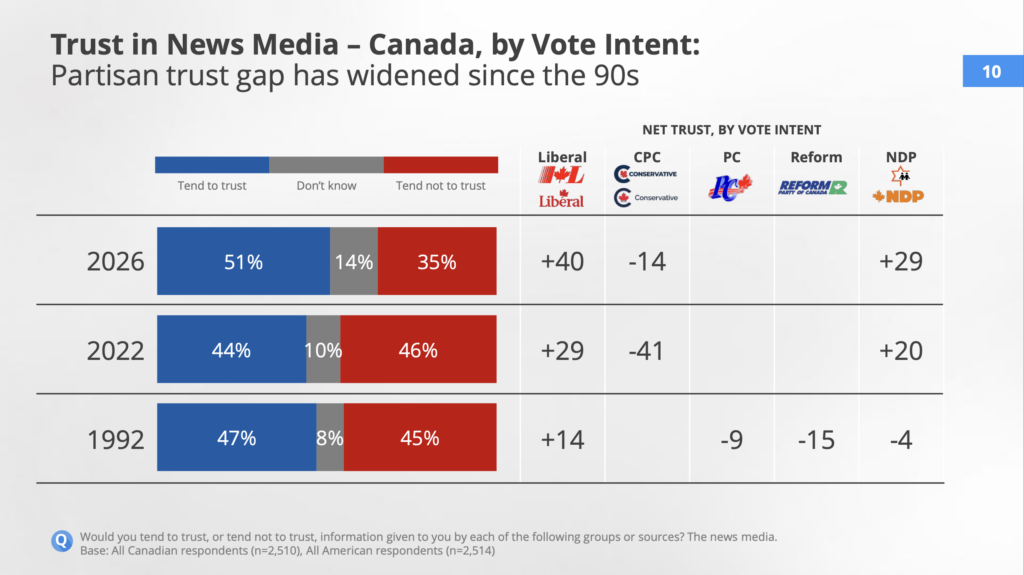
Pollara Strategic Insights’ latest Trust in Media study found that 51% of Canadian adults tend to trust information from the news media, compared with 35% who tend not to trust it. That is higher than Pollara’s readings in 2022 and 1992, and above the 45% trust level Pollara recorded among US adults in the same survey wave.
But the sharper risk is not the headline number. It is the distribution underneath it.
 Sponsored · Selkirk Copper Mines
Among Canadians aged 65 and older, net trust in the news media sits at +38. Among 18-to-34-year-olds, it is only +5. Pollara says this reverses the age pattern it saw in the 1990s, when younger Canadians were more trusting than older Canadians.
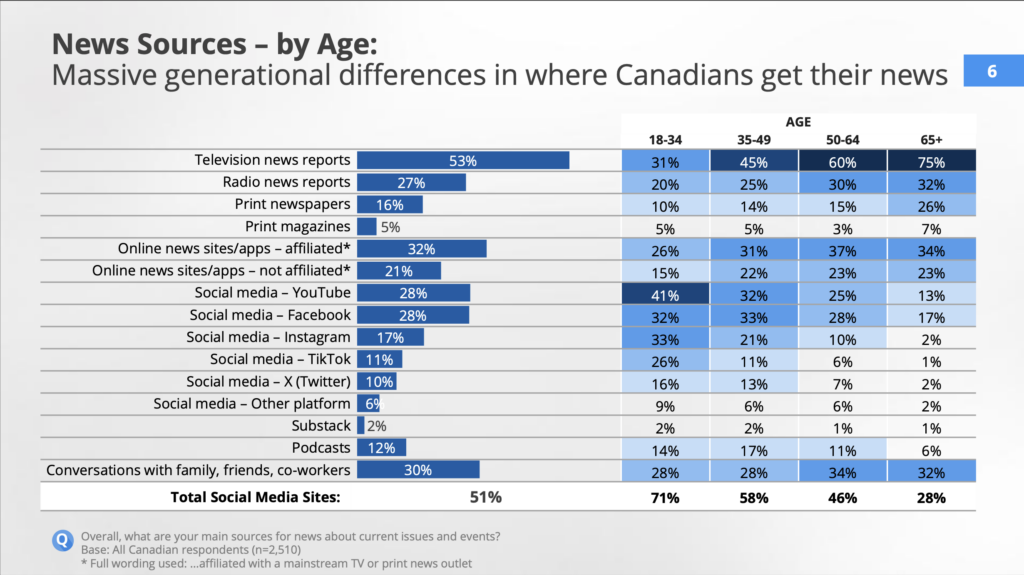
That generational gap matters because younger Canadians are not just less trusting. They are also getting news in a different place. Pollara found that 71% of Canadians aged 18 to 34 use social media sites as a main news source, compared with 28% of those aged 65 and older.
Television news shows the opposite pattern, used by 75% of seniors but only 31% of younger adults. YouTube is the leading social platform for younger adults at 41%, followed by Instagram at 33%, Facebook at 32%, TikTok at 26% and X at 16%.
The Weather Network ranked as Canada’s most trusted media organization in Pollara’s study, with 78% calling it trustworthy and a net trust score of +65. CBC followed at 71% trustworthy, CTV News at 68%, and Global News at 65%. Pollara found The Weather Network had the highest net trust score in every region except Quebec, where CBC/SRC ranked first.
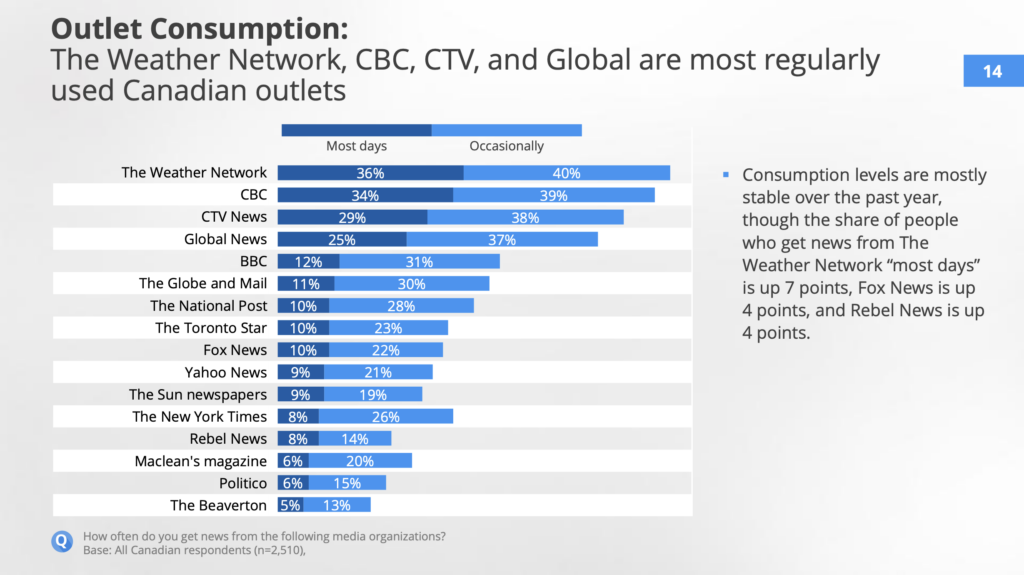
The numbers also show a trust premium for major TV networks that does not automatically translate into dominance among younger consumers. CBC was used “most days” by 34% of Canadians overall, while The Weather Network was used most days by 36%. But social media’s total reach among young adults is now much larger than any single outlet’s daily use.
 Sponsored · Cambria Gold Mines
The political split is even more material. Pollara found a 54-point gap in net trust in the news media between Liberal and Conservative voters in 2026. Liberal voters posted a +40 net trust score, while Conservative voters posted -14. In 1992, Pollara’s comparable gap between Liberal and Reform Party voters was 29 points.
That partisan divergence shows up at the outlet level. CBC’s net trust score was +78 among Liberal voters but +9 among Conservative voters. CTV News scored +71 among Liberal voters and +30 among Conservatives. Global News scored +68 among Liberal voters and +28 among Conservatives.
Fox News and Rebel News were the exceptions to the broader Conservative trust pattern. Pollara found Fox News had a +1 net trust score among Conservative voters, up from negative scores in 2023, 2024 and 2025. Rebel News posted +13 among Conservative voters, compared with -3 among Liberal voters and -7 among NDP voters.
The result is a Canadian media market where trust is not disappearing evenly. It is sorting by age, politics and channel.
That tracks with a broader global shift identified by the Reuters Institute’s 2026 Digital News Report, which found that platforms have become more popular globally than both TV and news websites or apps as sources of news. The Reuters Institute also reported that global trust in news fell to 37% in 2026, its lowest level since tracking began.
Canada looks stronger than that global baseline in Pollara’s dataset, but not immune to the same structural pressure. If younger audiences build their news habits around YouTube, Instagram, TikTok and other feeds, the trust advantage held by legacy outlets may become less useful unless those outlets can carry that credibility into platform environments.
Pollara’s study also complicates the easy “mainstream media is dead” narrative. The big Canadian TV brands remain highly trusted by the public overall. The problem is that high trust among older audiences can coexist with weakening relevance among younger ones.
For publishers, broadcasters and advertisers, the signal is not that the Canadian public has abandoned news. It is that news trust is becoming more segmented, and segmentation is harder to monetize, harder to regulate and harder to scale.