
A shipping route Canadian oil tankers have relied on for years to reach Asia more cheaply is disappearing. Rather than swapping onto bigger ships at a transfer zone off Southern California, they’re now sailing the whole way across the Pacific on smaller tankers — a route that, for the first time, is the cheaper option.
As recently as June 2024, tankers carrying about 78% of Canada’s Asia-bound crude still made that California stop; by August 2026, none did, per Bloomberg. A spike in tanker rates has made the bigger ships far pricier to charter, and Canada is under pressure to find oil buyers beyond the US, its main customer, as the two countries’ trade war grinds on.
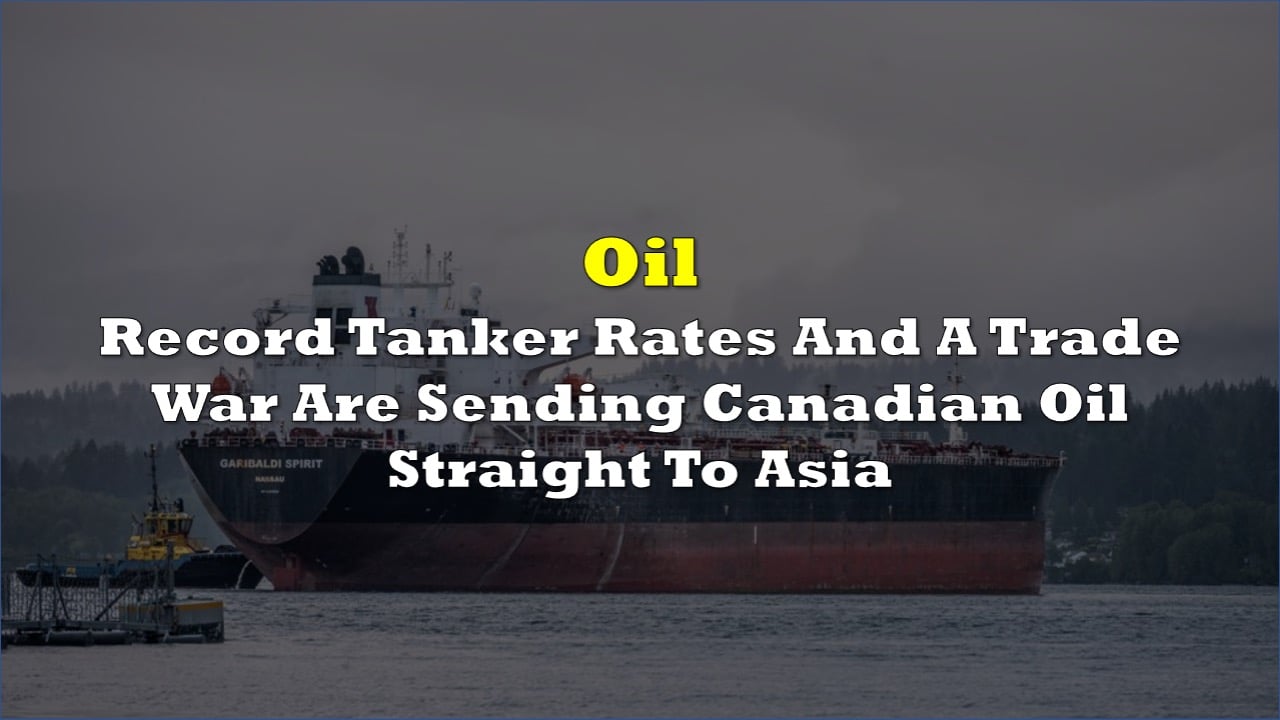
The Trans Mountain pipeline feeds Vancouver’s Westridge Marine Terminal, and the terminal can’t berth anything bigger than an Aframax tanker — a ship that holds up to about 750,000 barrels, well under a Very Large Crude Carrier’s roughly 2 million. So shippers have sailed those Aframaxes down to California and transferred the crude onto VLCCs for the more efficient Pacific crossing, despite the extra distance and time that added.
 Sponsored · Antimony Resources
VLCC charter rates have also spiked to nearly $500,000 a day — roughly ten times typical pre-war levels — as the war Israel and the US launched against Iran in February keeps pulling ships away from routine trade and driving up war-risk premiums. More Aframax tankers are working the western Pacific these days too, easing that side of the equation. That combination has cut the price of sailing an Aframax straight to Asia to roughly 54 cents on the dollar of the old VLCC route, according to Nick Watt, Argus’s head of freight pricing.
Ottawa has its own reasons to want this shift — it’s been trying to rely less on the US market. Trans Mountain expanded its pipeline to 890,000 barrels a day in 2024, and the line hit full capacity for the first time in June as Asian refiners turned to Canadian crude while the Iran war disrupted Gulf supply.
Canada is now backing an even bigger pipeline — a proposed 1-million-barrel-a-day line and deepwater port big enough for VLCCs to load directly, that Alberta’s government estimates would cost between C$35.2 billion (US$24.8 billion) and C$43.7 billion.
“Canada and Alberta will be equal partners in this project,” Prime Minister Mark Carney said, promising an ownership stake for Indigenous communities too. Pembina Pipeline plans to hold a 10% stake in the new line, with an option to double it; producers should get an open season for shipping commitments next year.