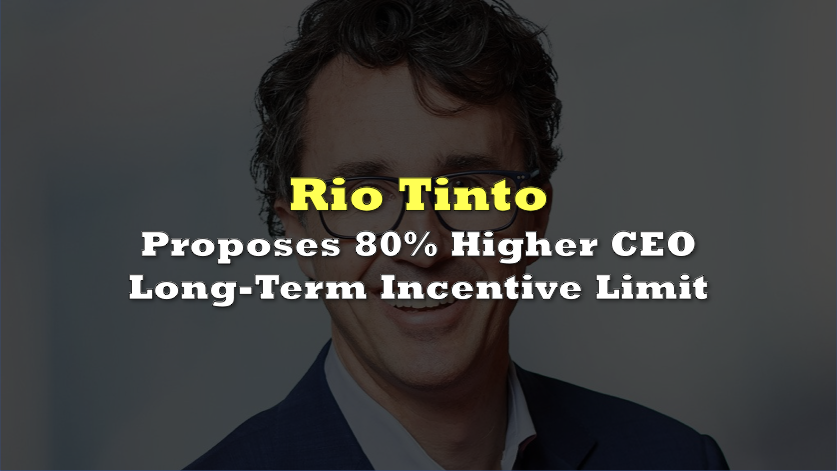

Rio Tinto is seeking to raise its chief executive’s long-term incentive ceiling from five times to nine times base salary, according to documents reviewed by Reuters, less than six months after a shareholder group publicly criticized the existing limit as excessive.
The proposed 80% expansion would be Rio Tinto’s second increase to the incentive ceiling in three years, reversing the restrained approach to executive pay that the mining giant emphasized when defending its previous remuneration policy.
According to Reuters, CEO Simon Trott’s target remuneration would increase 56% to £9.8 million (US$13.1 million), while maximum potential compensation would rise 63% to £18.3 million (US$24.4 million).
 Sponsored · Selkirk Copper Mines
His fixed salary would remain unchanged. Maximum short-term incentives would increase from 200% to 300% of salary.
At Rio Tinto’s May 6 annual general meeting, John Campbell, representing the Australian Shareholders’ Association, challenged the existing long-term incentive structure. Campbell described the five-times-salary maximum as excessive and said the association would oppose the company’s remuneration resolutions.
Chairman Dominic Barton defended the need to benchmark executives against global competitors but assured shareholders that the board was “not going to go crazy on it.”
Remuneration committee chair Ben Wyatt pointed out that shareholders had approved the increase from four to five times salary in 2024, following approximately a decade without increases to long-term incentive opportunities.
 Sponsored · Silver47 Exploration Inc.
In May 2024, then-remuneration committee chair Sam Laidlaw explained that the additional 100 percentage points of incentive opportunity would be tied to Rio Tinto’s decarbonization strategy.
Laidlaw also emphasized that the company was not seeking to match substantially higher American executive-pay levels.
The latest proposal expands Rio Tinto’s executive-pay comparison group to include ExxonMobil, Chevron, and GE Aerospace, according to the investor presentation examined by Reuters.
Trott’s proposed maximum compensation would rank just below the median of the 19-company comparison group.
The expanded benchmarks come as Rio Tinto reports substantially stronger financial results. First-half 2026 underlying earnings increased 43% year-over-year to $6.85 billion, while free cash flow climbed 75% to $3.83 billion. Underlying EBITDA rose 28% to $14.83 billion.
Wyatt told Reuters the proposed framework was intended to strengthen performance incentives and improve Rio Tinto’s ability to retain executives.
The company has also emphasized that incentive awards are not guaranteed. At the May AGM, Wyatt said the latest long-term incentive vesting outcome was zero because Rio Tinto had failed to outperform its relevant shareholder-return benchmarks.
The proposed remuneration framework would cover three years and requires shareholder approval at the 2027 annual general meeting.