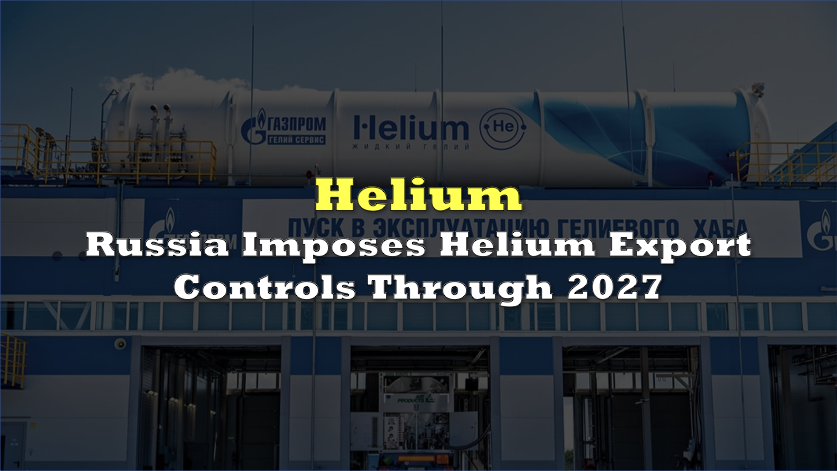

Russia has placed temporary export controls on helium through the end of 2027, adding another constraint to a global market already tightened by Middle East disruptions and rising demand from semiconductor manufacturing.
The decree adds helium to a list of goods that require special approval for exports outside the Eurasian Economic Union, according to Reuters. The restriction is aimed at maintaining stable domestic supply, with Moscow identifying fibre optics as a key use case.
Russia is the world’s third-largest helium producer, behind the US and Qatar, but accounts for only around 8% of global production, according to Gazprombank analysts cited by Reuters. Qatar produced more than one-third of global supply in 2025.
 Sponsored · Selkirk Copper Mines
The timing is the bigger tell. Helium supply has tightened after the Middle East conflict disrupted Qatar-linked gas processing, where helium is recovered as a byproduct of natural gas production. Qatar’s LNG halt exposed the fragility of helium supply chains and pushed prices higher.
Helium is used in chipmaking for cooling, leak detection, and precision manufacturing, while other demand comes from medical imaging, aerospace, welding, and research. The gas has few direct substitutes in high-spec applications, which is why small supply shifts can punch above their weight.
Russian Prime Minister Mikhail Mishustin earlier said Middle East disruptions had opened new trade opportunities for Russia, but domestic price stability remained a priority. Gazprom’s Amur Gas Processing Plant is Russia’s largest helium producer and a key source of future supply.
READ: How Russia Profited From the US/Israel—Iran War
For global buyers, the new controls do not remove Russian helium from the market entirely, but they add a permission layer at the same time Qatar-linked supply remains vulnerable. In a market where logistics are specialized and spare capacity is limited, that is enough to raise procurement risk.
The move also extends a broader pattern in critical materials: governments are treating supply security as more important than maximum export revenue.
Information for this story was found via the sources and companies mentioned. The author has no securities or affiliations related to the organizations discussed. Not a recommendation to buy or sell. Always do additional research and consult a professional before purchasing a security. The author holds no licenses.