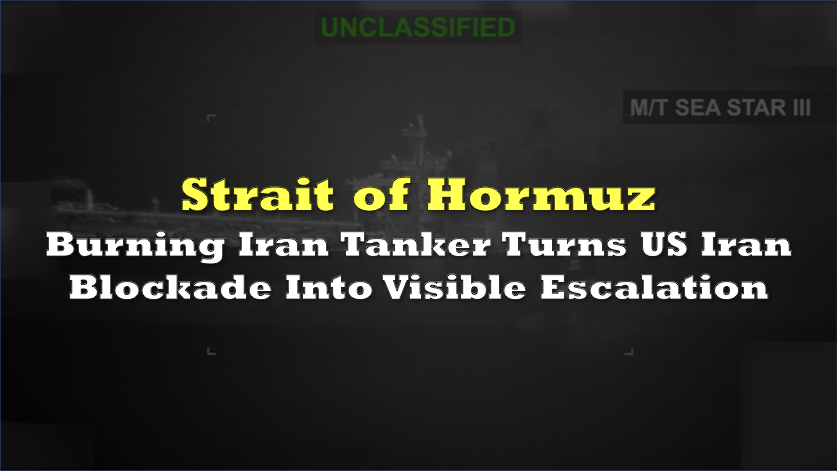

The reported fire aboard Iran’s Sea Star III has turned a US blockade enforcement action into a visible maritime risk near Jask, raising fresh questions about how far Washington is prepared to go to stop vessels from reaching Iranian ports.
OSINTtechnical reported that the Iranian oil tanker was still burning off Jask after being struck by a US Navy airstrike late last week, with heavy damage visible toward the vessel’s aft section.
US Central Command confirmed that American forces disabled Sea Star III and another Iranian-flagged tanker, M/T Sevda, on May 8 in the Gulf of Oman. CENTCOM said both vessels were unladen and were attempting to reach an Iranian port in violation of the US blockade.
 Sponsored · Cambria Gold Mines
While OSINTtechnical said the tanker was hit while at port, CENTCOM’s readout said the vessels were disabled before entering an Iranian port. That leaves the exact strike location and timing unclear based on the available public record.
The damage claim has been reinforced, but not fully verified, by maritime reporting. gCaptain said circulating images appeared to show fire and exterior damage aboard Sea Star III, while cautioning that the images had not been independently authenticated.
The Sea Star III incident is part of a wider US interdiction pattern. CENTCOM said American forces had also disabled the Iranian-flagged M/T Hasna on May 6, after it attempted to move toward Iran through the Gulf of Oman. In that case, the command said US aircraft fire left the vessel unable to continue.
For shipping markets, Sea Star III’s cargo status may be less important than the enforcement model. Even an unladen tanker can become a navigation, salvage, insurance, and environmental problem if it remains disabled or burning near a sensitive maritime corridor.
The incident also gives both sides competing escalation narratives. Washington can frame the strike as calibrated blockade enforcement. Tehran can frame the damage near its coast as a direct military attack on maritime assets.
Sea Star III’s reported fire therefore matters beyond one tanker as it further shows that the US blockade has moved from legal pressure into kinetic enforcement, with every damaged vessel increasing the risk that maritime control becomes a broader regional flashpoint.
Information for this story was found via the sources and companies mentioned. The author has no securities or affiliations related to the organizations discussed. Not a recommendation to buy or sell. Always do additional research and consult a professional before purchasing a security. The author holds no licenses.