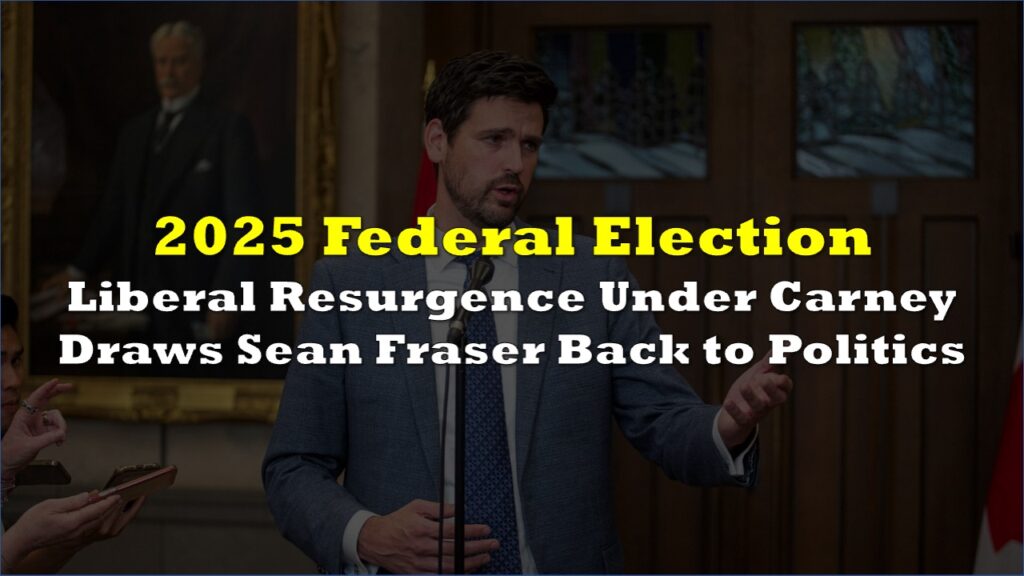

Justice Minister Sean Fraser has reportedly told a parliamentary committee he would “occasionally” check whether judicial appointees had made political donations during the appointment process, a Blacklock’s Reporter report said.
“I will on occasion have a candidate’s political activities flagged before a final appointment is made,” he said.
That line landed inside an already loaded debate. The June 29 House of Commons Justice Committee meeting was convened around the nomination of Glenn D. Joyal to the Supreme Court of Canada, with Fraser appearing alongside Maureen McTeer, chair of the Independent Advisory Board for Supreme Court of Canada Judicial Appointments, and Marc Giroux, Commissioner for Federal Judicial Affairs.
The government’s formal position is that Supreme Court appointments use an independent, non-partisan advisory board that gives merit-based recommendations to the prime minister. The Prime Minister’s Office said the board identified high-calibre, functionally bilingual candidates who met eligibility requirements for a Western Canada or Northern Canada seat before submitting a shortlist.
 Sponsored · Altamira Gold Corp.
Carney just recently posted that his office just appointed Joyal to the highest court, praising the judge who “has demonstrated the integrity, experience, and sound judgment that service on Canada’s highest court demands.”
However, Fraser’s problem is about whether the executive branch should be looking at political donations list while deciding who gets life-altering judicial power.
The issue has history. In 2019 briefing materials prepared by the Department of Justice addressed media reports that the Prime Minister’s Office had vetted judicial candidates using Liberalist, the Liberal Party’s political database. The prepared answer said political activity or donations had “no impact” on candidacy or selection, and that the government had appointed people involved with parties “of all political stripes.”
Opposition MPs later pressed the same concern at committee. In 2021, Conservative MP Michael Cooper moved for a study into judicial appointments and the alleged use of Liberalist, arguing that the database issue raised questions about whether candidates were receiving preferential treatment. Liberal MP James Maloney pushed back, saying the motion undermined confidence in the courts and that politics had never entered the equation in his legal experience.
The current flare-up comes at a more sensitive moment. Several premiers have recently pushed Ottawa for more say in superior and appeal court appointments. Fraser has rejected that demand, saying the existing process is functioning and that the government is not considering a “sea change” in how judges are appointed.
That makes the optics awkward. Ottawa is telling provinces that more political input could weaken judicial independence, while the Justice Minister is now facing criticism over whether federal political information is already part of the final-stage vetting ecosystem.
The most defensible government explanation is risk management. The danger is that risk management and partisan screening can look identical from the outside.