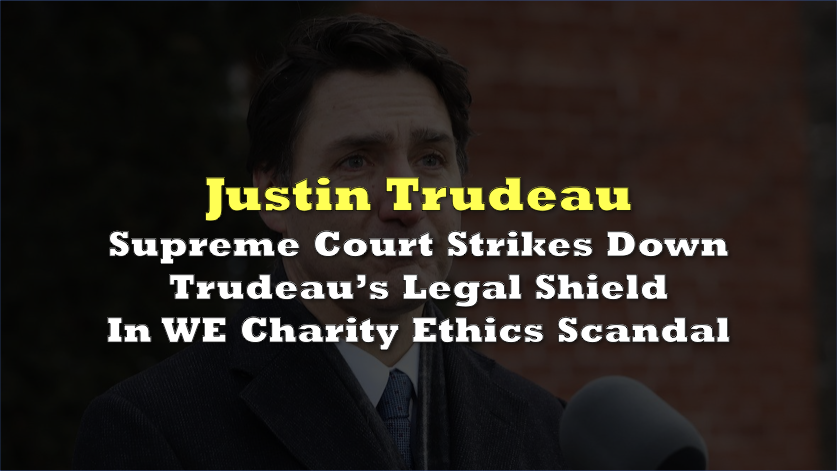

Canada’s highest court has used a five-year-old dispute over former Prime Minister Justin Trudeau’s handling of the WE Charity file to impose a broader constitutional limit on Parliament: political oversight cannot replace the courts when the legality of a public authority’s decision is challenged.
The Supreme Court of Canada unanimously allowed Democracy Watch’s appeal Thursday, striking down a provision of the Conflict of Interest Act that attempted to prevent courts from reviewing the ethics commissioner’s conclusions on questions of fact and law. The matter will now return to the Federal Court of Appeal, which must consider whether the commissioner’s 2021 ruling clearing Trudeau was legally reasonable.
Section 66 of the Conflict of Interest Act restricted judicial review of ethics commissioner decisions, generally leaving courts able to intervene only on grounds such as jurisdictional errors, procedural unfairness, fraud, or perjured evidence. Challenges involving the commissioner’s interpretation of the law or assessment of the facts were effectively excluded.
 Sponsored · Selkirk Copper Mines
Writing for the unanimous nine-judge panel, Chief Justice Richard Wagner concluded that Section 66 violated the constitutional guarantee that courts can examine whether public authorities have acted lawfully. The provision was declared unconstitutional and of no force or effect.
The Federal Court of Appeal had previously found that parliamentary scrutiny of the ethics commissioner’s reports provided an adequate alternative to judicial review. The Supreme Court rejected that approach.
Members of Parliament can debate, criticize, or question a commissioner’s conclusions, the Court said, but political institutions cannot determine whether the commissioner remained within the legal boundaries of the office’s authority. That function belongs to the courts.
The underlying case concerns Trudeau’s participation in two government decisions involving WE Charity and the Canada Student Service Grant during the COVID-19 pandemic. The federal government had allocated up to $912 million for the grant program. A contribution agreement valued at approximately $543.5 million was established with WE Charity Foundation, including $500 million intended for student grants and up to $43.5 million for program delivery. The arrangement was terminated on July 3, 2020, and the government later reduced the program’s funding estimate to zero.
 Sponsored · Cambria Gold Mines
Then-ethics commissioner Mario Dion concluded in May 2021 that Trudeau had not violated provisions concerning decision-making, preferential treatment, or the duty to recuse. Dion found that the relationships between members of Trudeau’s family and WE created the appearance of a conflict of interest.
However, he said the legislation did not prohibit apparent conflicts without an actual or potential conflict captured by the Act.
Trudeau had publicly acknowledged that he should have recused himself because of the appearance created by those relationships.
Democracy Watch applied for judicial review in June 2021, alleging that Dion made errors in interpreting the Act and assessing the evidence. Government lawyers sought to have the case dismissed under Section 66. The Federal Court of Appeal ultimately struck the application in October 2024 without examining whether Dion’s decision was lawful.
The constitutional issue attracted 15 interveners, including four provincial attorneys general, the Canadian Telecommunications Association, the Canadian Civil Liberties Association, Ecojustice, the City of Surrey, the Centre for Free Expression, and the Canadian Council for Refugees.
The Federal Court of Appeal must now address the question it previously avoided: whether Dion’s interpretation and application of the Conflict of Interest Act in the Trudeau III Report can withstand judicial scrutiny.