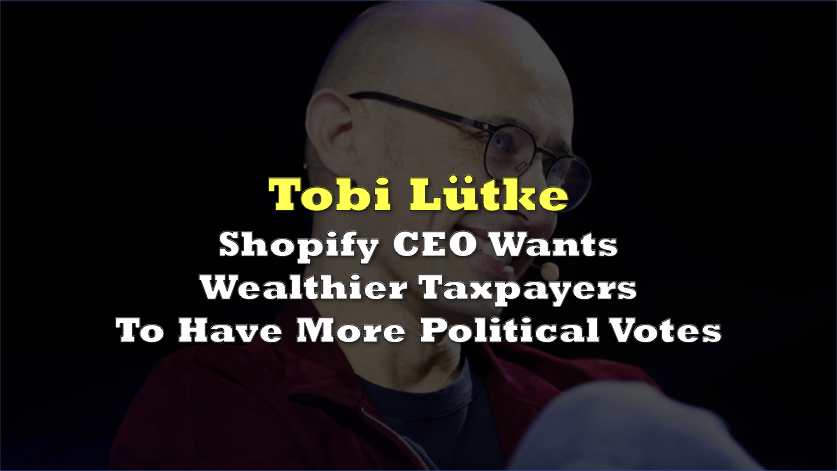

Shopify CEO Tobi Lütke has extended a debate over pensions and generational fairness into an argument for unequal political rights, publicly supporting a system that would remove votes from people paying no income tax and grant additional votes to higher taxpayers.
Lütke leads one of Canada’s most valuable public companies and had an estimated net worth of $11.2 billion as of July 27, according to Forbes. Shopify itself had a market capitalization of approximately $167.5 billion during July 28 trading.
It also creates an unusually direct corporate-governance tension. Shopify’s share structure already gives Lütke substantially more control than an equal-vote system would provide, with the company’s latest circular showing that he controls 40.02% of its total shareholder voting power.
 Sponsored · Cambria Gold Mines
The controversial exchange began during an online discussion about housing, public benefits, and older voters. Lütke proposed guaranteeing pension arrangements while treating their recipients as dependents.
“But now you are a dependent and that means no voting, just like dependents under age,” he wrote.
He added that people with a stake in the future should make electoral decisions.
Another user then proposed weighting votes according to income-tax contributions. Under the proposed system, people paying no income tax would receive zero votes. Higher taxpayers would receive between one and five votes, with the maximum assigned at the highest bracket described in the post.
 Sponsored · Selkirk Copper Mines
Lütke responded, “Good system.”
After another user challenged whether the Shopify founder should receive more than 100 votes, Lütke clarified that he supported a five-vote ceiling or potentially returning the allocation to one vote above a certain level.
“Reward productive people with leverage,” he wrote.
The later explanation makes the endorsement more substantial than an isolated two-word response. Lütke explicitly connected political influence with what he considered economic productivity, while leaving unanswered how unpaid caregiving, disability, education, retirement contributions, and other forms of social participation would be valued.
Shopify’s corporate structure provides a concrete parallel to the system Lütke supported. The company’s Class A subordinate voting shares carry one vote each, while its Class B restricted voting shares carry 10 votes.
Lütke also owns a Founder Share with a variable number of votes.
As of April 21, he controlled 99.59% of the outstanding Class B shares. Those holdings, his Class A shares, and the Founder Share gave him 40.02% of Shopify’s aggregate voting power, according to the company’s 2026 management information circular.
Corporate share structures and democratic elections operate under different legal principles. Investors voluntarily acquire securities carrying disclosed rights, while citizenship is not an investment contract.
Lütke’s proposal would actually face an immediate constitutional barrier in Canada. Section 3 of the Canadian Charter of Rights and Freedoms states that every Canadian citizen has the right to vote in federal and provincial elections.
The notwithstanding clause would not provide a workaround. Section 33 allows governments to override rights contained in Section 2 and Sections 7 through 15, but not the democratic rights protected by Section 3.
Shopify did not immediately respond when Fortune requested comment on the posts.
The legal prospects appear remote, but the political position is explicit. Lütke endorsed assigning political leverage according to taxation and productivity, shifting scrutiny away from pension sustainability and toward whether concentrated economic power should be converted into additional democratic power.