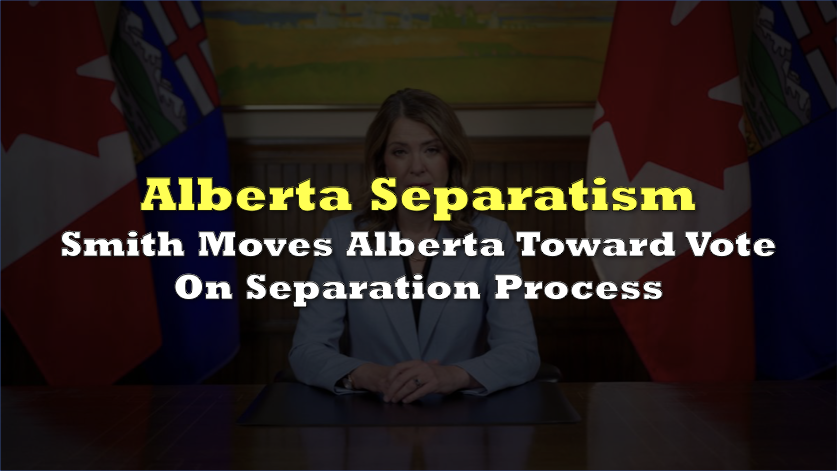

Alberta Premier Danielle Smith is trying to move a legally stalled separation fight from the courts back onto the ballot, asking voters to decide whether the province should start the constitutional process for a future binding referendum while still saying she wants Alberta to remain in Canada.
Smith said that her government will seek to add a new question to the province’s October 19, 2026 referendum vote: “Should Alberta remain a province of Canada or should the Government of Alberta commence the legal process required under the Canadian Constitution to hold a binding provincial referendum on whether or not Alberta should separate from Canada?”
Alberta Premier Danielle Smith has added this referendum question to be voted on October 19th
— Mackenzie Gray (@Gray_Mackenzie) May 22, 2026
“Should Alberta remain a province of Canada or should the government of Alberta commence the legal process required under the Canadian constitution to hold a binding provincial…
This is not a direct vote to separate. The October ballot would authorize the next procedure, not the rupture itself. That makes the question a political workaround after a Court of King’s Bench ruling halted the citizen-led Stay Free Alberta separation petition over First Nations consultation concerns.
Smith said the government will appeal the ruling to the Alberta Court of Appeal and, if needed, the Supreme Court of Canada. But she also acknowledged the appeal could take “many months, and possibly years,” leaving the court decision as binding law in Alberta for now.
Fellow Albertans, please join me this evening for an important update on the 2026 Referendum. https://t.co/XG5SeCKvZs
— Danielle Smith (@ABDanielleSmith) May 21, 2026
Smith is drawing a legal line between asking about process and asking about exit. The court issue, however, is not dead. JURIST reported that Justice Shaina Leonard found Alberta’s chief electoral officer owed a duty to consult before approving the separation petition, because the decision was a key step in a process that could affect treaty rights.
A law firm representing Athabasca Chipewyan First Nation said the ruling found Alberta could not legislate around its constitutional obligation to consult First Nations before administrative decisions that imperil treaty rights. It also said the decision could affect independence movements in other provinces.
The numbers give Smith her political justification. She said roughly 700,000 Albertans signed either the Forever Canada petition, which sought a vote on remaining in Canada, or the Stay Free Alberta petition, which sought a vote on leaving.
That makes the October vote less a secession mechanism than a pressure valve. Smith is asking voters to bless a process while positioning herself against the endpoint. She said she supports Alberta staying in Canada, called that the position of her government and caucus, and said she would vote for Alberta to remain.
“Now, I want to be clear. I support Alberta remaining in Canada. That is how I would vote on separation in a provincial referendum,” Smith said. “As premier, will not have a legal mistake by a single judge, silence the voices of hundreds of thousands of Albertans. That’s not the Alberta way.
“Alberta’s future will be decided by Albertans, not the courts.”
The constitutional ceiling remains high. The Supreme Court of Canada’s 1998 Quebec secession reference held that a province cannot unilaterally leave Canada. A clear majority on a clear question would create a duty to negotiate, but not independence by ballot alone.
The federal Clarity Act adds another filter by giving the House of Commons a role in judging whether a referendum question and result are clear enough for negotiations, including consideration of views from Indigenous representatives.
That is the core risk for Smith. A yes vote would not split Alberta from Canada, but it could force a second, higher-stakes confrontation involving the province, Ottawa, courts, and First Nations. A no vote could let Smith argue the matter has been tested and contained.
Either way, Alberta has now placed national unity, treaty rights, and provincial autonomy on the same October ballot. That is not separation yet. It is the pregame lobby, and the server already looks unstable.
Information for this story was found via the sources and companies mentioned. The author has no securities or affiliations related to the organizations discussed. Not a recommendation to buy or sell. Always do additional research and consult a professional before purchasing a security. The author holds no licenses.