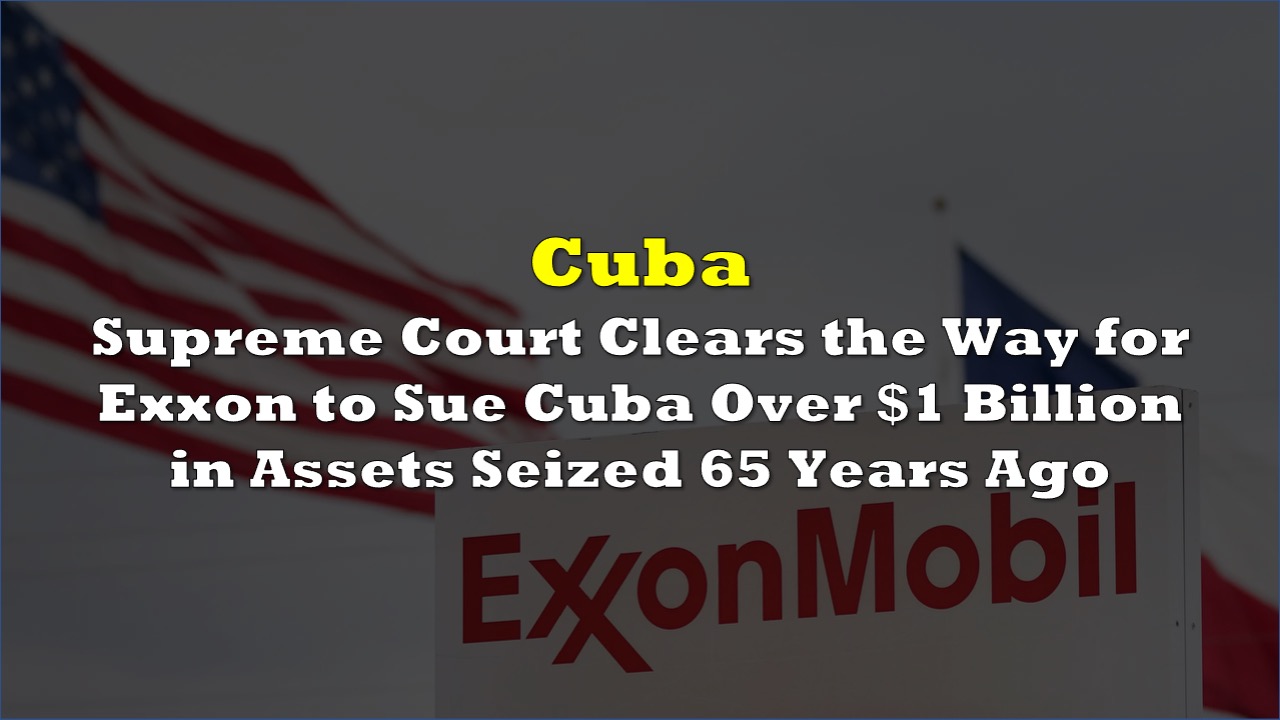

The Supreme Court ruled Tuesday that ExxonMobil can proceed with a lawsuit seeking more than $1 billion in compensation for oil refineries, terminals, and service stations seized by Fidel Castro’s government in 1960 — stripping Cuban state-owned companies of the sovereign immunity defense they had used for years to block litigation in American courts.
In a 6-3 decision split along ideological lines, Justice Brett Kavanaugh wrote that the Helms-Burton Act of 1996 itself cancels the sovereign immunity that Cuba’s state-owned companies would normally hold, and that companies suing under the law do not need to separately satisfy the requirements of the Foreign Sovereign Immunities Act of 1976.
Requiring plaintiffs to clear both hurdles, Kavanaugh wrote, would mean Helms-Burton suits would “largely be nonstarters.” The three liberal justices dissented. Justice Elena Kagan, writing for that minority, argued that “nothing in the text or ‘architecture’ of the Helms-Burton Act” supports eliminating sovereign immunity protections with the clarity Congress must demonstrate.
 Sponsored · Altamira Gold Corp.
The case goes back to the lower court for deliberations on CIMEX‘s potential liability. Corporación CIMEX — Cuba’s largest state-owned conglomerate — has operated the expropriated assets since Castro nationalized them.
ExxonMobil’s corporate predecessor, Standard Oil of New Jersey, lost an oil refinery, terminals, packaging plants, and more than 100 service stations to Cuba’s nationalizations in 1960. The certified value at the time was approximately $70 million. With six decades of prejudgment interest and the treble damages provision written into the Helms-Burton Act, the total claim now exceeds $1 billion.
The Helms-Burton Act, formally the Cuban Liberty and Democratic Solidarity Act, was passed in 1996 after Cuba shot down two unarmed planes flown by the Brothers to the Rescue humanitarian organization. Title III gave US nationals a private right of action against anyone “trafficking” in their confiscated Cuban property.
Three consecutive presidents — Clinton, Bush, and Obama — suspended that provision to avoid straining relationships with European and Canadian allies who had made substantial investments in Cuba. Trump lifted the suspension in 2019. ExxonMobil filed suit the same day.
 Sponsored · Cambria Gold Mines
Tuesday’s ruling was one of two Helms-Burton decisions the Supreme Court issued this term; a separate ruling last month found companies could be held liable for using confiscated property.
The decision clears a path for a significant body of pending litigation. When Trump activated Title III in 2019, approximately 40 similar cases flooded American courts; most foundered on jurisdictional grounds that this ruling now eliminates. US nationals hold billions of dollars in certified claims against Cuba for property seized during the revolution — claims that previously had no viable route through the federal court system.
On the same day, Secretary of State Marco Rubio announced new sanctions targeting additional entities within GAESA — the Cuban military conglomerate that controls most of the island’s tourism, trade, and hard currency income — as well as entities responsible for exploiting Cuba’s mineral and metal reserves.
Rubio warned that foreign banks and companies providing services to the newly designated entities should “freeze those activities immediately” or risk facing sanctions themselves.
Cuba’s Communist Party approved sweeping free-market reforms on June 18 — the most significant economic opening since the revolution, explicitly modelled on China and Vietnam — under sustained pressure from Washington that included a fuel blockade in effect since January. The Supreme Court’s ruling and Rubio’s new sanctions arrived six days later.
Read: What Cuba’s Free-Market Reforms Actually Mean