
The Supreme Court did more than block one of Donald Trump’s most aggressive immigration orders. It forced the president’s birthright citizenship fight back onto the same constitutional ground that helped define generations of American families, including families built through immigration like his own.
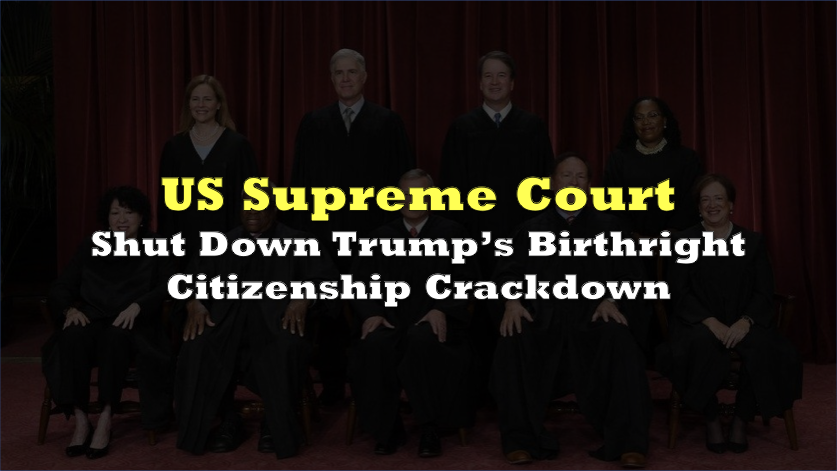
In a 6-3 ruling on Tuesday, the Supreme Court rejected President Donald Trump’s executive order that directed federal agencies not to recognize citizenship for certain children born in the US. Reuters reported that the justices upheld a lower court decision blocking the order, which targeted children whose parents were neither US citizens nor lawful permanent residents.
Chief Justice John Roberts wrote for the majority, grounding the decision in the 14th Amendment and the 1898 Supreme Court precedent United States v. Wong Kim Ark. The ruling reaffirmed that children born on US soil are citizens in nearly all cases, with narrow exceptions such as children of foreign diplomats or members of an enemy occupying force.
 Sponsored · PTX Metals Inc.
That made the decision a direct hit to Trump’s legal theory. His order argued that children were not automatically citizens if their mother was unlawfully present in the US and their father was not a US citizen or green card holder, or if their mother was in the country temporarily on a visa and the father also lacked citizenship or permanent residency. The White House order framed citizenship as a “priceless and profound gift,” but then tried to narrow who could receive it at birth.
READ: Trump Lashes Out at Supreme Court in 1AM Rant Over Birthright Citizenship Battle
The administration’s legal position tried to move citizenship away from place of birth and toward parental status. During arguments, Solicitor General D. John Sauer argued that birthright citizenship encouraged illegal immigration and diminished the value of citizenship, according to AP. Reuters reported that Sauer also cited “birth tourism,” while conceding that “no one knows for sure” how large the issue is.
The challengers framed the order as a direct conflict with the text of the 14th Amendment, federal law, and Wong Kim Ark. The court sided with that view.
 Sponsored · Selkirk Copper Mines
The court’s answer was effectively that the president cannot redraw the Citizenship Clause by executive instruction. Roberts wrote that there was “scant evidence” for the administration’s revisionist reading, according to Reuters.
AP reported that the justices relied on the long-settled understanding of the amendment and federal statutes in ruling that anyone born in the country is a citizen, with limited exceptions.
He also wrote that if Congress meant to limit citizenship to children of people domiciled in the US, that limitation was not reflected in the clause’s language.
Trump’s order had already been blocked by lower courts and had not taken effect anywhere in the country, according to AP. But Reuters reported that experts estimated the directive could have affected the legal status of as many as 250,000 babies born each year and forced millions of families to document newborn citizenship status.
The deeper political tension is harder for Trump to escape. He has spent years attacking birthright citizenship as a magnet for illegal immigration and “birth tourism,” yet his own public biography is inseparable from immigrant family history. Trump was born in Queens in 1946. His mother, Mary Anne MacLeod Trump, immigrated from Scotland and became a naturalized US citizen before his birth, while his father, Fred Trump, was a US citizen born in New York to German-born parents.
All five of Trump’s children were born to at least one US-citizen parent and were born in the US. Trump’s first three children with Ivana Trump were citizens because Trump was a US citizen, even though Ivana did not become a citizen until 1988.
Politically, the decision lands at an awkward moment for Trump’s broader executive-power project. The same Supreme Court term has included rulings that expanded presidential control over federal agencies, but birthright citizenship marked a limit.
This is also the second major loss of Trump’s Republicans in recent Supreme Court rulings. In a recent ruling on late-arriving mail ballots, the court upheld Mississippi’s law allowing ballots postmarked by Election Day to be counted if they arrive within five business days. Trump appointee Justice Amy Coney Barrett wrote the 5-4 majority opinion, to which Roberts sided.