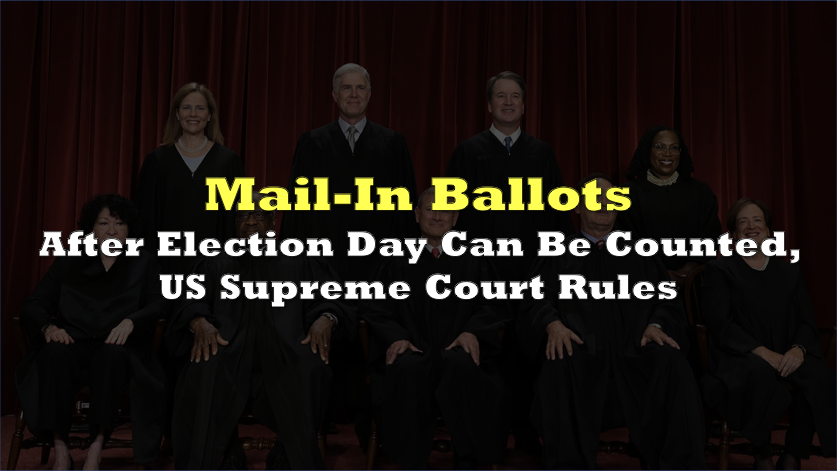

The US Supreme Court has kept a narrow but politically explosive category of mail ballots in play, ruling 5-4 that federal law does not force states to throw out ballots postmarked by Election Day simply because they arrive later.
The decision in Watson v. Republican National Committee reversed the US Court of Appeals for the Fifth Circuit and upheld Mississippi’s rule allowing absentee ballots to be counted if they are postmarked by Election Day and received within five business days. The case asked whether federal statutes setting a single Election Day for federal races preempt state laws that count ballots mailed on time but delivered afterward.
Justice Amy Coney Barrett wrote the majority opinion, joined by Chief Justice John Roberts and Justices Sonia Sotomayor, Elena Kagan, and Ketanji Brown Jackson, according to Reuters. Justices Samuel Alito, Clarence Thomas, Neil Gorsuch, and Brett Kavanaugh dissented.
The Republican National Committee initially argued that an election is not complete until ballots are received, making post-Election Day receipt deadlines incompatible with federal law. Mississippi defended the law as a rule for counting ballots already cast by the federal deadline.
 Sponsored · Cambria Gold Mines
That distinction carried the case. The court’s majority treated Election Day as the deadline for voter action, not the last possible moment for election offices to physically possess every ballot.
In practical terms, the voter’s legal act is mailing or submitting the ballot on time. The postal system’s delay does not retroactively make the vote late.
Mississippi’s law was not a blue-state innovation. The state enacted the postmark rule in 2020, and its absentee voting system remains limited compared with broader vote-by-mail states. Reuters noted that Mississippi absentee voting is available only to select groups, including older voters and voters with disabilities.
The Fifth Circuit had taken the opposite view in October 2024, holding that federal Election Day statutes required ballots to be both cast and received by Election Day. The Supreme Court docket shows Mississippi Secretary of State Michael Watson sought review in June 2025, with the Court granting the petition in November 2025 and hearing argument on March 23, 2026.
The Justice Department, under the Trump administration, backed the RNC’s position in a February 2026 amicus brief, arguing that federal law designates a single day for federal elections and that states should not count ballots received afterward in those races. The Court’s ruling rejects that federal position.
The political effect is still national. The Guardian reported that the ruling preserves similar grace-period laws across 14 states, Washington, DC, and three US territories. In the 2024 general election, it is reported that more than 750,000 mail ballots were cast on time but arrived after Election Day in states with grace periods.
AP reporting described the affected universe more broadly, saying the decision protects laws in more than half the states or about 30 states and Washington, DC, when rules for military and overseas voters are included.
The decision is a defeat for the RNC and Trump-aligned efforts to tighten mail-ballot deadlines before the 2026 midterm elections. It also prevents an immediate administrative scramble in states that would have had to rewrite ballot instructions, voter education materials, canvassing procedures, and military or overseas voting guidance months before federal contests.
The case also produced an unusual alignment. Barrett and Roberts joined the three liberal justices to preserve state flexibility, while four conservatives sided with the challengers’ stricter Election Day reading.