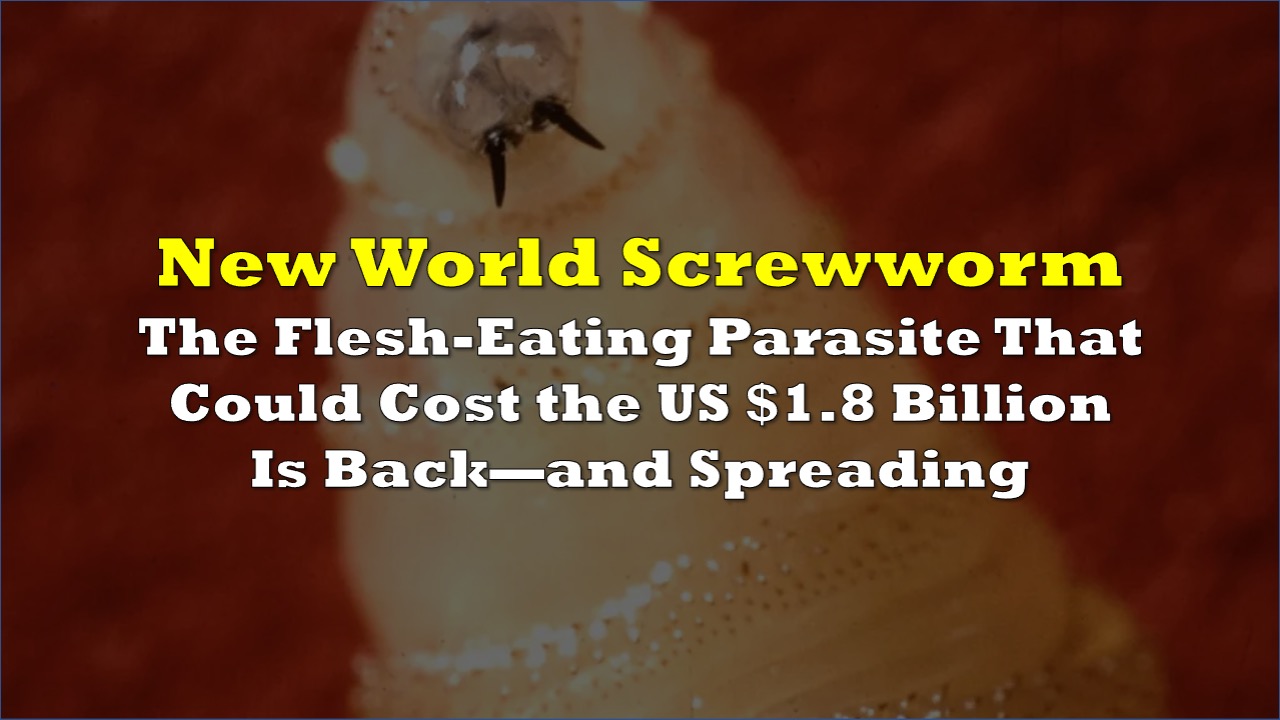

A parasite the US spent decades and tens of millions of dollars to eradicate is back — and no longer confined to a single state. Here is what it is, what it does, and why five confirmed cases in Texas and New Mexico are cause for serious concern.
What is it?
New World screwworm (Cochliomyia hominivorax) is a parasitic fly whose females lay eggs in open wounds on warm-blooded animals. The larvae do not feed on dead tissue — they burrow into living flesh, spiraling inward, causing deep wounds that can kill a full-grown cow in under ten days if untreated. Livestock, pets, wildlife, and, in rare cases, humans are all susceptible. The parasite poses no food safety risk — it does not infest processed meat — but it devastates the living animals that produce it.
The US beat this once
The US eradicated NWS in 1966 — a landmark achievement that used the sterile insect technique, flooding the fly’s territory with lab-bred sterile males to collapse reproduction over successive generations. Before eradication, US producers lost between $50 million and $100 million annually to the pest. The program succeeded and held for decades.
 Sponsored · Altamira Gold Corp.
A brief re-emergence hit the Florida Keys in 2016, affecting only an endangered deer population, and was eradicated by March 2017 before reaching livestock.
The current situation is different. NWS has been advancing northward through Central America and Mexico since 2023, and as of June 8, USDA confirmed its fifth US case in six days — the first in New Mexico, the first time in this outbreak the parasite has crossed a state line.
The economic stakes
A USDA estimate puts potential losses to the Texas economy alone at $1.8 billion in the event of a full outbreak, with per-head livestock impact reaching $452 in today’s dollars. The National Cattlemen’s Beef Association has framed the math directly: investing $300 million in containment now could prevent $8 billion in future eradication costs. Texas A&M research calculates that freedom from the pest generates roughly $1 billion in direct annual benefits to livestock producers and $3.7 billion to the broader economy.
That math lands on an already stressed industry. US beef prices hit a national average of $7.85 per pound for ground beef in February 2026, and the US cattle herd sits at its lowest level in 75 years. An established screwworm outbreak would tighten supplies further and push prices higher at a time when consumers are already absorbing record costs. Tyson Foods (NYSE: TSN), which has reportedly projected an adjusted operating loss of up to $600 million for its beef segment in fiscal 2026, has cited supply disruptions linked to screwworm-related import restrictions on Mexican cattle as a contributing factor.
 Sponsored · Canadian Copper Inc.
Human risk
Human infestations are rare but possible, particularly for people who work with livestock outdoors or have open wounds. The most recent US human case involved a traveler who returned from El Salvador in 2025 and recovered without further spread. USDA Secretary Brooke Rollins has described the current threat to human health as extremely low.
Why containment is hard
The sterile fly technique that beat NWS in 1966 requires massive production capacity. Current output sits at roughly 110 million flies per week from a facility in Panama — far short of the 400 to 500 million per week experts say is needed to control the active outbreak. USDA activated a sterile fly dispersal facility at Moore Air Base in Edinburg, Texas, with aerial flights beginning June 9.
A facility in Metapa, Mexico, expected to open in July 2026, will add another 60 to 100 million flies per week. A permanent facility in Edinburg is under construction and will not open until fall 2027.
In the meantime, USDA has established quarantine zones around all five confirmed cases, restricted animal movement in affected areas, and is investigating the Lea County, New Mexico dog’s travel history, which remains unknown.
The agency says it believes current detections are isolated — but with the outbreak still evolving and the production capacity gap unresolved, the window for containment is narrow.
Information for this story was found via the sources and companies mentioned. The author has no securities or affiliations related to the organizations discussed. Not a recommendation to buy or sell. Always do additional research and consult a professional before purchasing a security. The author holds no licenses.