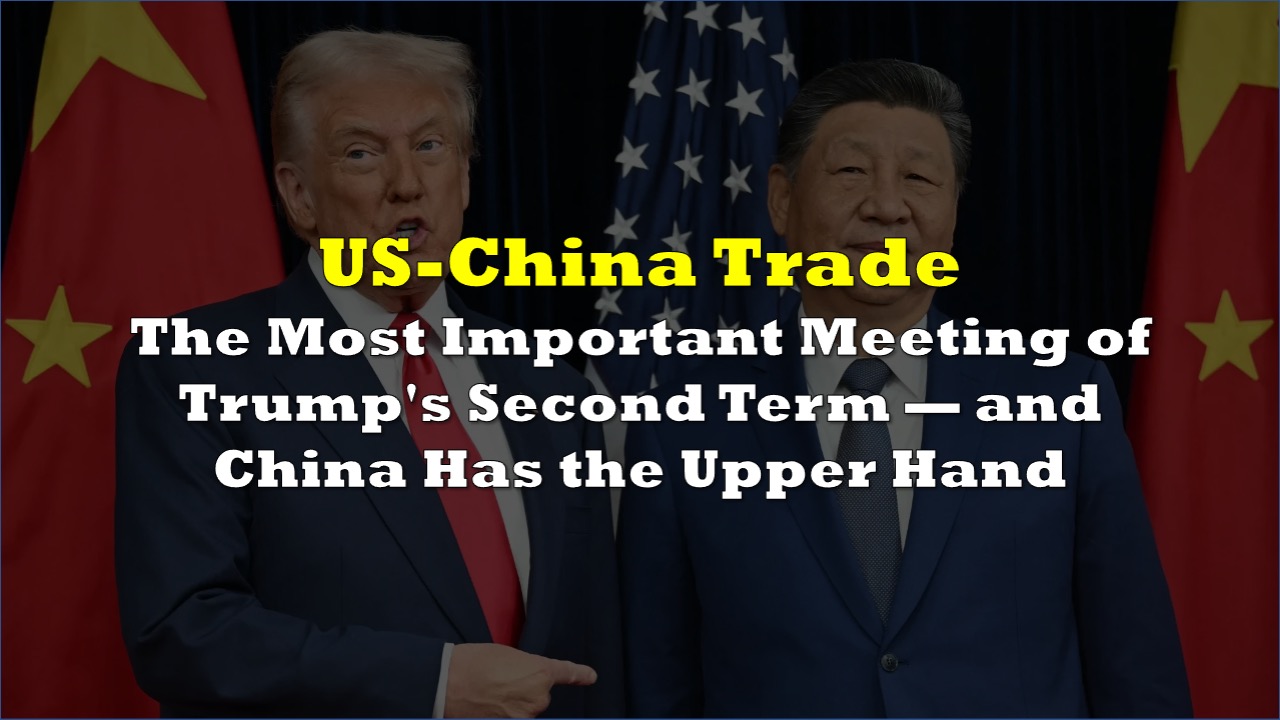

President Trump departed Washington on Tuesday for a two-day summit with President Xi Jinping, bringing the largest CEO delegation ever to accompany a sitting US president abroad — and arriving at a moment when China holds more leverage over the meeting than Washington does.
Trump is expected to land in Beijing on Wednesday evening, with bilateral meetings scheduled for Thursday and Friday. The White House confirmed more than a dozen executives are making the trip, including Tesla‘s Elon Musk, Apple’s Tim Cook, BlackRock‘s Larry Fink, Boeing‘s Kelly Ortberg, Blackstone‘s Stephen Schwarzman, Citigroup‘s Jane Fraser, Goldman Sachs‘s David Solomon, Micron‘s Sanjay Mehrotra, and Qualcomm‘s Cristiano Amon.
Trump said “many other” undisclosed CEOs are also attending. NVIDIA‘s Jensen Huang, who said last week it “would be a great honor to represent the United States” if invited, is not on the confirmed list. Eric Trump and Lara Trump are accompanying the president in a personal capacity — Reuters flagged a potential conflict of interest given Eric manages Trump’s personal wealth and business dealings.
 Sponsored · Selkirk Copper Mines
The Iran war pushed a late-March summit back by six weeks — and shifted the balance of power in the room. When the meeting was first planned, the Trump administration had just launched Operation Epic Fury and was projecting a four-to-six-week campaign. The war is now in its eleventh week. The Strait of Hormuz remains effectively sealed. Gas prices averaged $4.50 a gallon Tuesday, up more than 28% from a year ago.
“The war in Iran has given President Xi sources of leverage that he would not have anticipated having at the beginning of this year,” said Ali Wyne of the International Crisis Group.
Trump sent conflicting signals before departing. He told reporters he would be talking with Xi about trade “more than anything else” — then said “I don’t think we need any help with Iran” and declared the US would win the war “one way or the other,” even as officials confirmed Iran would be a central topic.
“It is remarkable that President Trump is prepared to go to China under these circumstances,” said Kurt Campbell, chair of The Asia Group and a former Biden administration China adviser. “But may I also say that it’s also deeply unusual that China is prepared to host him.”
 Sponsored · Silver47 Exploration Inc.
Related: Iran Turns to Beijing as China Positions Itself Between Tehran and Trump
The state-run China Daily placed the Trump-Xi summit as a sidebar Wednesday morning — below a banner headline on Sino-Tajik relations, with the subhead: “Xi navigates China-US relations amid global uncertainty.”
A Council on Foreign Relations analysis found Xi “likely to project calm confidence,” his objective “not confrontation but control.” His approach, as one analyst put it, is to steady the ship at home while waiting for the storm abroad to pass.
Trump’s primary asks: Chinese pressure on Iran to reopen the Strait, purchase commitments for US soybeans and Boeing aircraft, and progress on rare-earth supply.
Xi’s primary asks: stability on Taiwan, a rollback of AI chip export restrictions, and bilateral trade and investment “boards” to manage disputes. On Taiwan arms sales and chip controls, analysts across CSIS, Heritage, and the Council on Foreign Relations say substantive agreement is unlikely.
Apple manufactures the vast majority of its products in China and has been pressing for tariff exemptions. Boeing needs Chinese aircraft orders to stabilize its production line. Qualcomm and Micron sell critical chips into the Chinese market and face retaliatory exposure. These are not executives who want confrontation — they are executives who need access. Their presence signals what the administration actually wants: deals, purchases, and enough stability to let US multinationals breathe.
China accounts for roughly 90% of Iran’s exported oil and was credited with helping push Tehran toward the initial ceasefire. Beijing has also made its position on sanctions enforcement explicit: on May 4, China’s Ministry of Commerce issued a formal blocking order prohibiting five Chinese oil refineries from complying with US sanctions on Iranian crude purchases — the first time Beijing has invoked its blocking statute against Washington.
The order covers major independent refiners, including Hengli Petrochemical and Shandong-based teapot refineries that together process a significant share of Iran’s exported oil.
Trump told reporters before departure: “Great things will happen for both countries.” Xi has so far said nothing.
Information for this story was found via the sources and companies mentioned. The author has no securities or affiliations related to the organizations discussed. Not a recommendation to buy or sell. Always do additional research and consult a professional before purchasing a security. The author holds no licenses.