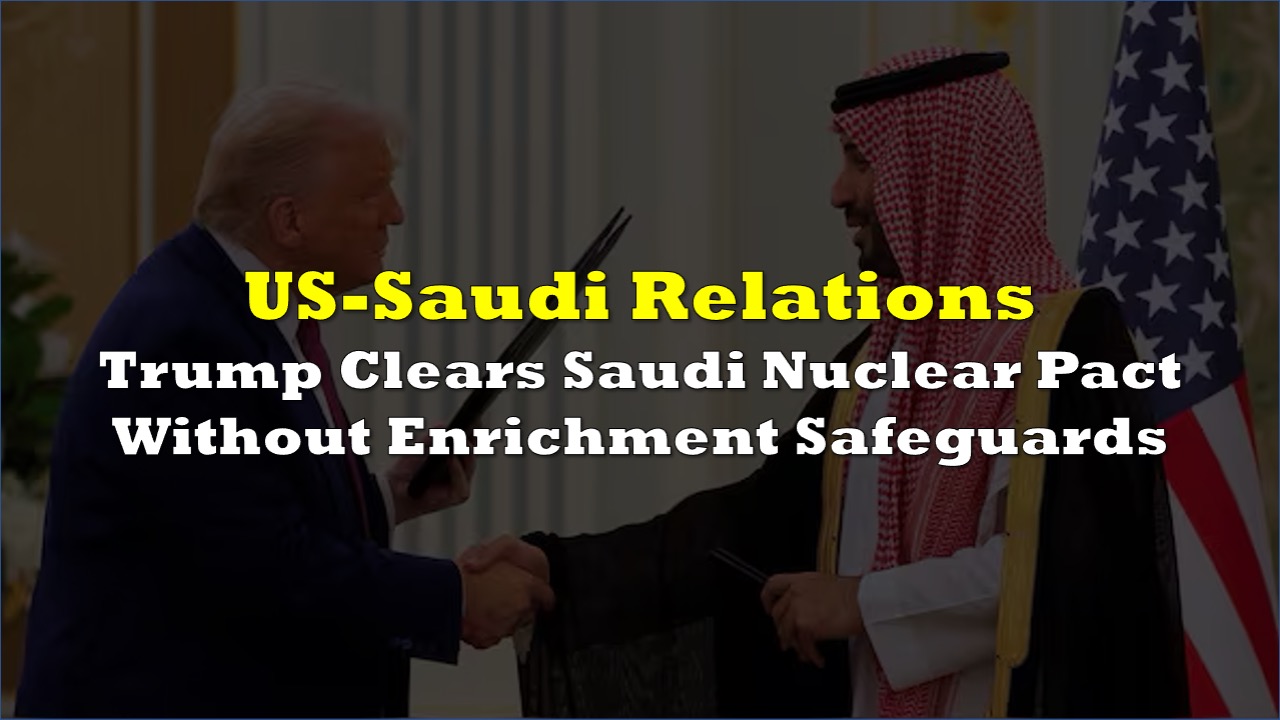

President Donald Trump has signed off on a nuclear cooperation pact with Saudi Arabia, a step that could let the kingdom enrich uranium as part of its civilian energy program, according to the Associated Press, citing people with direct knowledge of the matter. The sources, who spoke on condition of anonymity because the decision has not been made public, said an official announcement could come as soon as today.
Under terms described to the AP, the agreement would run three decades and bring US companies into the buildout of Saudi Arabia’s nuclear sector. A separate joint study between Washington and Riyadh is expected to determine whether an enrichment plant gets built on Saudi soil.
The agreement centers on what is known as a Section 123 agreement, the legal foundation the US requires before American companies or the government can share nuclear technology and material with a foreign partner. US Energy Secretary Chris Wright and Saudi Energy Minister Abdulaziz bin Salman are expected to formalize it, building on a preliminary declaration the two signed in Washington last November.
 Sponsored · Altamira Gold Corp.
The framework leaves out two guardrails Washington has used in past nuclear pacts. It skips the so-called Gold Standard, which would have barred Saudi Arabia outright from enriching uranium or reprocessing spent fuel, both considered stepping stones toward a weapon. It also bypasses the IAEA’s Additional Protocol, the mechanism that gives international inspectors authority to show up unannounced at undeclared sites. Monitoring would instead fall to a safeguards arrangement negotiated directly between the US and the kingdom.
One source told the Jerusalem Post that the pact creates a legal opening for cooperation across the fuel cycle, enrichment included, without automatically handing Saudi Arabia the technology itself. Any actual transfer of enrichment-related capability would still need separate approval.
The last country to sign a 123 agreement with the US, the United Arab Emirates, accepted the Gold Standard in 2009 in exchange for South Korean help building its Barakah nuclear plant. Saudi Arabia held out for enrichment rights instead.
Once a 123 agreement reaches Capitol Hill, lawmakers get roughly 90 days of continuous session to formally object before it takes effect automatically. Reports say the administration plans to submit the deal to Congress within days.
Having enrichment capability alone would not get a country to a bomb. Turning enriched material into a working weapon takes additional technical hurdles, among them precision-timed conventional explosives. Still, enrichment is widely viewed as the critical first step toward weaponization, which explains why Iran’s program has drawn sustained Western scrutiny for years.
Most countries with civilian nuclear reactors buy enriched fuel from outside vendors rather than producing it domestically. Saudi Crown Prince Mohammed bin Salman has said repeatedly, including in a 2018 interview, that the kingdom would pursue a nuclear weapon if Iran built one first.
The approval also comes as regional alliances continue to shift. Last year, Saudi Arabia struck a mutual defense pact with Pakistan, itself a nuclear power, following Israel’s strike on Hamas officials in Qatar. Islamabad’s defense minister followed up by saying Pakistan’s nuclear arsenal “will be made available” to Saudi Arabia if the need arose, a line many read as a message aimed at Israel, long the only acknowledged nuclear power in the Middle East.