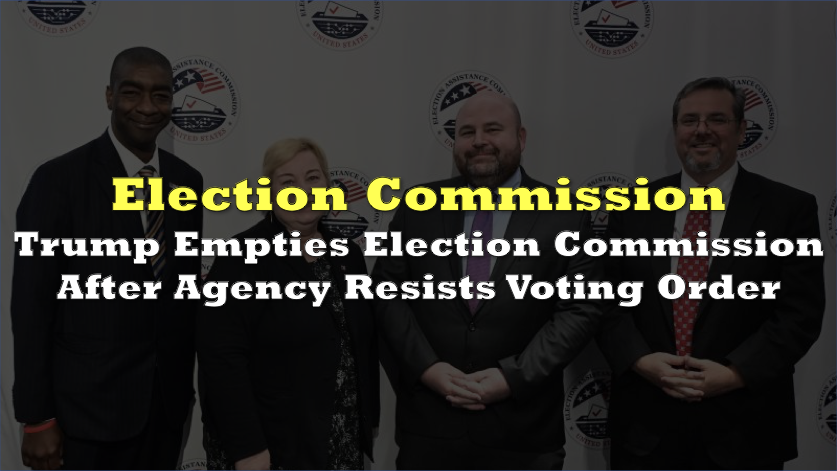

President Donald Trump has left the federal government’s bipartisan election-support agency with no commissioners, creating an institutional dead zone four months before the November midterms.
The recent shake-up removed the Election Assistance Commission’s two Democratic members, Thomas Hicks and Benjamin Hovland. Its remaining Republican member, Christy McCormick, resigned. A second Republican commissioner, Donald Palmer, had already stepped down on April 29.
All three departing commissioners had been confirmed unanimously by the Senate. Their exits leave every seat vacant at an agency designed by Congress to maintain an equal two-to-two partisan split.
 Sponsored · Mercado Minerals Ltd.
Trump has disabled the commission’s political leadership at the point where federal election policy, voting technology, and his administration’s push for tighter registration rules intersect.
Reuters reported that Hicks and Hovland received termination notices from the White House Presidential Personnel Office. McCormick was permitted to resign, according to reporting subsequently confirmed by the administration.
“On behalf of President Donald J. Trump, I am writing to inform you that your position as Commissioner of the Election Assistance Commission is terminated, effective immediately,” the email reviewed by Reuters said.
The White House said the president had authority to remove commissioners who might not be “totally aligned” with his election-security agenda.
 Sponsored · Cambria Gold Mines
“The President, and head of the Executive Branch, reserves the right to remove individuals that may not be totally aligned with the important task of securing America’s elections and ensuring every legal vote is counted,” the administration said.
That language is significant because the EAC was not built as an arm of a president’s election platform. Congress established it through the Help America Vote Act of 2002 as a bipartisan, independent body following the administrative failures exposed by the 2000 presidential election.
The agency accredits laboratories that test voting equipment, certifies voting systems against federal standards, distributes election grants, gathers nationwide election data, and maintains the National Mail Voter Registration Form.
Official commission business or policy requires affirmative votes from at least three commissioners. With zero members, career employees may continue routine functions, but the agency cannot take actions requiring commission approval.
The commissioners’ removal followed a confrontation over Trump’s attempt to rewrite federal voter-registration and mail-voting procedures. Trump’s March 31 executive order directed federal agencies to expand citizenship verification and impose additional controls on voting through the mail. The order argued that Social Security Administration records and the Department of Homeland Security’s SAVE database could be used to verify voter eligibility.
The EAC had previously declined to modify the national registration form to require applicants to submit documentary proof of citizenship, according to AP News. The existing form requires applicants to attest that they are US citizens and warns that false registration claims are illegal.
A federal judge blocked the administration’s attempt to force the change, finding that the president had exceeded his authority because the Constitution assigns substantial power over federal election rules to Congress and the states. The administration has indicated that it will appeal.
The administration cited the Supreme Court’s June 29 ruling in Trump v. Slaughter, which expanded the president’s ability to dismiss leaders of independent executive agencies.
The court ruled 6–3 that statutory restrictions could not prevent Trump from removing Federal Trade Commission Commissioner Rebecca Slaughter without cause. The majority concluded that executive officials exercising substantial federal authority must remain accountable to the president.
The decision weakened a nearly century-old precedent that had protected certain independent commissioners from removal based solely on political disagreement.
Trump moved against the EAC’s remaining commissioners 10 days later.
The Associated Press reported that the vacancy could prevent the agency from authorizing new grants and complicate oversight of voting-system testing and certification. It also concluded that the departures are unlikely to produce major immediate effects on the November midterms because election preparation is already largely in the hands of state and local officials.
Sen. Mark Warner said removing the commission’s remaining members “just months before the 2026 midterm elections” demanded an immediate explanation and raised serious questions about interference in election-support institutions. Sen. Alex Padilla and Rep. Joe Morelle accused Trump of dismantling an independent democratic guardrail and politicizing support for state and local election administrators.
The November election may proceed with little visible disruption. The longer-term consequence is that a bipartisan institution intended to build confidence in election administration has itself become another contested instrument of presidential authority.