
President Donald Trump’s latest financial disclosure does not read like a conventional billionaire-politician filing. It reads like a before-and-after chart for the monetization of political celebrity in the crypto era.
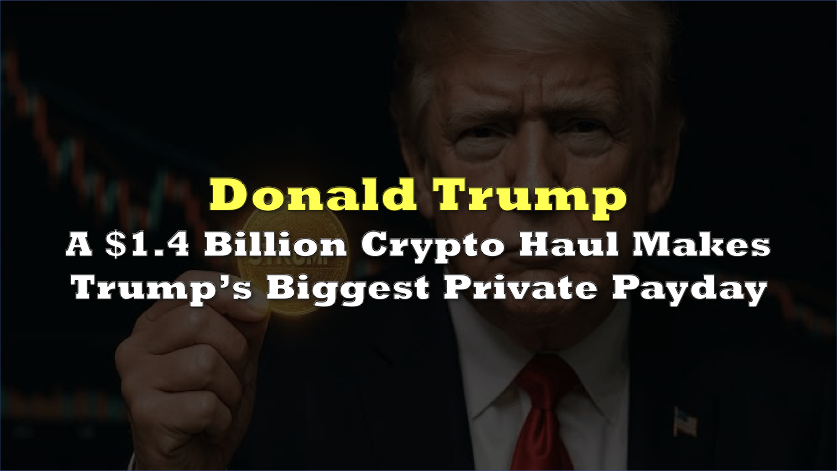
Trump reported more than $1.4 billion in income from crypto ventures in 2025, according to Reuters’ review of his annual disclosure. That dwarfed the private income profile of Vice President JD Vance, whose own report showed a still-lucrative but far more traditional mix of book royalties, venture-capital interests, ETFs, real estate, and Bitcoin.
The strategic tension is not simply that Trump made a lot of money. It is that the biggest income category now sits inside an industry his administration has aggressively moved to legitimize, regulate favorably and bring closer to the financial mainstream. The White House has promoted stablecoin regulation, digital asset banking access, tax changes and a broader policy push to make the US a leader in crypto finance.
 Sponsored · Altamira Gold Corp.
The Office of Government Ethics lists both Trump’s and Vance’s certified annual financial disclosure reports as available documents. Trump’s filing runs 927 pages. Vance’s runs 17. That page-count gap is the most low-tech way to understand the wealth gap.
The crypto mine
Trump’s filing shows CIC Digital LLC, described as receiving license fees for NFTs and meme coins, held a US bank account, cold wallets for virtual USD, USDC, Ethereum and Bitcoin, and reported a Bitcoin wallet valued at more than $50 million. It also reported $45,932 in USDC interest, $510,808 in Ethereum staking validator rewards and $635.1 million in royalties from a license agreement with Celebration Coins.
World Liberty Financial is the second major crypto pillar. Trump’s filing lists DT Marks Defi LLC as holding a 38.25% ownership interest in WLF Holdco LLC. The same page reports $65.6 million in net proceeds from an equity sale in WLF Holdco and $236.3 million in net proceeds from token sales distributed by World Liberty Financial LLC. It also lists additional token-sale proceeds distributed into crypto wallets, including $42.3 million in virtual USD, $56.0 million in USDC, $150.6 million in Ethereum and $33.5 million in Bitcoin.
A following page adds more World Liberty-related token-sale proceeds tied to AAVE, ENA, MOVE and ONDO wallets. It also lists 15.75 billion World Liberty Financial governance tokens held through a virtual Ethereum key, valued at more than $50 million, with no reported income from that line.
 Sponsored · Cambria Gold Mines
Reuters reported that Trump’s companies received almost $800 million from World Liberty Financial, including more than $520 million from crypto token sales and more than $250 million from the sale of interests in the business. It also reported another $635 million from Trump meme coin sales.
Trump’s real estate, golf and licensing empire still generated major money, but now sits as a side pot. Reuters reported more than $500 million in 2025 revenue from golf and resort facilities, including $77 million from Mar-a-Lago, up from $50 million in 2024.
The filing also shows large legacy assets and operating businesses, including 40 Wall Street LLC with rent income listed above $5 million and 401 North Wabash Venture LLC with hotel-related revenue of $38.5 million.
Trump Media & Technology Group also remains in the disclosure picture. The filing says Trump’s equity interest in TMTG converted into the post-merger entity after the March 2024 merger with Digital World Acquisition Corp., and that 114.75 million shares were transferred to the Donald J. Trump Revocable Trust in December 2024.
Vance’s wealth by comparison
Vance’s disclosure is rich, but in a different register. It shows JD Vance Enterprises LLC, a Huntington National Bank cash account valued between $1 million and $5 million, a Narya Capital Fund I stake valued between $500,001 and $1 million, and income from Rise of the Rest Seed Fund LP listed between $100,001 and $1 million.
His biggest public-facing income engine remains “Hillbilly Elegy.” The filing lists HarperCollins royalties from the memoir at $1 million to $5 million, paid through William Morris Endeavor to JD Vance Enterprises LLC. It also lists smaller foreign publishing advances and royalties from multiple international publishers.
Vance also disclosed a Coinbase account holding Bitcoin valued between $250,001 and $500,000, a Washington, DC residential property valued between $500,001 and $1 million with $15,001 to $50,000 in rental income, and a Narya Capital Management promissory note valued between $500,001 and $1 million with $100,001 to $1 million in interest income.
His trading activity was also sizable but conventional. The disclosure lists June 27, 2025 purchases of Invesco QQQ Trust, SPDR Dow Jones Industrial Average ETF and SPDR S&P 500 ETF, with each of the latter two purchases ranging from $500,001 to $1 million. It also lists a January 16, 2025 sale of Rise of the Rest Seed Fund LP worth $100,001 to $250,000.
Policy conflict
The White House rejected conflict-of-interest concerns. Reuters quoted spokesperson Anna Kelly saying neither Trump nor his family has engaged or will engage in conflicts of interest, and that Trump’s crypto actions were taken in the public interest.
The disclosure itself says Trump’s report was reviewed and found compliant with applicable laws and regulations, subject to comments. Those comments include the 45-day extension and late filing fees related to previously unreported transactions.
That legal compliance point is not the same as a political clean bill of health. Presidents and vice presidents are treated differently from many executive branch employees under federal conflict rules. Reuters cited Don Fox, a former acting head of the federal ethics office, saying presidents and vice presidents are exempt from ethics laws that bar conflicts for executive branch employees, while arguing that the current structure strengthens the case for reform.
Vance’s report raises less dramatic policy exposure, but it still places the vice president in markets affected by administration decisions. His holdings include major index ETFs, Bitcoin, gold exposure through SPDR Gold Trust and venture-capital-linked interests.
A sitting president, and to an extent, sitting vice president, whose largest reported private income stream now comes from tokens, wallets, staking rewards and branded crypto products operating in a policy environment his administration is reshaping in real time.