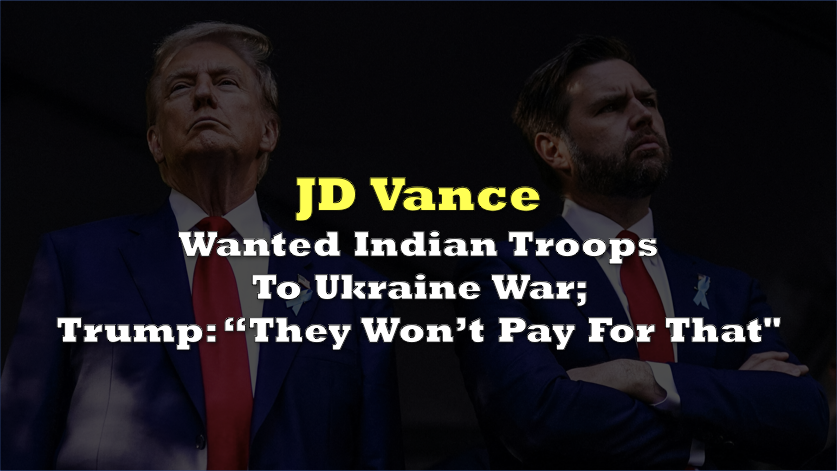

A new account from Regime Change, the book by New York Times reporters Maggie Haberman and Jonathan Swan, says Vice President JD Vance floated India and Saudi Arabia as possible non-European contributors to a postwar Ukraine security force. President Donald Trump reportedly laughed off the idea, saying India would not pay for such a mission, according to Hindustan Times’ report on the book.
According to the book excerpt circulated online and reported by Hindustan Times, envoy Keith Kellogg discussed the need for an “Article 5 exemption,” meaning Ukraine’s security arrangement could not function as a NATO mission. Article 5 is NATO’s collective defense clause, under which an attack on one member is considered an attack on all members.
That legal and military constraint is the hinge of the story. The reported conversation suggests US officials were searching for a force that could reassure Kyiv without automatically making the alliance a direct party to the conflict.
 Sponsored · Cambria Gold Mines
Vance’s reported answer was to look outside Europe. India and Saudi Arabia were apparently named as possibilities. Trump’s reported answer was more revealing than diplomatic: he did not present India as a strategic partner ready to absorb risk. He presented it as a country unlikely to spend money on someone else’s war.
“Indians won’t do that,” Trump said, quoted in the book. “They won’t pay for something like that.”
The book says Trump was comfortable with British or French troops going into Ukraine, as long as the United States was not involved, according to Hindustan Times.
That is the key policy tension. Trump’s team wanted a Ukraine settlement with enforcement, but Trump reportedly wanted the enforcement to stop at the water’s edge of US responsibility.
 Sponsored · Silver47 Exploration Inc.
India was not a random name to raise in a security discussion. It has long been one of the world’s major contributors to UN peacekeeping. UN data tracks India among the largest contributors of uniformed personnel to UN operations, and a January 2025 UN ranking listed India fourth with 5,375 personnel.
But Ukraine would not be a normal peacekeeping file. A deployment there would place foreign troops in the center of Europe’s most dangerous active war, beside a nuclear-armed Russia, and inside a conflict where any mandate would likely be contested at the UN Security Council.
That is why India’s peacekeeping résumé does not translate cleanly into willingness to send troops to Ukraine. Reuters reported in October 2025 that Vishwesh Negi, a senior Indian defence ministry official, said it was “highly unlikely” that UN peacekeepers would be deployed in Ukraine or Gaza because of the Security Council’s composition.
India’s public position has also leaned toward mediation language, not military intervention. Modi has repeatedly emphasized peace and diplomacy in the Ukraine conflict. Reuters reported that Modi reaffirmed support for a peaceful resolution in a 2025 call with Zelenskyy, while Reuters also reported that Zelenskyy and Modi met at the G7 in June 2026 as Kyiv sought stronger ties with Global South countries.
That makes the reported Vance idea strategically understandable but politically hard to execute.
So, the quoted remark attributed to Trump will likely draw attention because of its language about India. But the deeper consequence is operational.
A Ukraine security guarantee needs four things: troops, money, command structure, and political consent. The reported exchange shows all four were unresolved.
A NATO mission would trigger escalation concerns. A US mission would clash with Trump’s preference to avoid American exposure. A Europe-led mission would depend heavily on Britain and France, whose role Russia has opposed. A non-European mission would require countries like India or Saudi Arabia to accept risk for a war they did not start and do not own.
The Trump-Vance split, as described in the book, therefore captures a familiar Washington move with a new cast: asking partners to underwrite a strategic objective that the US itself does not want to fully guarantee.
The reported exchange also sits awkwardly beside Vance’s own foreign-policy messaging. In May 2025, Vance said the US would not intervene in the India-Pakistan conflict, calling it outside America’s business, according to The Guardian.
The India troop discussion remains a book claim. If true, it breeds a deeper clash between Trump and his apparent successor.