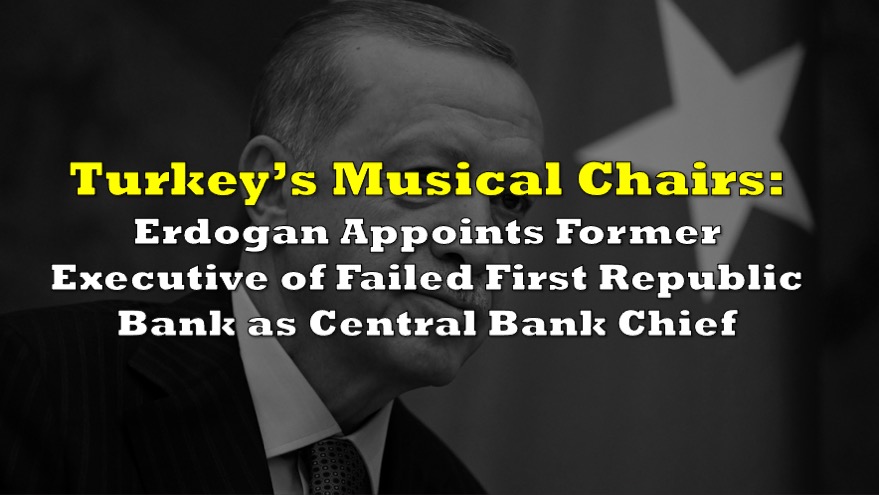

Turkey’s central bank became the country’s political shock absorber after a court ruling against the main opposition collided with fresh state moves over universities and local governments, forcing markets to price institutional risk before investors could finish pricing monetary policy.
The most visible cost was in currency defense. Reuters reported that traders estimated the central bank sold about $8 billion in foreign exchange after a Turkish court invalidated the Republican People’s Party’s 2023 congress, a ruling that removed Özgür Özel from the party leadership and restored former chairman Kemal Kılıçdaroğlu.
The lira did not collapse, but that stability was not free. Istanbul equities lost 6% before exchange safeguards paused trading, while dollar bonds also sold off, with some issues losing as much as 1.4 cents, according to Reuters.
 Sponsored · Selkirk Copper Mines
That is the strategic tension for Ankara. President Recep Tayyip Erdogan’s economic team has tried to sell investors on a return to policy discipline, but the market reaction showed that the country’s risk premium is still being driven by institutions outside the central bank.
The court ruling did more than reopen an internal fight at the CHP. It changed the market’s assumptions about how far legal pressure on Erdogan’s strongest political challengers can go.
The court cited irregularities in the CHP’s 2023 congress, while the party condemned the decision as a judicial attack. Reuters reported that the decision comes after a broader wave of cases and detentions involving opposition figures, including Istanbul Mayor Ekrem İmamoğlu, whom the CHP has named as its presidential candidate.
The government denies using the courts to weaken opponents.
 Sponsored · Altamira Gold Corp.
The political consequences are not cleanly separable from the financial ones. If the ruling deepens factional strain inside the CHP, it may alter the opposition’s route into the next presidential contest, scheduled for 2028 unless called earlier.
For investors, that means the election timetable is less important than the institutional process shaping who gets to compete.
Bilgi students
The same week’s institutional pressure reached beyond party politics. Istanbul Bilgi University, a major private university with about 22,000 students, lost the authorization it needs to operate after a decision published in the Official Gazette, Reuters reported.
The education disruption follows the state’s earlier takeover of assets linked to Can Holding, which Reuters said was tied to an investigation involving alleged money laundering, tax evasion, and organized crime. Bilgi was founded in 1996 and acquired by Can Holding in 2019.
The official action now creates a student-transfer problem as much as a legal one. Reuters reported that Turkish media said affected students would continue at Mimar Sinan Fine Arts University, Bilgi’s guarantor institution.
Local governments
Another decree tightened the operating space for municipalities. CNBC-E reported that a regulation published in the Official Gazette requires presidential permission before local administrations, local-government unions, affiliated entities, and companies under majority local-government ownership can create companies or cooperatives, acquire shares, join partnerships, or participate in capital increases.
The practical consequence is central approval over a wider set of local economic tools. That matters because municipalities are not only service providers. They manage procurement, infrastructure, utilities, transport, and local development vehicles.
The timing is politically loaded. The CHP’s strong showing in the 2024 local elections gave the opposition control of major municipal platforms. A rule requiring presidential approval for local corporate activity may limit how opposition-run cities expand operating capacity outside ordinary budget channels.
Turkey’s one-day shock therefore points to a larger investor problem: economic normalization can be interrupted by non-economic decisions. The central bank can spend reserves to steady the lira, but if courts, universities, and municipalities remain sources of surprise, markets will keep treating governance itself as the trade.
Information for this story was found via the sources and companies mentioned. The author has no securities or affiliations related to the organizations discussed. Not a recommendation to buy or sell. Always do additional research and consult a professional before purchasing a security. The author holds no licenses.