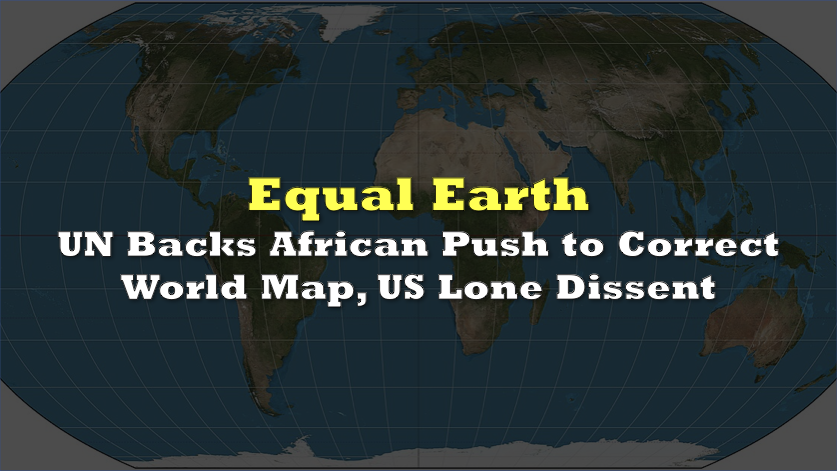

The US stood alone Friday against a UN General Assembly resolution that could reshape how the world is displayed in classrooms, media, and digital platforms, turning an African-led cartography campaign into a broader fight over whether map design carries political weight.
The “Correct the Map” resolution passed 164-1, with Estonia, Georgia, Lithuania, Moldova, Serbia, and Ukraine abstaining. The measure encourages governments, international organizations, schools, and technology companies to use Equal Earth and other equal-area projections when the comparative size of continents matters.
The target is the Mercator projection, created by Gerardus Mercator in 1569 for navigation. Mercator preserves angles and makes constant compass bearings easier to plot, but it increasingly enlarges landmasses farther from the equator. That makes regions including Greenland, northern Europe, Russia, and Canada appear disproportionately large relative to Africa and other lower-latitude regions.
 Sponsored · Selkirk Copper Mines
Equal Earth, developed in 2018 by cartographers Bojan Šavrič, Tom Patterson, and Bernhard Jenny, takes the opposite trade-off. It preserves relative area while accepting distortions in shape, direction, angle, and distance.
Togo introduced the resolution on behalf of the African Group after the African Union backed the campaign. Supporters linked the issue to education, historical representation, and what the resolution describes as “cognitive justice.”
“A fair map does not change the geography of the world, it changes how we see the world,” Togo Foreign Minister Robert Dussey said.
Washington rejected that framing. US representative Yaryna Ferencevych called the measure part of a “much larger and more radical ideological project,” arguing the General Assembly should instead focus on international peace, prosperity, and relations.
The vote does not make Equal Earth a mandatory UN world map. The resolution is nonbinding, does not ban Mercator, and does not alter borders. Several countries that voted yes also entered qualifications. India said its support should be read as backing equal-area methods generally, not endorsing one specific projection. Canada, Australia, New Zealand, the UK, and the Philippines separately stressed that the measure has no effect on sovereignty or territorial claims.