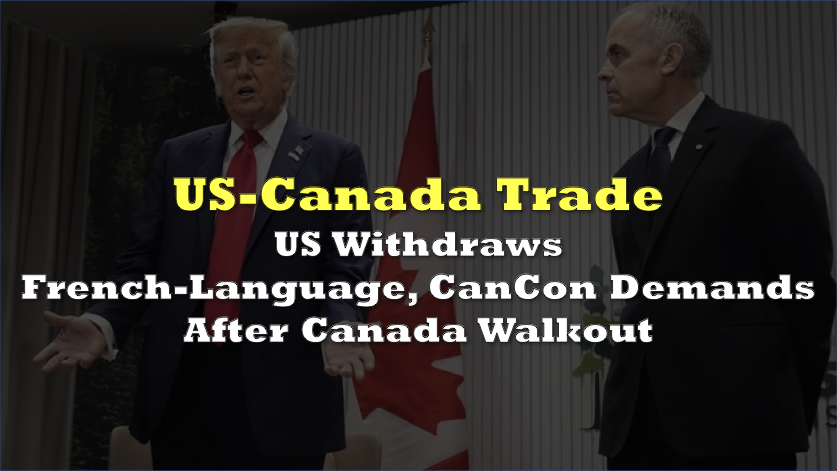

The US has backed away from two cultural demands Canada identified among the issues surrounding the collapse of trade negotiations, less than a week after Ottawa walked out of the talks and new 50% US tariffs took effect.
Canada-US Trade Minister Dominic LeBlanc said Thursday, Global News reports, that Washington is withdrawing its positions on content discoverability and labelling, while assuring Ottawa that measures supporting the French language and Canadian culture will not become targets of future US trade actions.
LeBlanc said Canada is waiting for further clarification on other US positions before a trade agreement that respects Canadian sovereignty becomes possible.
 Sponsored · Selkirk Copper Mines
The development removes two issues that had become unusually prominent in the political fallout from the failed negotiations.
Prime Minister Mark Carney said on August 22 that Canada had refused to compromise protections for French and Canadian culture even as the US continued pressing the issues through the final stage of negotiations.
“We were not prepared to compromise on the protection of the French language and our culture,” Carney said in his address announcing Canada’s withdrawal from talks. He described the final US proposal more broadly as economically unacceptable and said its cumulative demands raised concerns over Canadian sovereignty and the reliability of any agreement.
Carney subsequently identified Canadian-content discoverability on streaming services and French-language labelling requirements among the US objections, according to Canadian Press reporting.
 Sponsored · Altamira Gold Corp.
Washington disputes
On the other hand, US Trade Representative Jamieson Greer has rejected the suggestion that French-language protections caused the agreement to collapse.
In an August 26 CBC interview, Greer acknowledged that US negotiators had raised questions about Canada’s Online Streaming Act and Quebec’s French-language discoverability law, Bill 109, but described the matter as the “farthest thing from the redline.”
“There is no way we would let a good deal go by for something like this,” Greer said.
He also disputed Carney’s claim that Washington introduced new demands at the last minute.
President Donald Trump had gone further a day earlier, writing that he would “never interfere with Canadians speaking French” and accusing Carney of mischaracterizing the US position.
LeBlanc’s Thursday statement effectively treated Greer’s comments as a withdrawal of the US positions rather than simply a disagreement over how important they had been.
The rules remain
The discoverability dispute touches both federal and Quebec policy. Canada’s federal broadcasting regulator has been developing requirements under the Online Streaming Act that would govern how platforms make Canadian and Indigenous programming available and visible. Specific system-wide discoverability rules have not yet been finalized.
Quebec separately adopted Bill 109 in December 2025, creating a framework intended to increase the visibility and availability of original French-language cultural content on digital platforms. Regulations are still required to establish several of its specific obligations.
Canada also has federal requirements for information on many consumer products to appear in English and French. Quebec maintains stricter French-language rules affecting packaging, marketing, signage, and other commercial communications. It remains unclear which specific labelling provisions were addressed in the trade negotiations.
Tariffs remain
The shift on culture does not reverse the trade measures imposed after negotiations collapsed. The US put 50% tariffs on $27.60 billion of Canadian goods into effect on August 22.
Ottawa has also announced matching countermeasures covering $27.60 billion of US imports beginning September 8, concentrated in sectors including steel and aluminum, dairy, appliances, agricultural equipment, pulp and paper, plastics, and electronics.
A separate US threat to raise tariffs on Canadian-built cars, trucks, and auto parts to 50% beginning January 1, 2027 also remains outstanding.
Reuters reported Thursday that there is currently no open negotiating channel between the Trump administration and Ottawa. LeBlanc’s statement leaves the possibility of renewed talks open, but makes clear that Canada is seeking movement on the remaining US positions before returning to a deal.