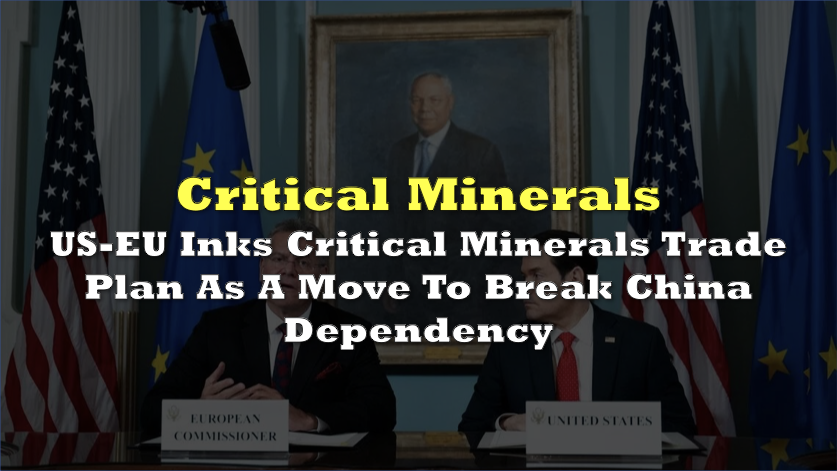

The US and EU are moving to coordinate trade policy, price support, stockpiling, standards, and investment screening for critical minerals, marking one of the clearest transatlantic attempts yet to reduce reliance on China-controlled supply chains.
US Secretary of State Marco Rubio and EU Trade Commissioner Maroš Šefčovič signed a memorandum of understanding in Washington, while US Trade Representative Jamieson Greer announced a separate US-EU Action Plan for Critical Minerals Supply Chain Resilience. The plan is designed to become the “primary US-EU mechanism” for coordinating critical minerals policy, with the longer-term goal of a binding plurilateral trade agreement with like-minded partners.
The action plan does not name China directly, but its target is obvious: supply chains shaped by “pervasive non-market policies and practices” that have left market-oriented economies vulnerable to disruption and economic coercion. Critical minerals are central to semiconductors, electric vehicles, advanced weapons, batteries, and other industrial technologies.
 Sponsored · Selkirk Copper Mines
“The over-concentration of these resources, the fact that they’re dominated by one or two places, is an unacceptable risk,” Rubio said before signing the memorandum. He said the US and EU together represent “the largest customers and users” of critical minerals, giving the two sides market weight if they coordinate policy rather than compete piecemeal.
Price floors, subsidies, and stockpiles
The most market-moving element is the plan to explore coordinated trade measures based on reference prices, including border-adjusted price floors, standards-based markets, price gap subsidies, and offtake agreements. In practice, that means Washington and Brussels are looking at mechanisms that could shield allied producers from being undercut by cheaper exports, while giving investors more predictable pricing for mines, processing, recycling, and downstream manufacturing.
Greer said the US and EU share a commitment to addressing “non-market policies and practices” that have distorted critical minerals supply chains, adding that border-adjusted price floors could strengthen domestic minerals industries and downstream sectors critical to industrial competitiveness. That is a notable shift for a Trump administration that often attacks the EU politically, but is now using Brussels as a partner in a strategic industrial bloc.
The plan also calls for cooperation on standards for mining, processing, recycling, and trade in critical minerals. It includes technical and regulatory cooperation, investment promotion and screening, research and development, and coordinated rapid responses to supply disruptions or crises, including those originating from third countries. Stockpiling cooperation is also explicitly listed.
A broader minerals bloc
The US-EU pact follows Washington’s broader effort to assemble a critical minerals club among allies. The Trump administration has previously floated a preferential trade zone for critical minerals, and Washington has already signed similar action plans with Japan and Mexico, alongside supply frameworks with Australia and other partners.
For the EU, the agreement gives Brussels a seat inside a US-led minerals strategy at a time when Washington has been willing to use tariffs against allies and adversaries alike. For the US, it brings the world’s largest integrated market into a supply-chain project that depends on scale, financing, standards, and guaranteed demand.
The caveat is that the agreement is still a framework, not a completed trade regime. The action plan says the participants “intend to discuss” the feasibility and development of mechanisms, then explore how those tools could be embodied in a plurilateral agreement.
That leaves key questions unresolved, including which minerals are covered, how price floors would be calculated, how subsidies would be shared, and whether allied producers can scale fast enough to compete with entrenched Chinese processing capacity.
Information for this story was found via Reuters, CTV News, and the sources and companies mentioned. The author has no securities or affiliations related to the organizations discussed. Not a recommendation to buy or sell. Always do additional research and consult a professional before purchasing a security. The author holds no licenses.