
Annual US inflation eased to 3.5% in June, its first decline in five months, but the reading still leaves the United States with the highest inflation rate among G7 countries, according to Bureau of Labor Statistics data released Tuesday.
The Consumer Price Index fell a seasonally adjusted 0.4% for the month, the largest monthly drop since April 2020, pulling the annual rate down from May’s 4.2%, which had been the highest reading since April 2023. Core inflation, which excludes food and energy, eased to 2.6% annually from 2.9%. Economists had forecast a smaller decline, with consensus estimates around 3.8%.
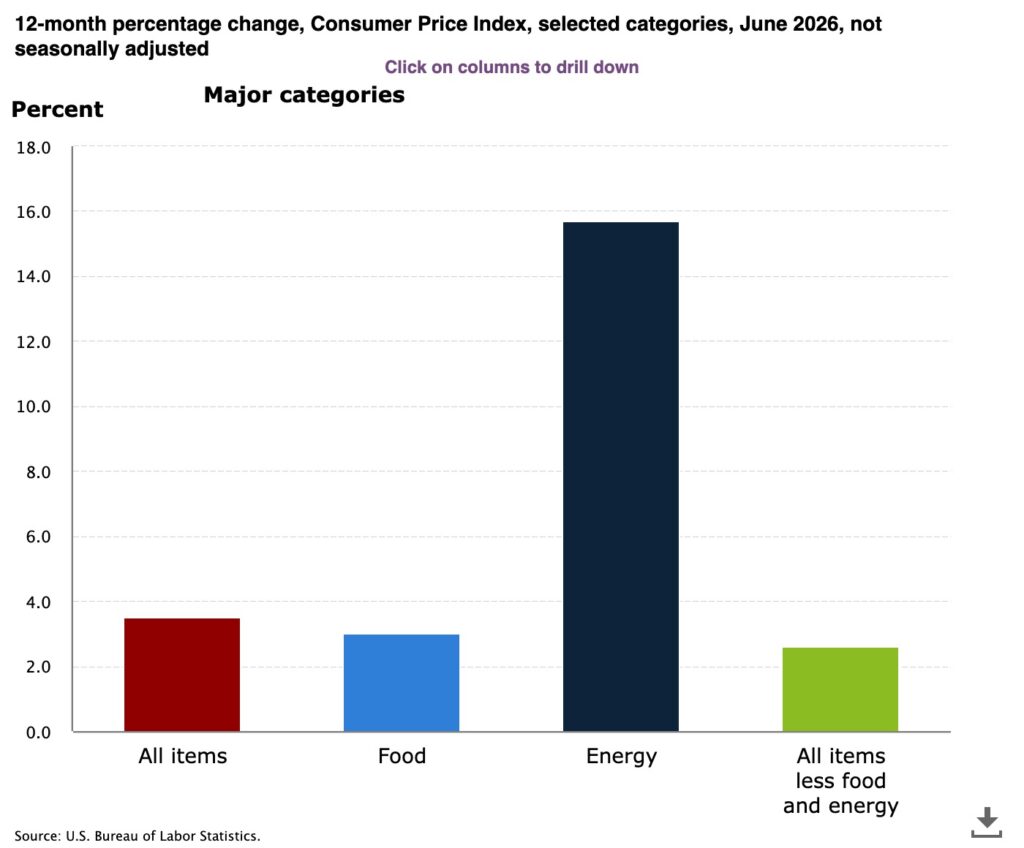
Energy prices drove the improvement. The energy index fell 5.7% in June, its steepest monthly drop in six years, as gasoline prices dropped nearly 10% following a temporary ceasefire between the United States and Iran. But that relief looks fragile. The ceasefire appears increasingly fractured, with the two countries exchanging strikes for a third consecutive day this week, raising the risk that energy costs and inflation with them could climb again in the months ahead.
 Sponsored · McLaren Resources Inc.
Even after June’s improvement, the US remains the outlier among its peers. Economist Justin Wolfers highlighted OECD data showing the US at 3.5% inflation, ahead of Canada at 3.2%, Italy at 3.1%, the United Kingdom at 2.8%, Germany at 2.4%, France at 2.0%, and Japan at 1.5%.
The OECD’s own analysis of G7 data found core inflation, not food or energy costs, has been the main driver of elevated prices specifically in Germany, the United Kingdom, and the United States.
Federal Reserve Chairman Kevin Warsh, in his second month leading the central bank after replacing Jerome Powell, cautioned against reading too much into a single month of improvement. Testifying before the House Financial Services Committee, Warsh said the report was “positive relative to expectations” but that it was too soon to call it a turning point.
“That is not my view,” he said of the idea that the Fed’s work is done. The Fed has held its benchmark rate steady at 3.5% to 3.75%, and traders widely expect it to consider raising rates as soon as September if price pressures resume.