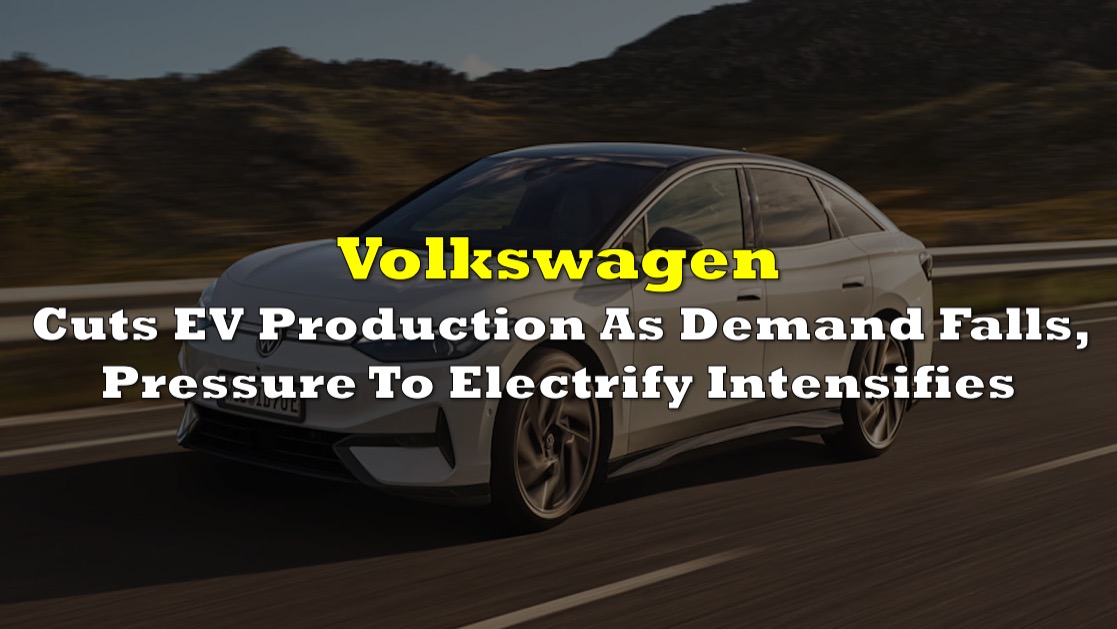

Volkswagen, the UK’s most popular car manufacturer, has made the unprecedented decision to scale back production of electric vehicles (EVs) due to a significant decline in customer demand. The company announced that work on EVs will be halted for at least six weeks at one of its largest plants in northwest Germany, while production of traditional internal combustion engine cars will continue unaffected.
According to company executives, demand for EVs has fallen by 30% compared to initial forecasts, leading to the layoff of 300 out of 1,500 employees working on EVs at the Emden plant in Germany.
“We are experiencing strong customer reluctance in the electric vehicle sector,” said Manfred Wulff, the head of the Emden plant.
 Sponsored · Selkirk Copper Mines
One of the vehicles affected by the production cutbacks is the new VW ID.7 electric model, which was scheduled to begin production in July but has been delayed until the end of the year. Additionally, the production of the ID.4 electric SUV and the upcoming ID.7 electric sedan will also be impacted.
Volkswagen UK stated that the decline in demand for electric cars could be attributed to reduced subsidies, higher inflation, and longer delivery times caused by parts shortages.
“The Volkswagen brand, like other car manufacturers, is currently seeing softening demand for electric cars. Reasons for this include: reduced subsidies, higher inflation and recent longer delivery times due to the shortage of parts,” a spokesperson for Volkswagen UK said.
However, the company remains optimistic that demand for all-electric cars will pick up as the year progresses, with the introduction of attractive new models such as the extensively revised ID.3 and the new ID.7.
 Sponsored · Cambria Gold Mines
Despite the temporary setback, Volkswagen is committed to its ambitious electric vehicle targets. The German manufacturer aims to achieve 80% electric sales in Europe and 55% in North America by 2030. It plans to launch ten electric models by 2026, including a battery-electric car priced under €25,000 (£22,000).
The announcement comes merely over a month after Canada’s Parliamentary Budget Officer Yves Giroux opened an investigation into the Liberal government’s unprecedented $13.8 billion subsidy to Volkswagen, which was intended to encourage the European automaker to construct its first North American battery cell plant in Ontario.
The decline in EV sales comes as car manufacturers grapple with shifting consumer attitudes, driven by rising electricity costs and relatively cheaper petrol prices. A recent study conducted by Teads, an advertising technology company, revealed that one in ten EV drivers planning to buy a new car in the next six months is considering opting for a petrol or diesel model due to the increasing costs associated with charging.
Furthermore, the scarcity of public charging infrastructure is also deterring potential buyers. In some regions, there are now more than 85 EVs for every public charger, leading to concerns among drivers about reaching their destinations on a single charge. Long queues at charging stations during peak travel periods have further added to the frustration.
The production cut announcement also happened days after Volkswagen recently relayed a leadership change at its luxury brand, Audi. Gernot Döllner, who has served as Volkswagen’s leading strategist, will replace Markus Duesmann as the chief executive of Audi, effective September 1.
The move is part of Volkswagen’s efforts to accelerate its transition to electric vehicles. Audi, while profitable, has faced challenges in adapting to battery power and competing with the growing threat from Chinese carmakers.
Volkswagen’s earnings grew by 40% to 7.6 billion euros ($8.3 billion) in 2022, primarily due to prioritizing higher-end vehicles during a chip shortage caused by pandemic-related supply chain disruptions. Audi is currently working on its final generation of combustion engine models and plans to introduce ten new electric models before transitioning to exclusively producing EVs by 2026.
Audi’s success in the luxury market has been driven by the popularity of its combustion engine vehicles. However, it now faces tough competition from leading electric vehicle producers such as Tesla and Chinese automakers. The appointment of Döllner, who has extensive experience working at Volkswagen and alongside Audi’s current CEO, Oliver Blume, aims to strengthen Audi’s innovation and improve production coordination with Volkswagen and Porsche.
Information for this briefing was found via The Times, The New York Times, and the sources mentioned. The author has no securities or affiliations related to this organization. Not a recommendation to buy or sell. Always do additional research and consult a professional before purchasing a security. The author holds no licenses.