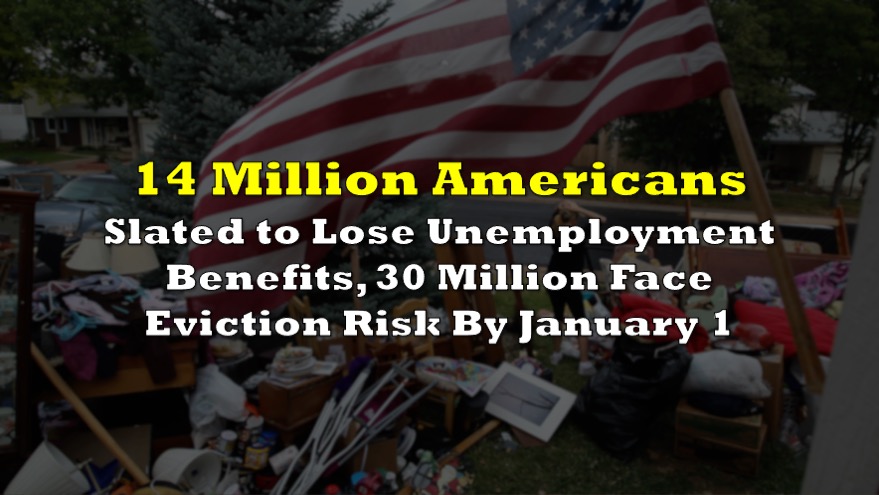

The Christmas holidays are likely going to be grim for millions of Americans, and not only due to soaring coronavirus cases across the country: by the end of December, several vital provisions of the CARES Act are slated to expire if there is no action from Congress, leading to over 14 million unemployed workers losing their emergency benefits and another 30 million Americans facing eviction.
During the pandemic, the CARES Act served to increase the duration of unemployment insurance as well as expand the eligibility criteria. The largest component of this is the Pandemic Unemployment Assistance (PUA) program, which provided 39 weeks worth of unemployment benefits to gig-economy or self-employed workers that would normally not quality for regular state insurance programs. In the meantime, the Pandemic Emergency Unemployment Compensation (PEUC) program was put in place to provide an additional 13 weeks of benefits to those Americans that had drained there normal state-provided unemployment benefits.
Latest data compiled by the US Department of Labour shows that over 21 million Americans are currently receiving some form of unemployment benefits, with 13.6 million of them enlisted under the PEUC or PUA programs. However, both of those programs are slated to expire on December 26, with no word of a replacement program from Congress anytime soon. According to Bank of America calculations, with nearly 12 million workers potentially losing their unemployment benefits come year-end, the loss in income would translate to approximately $39 billion in the first quarter of 2021 in the event that the workers are unable to find alternative means of income or other jobs.

The BofA also took fiscal multipliers into consideration, and calculated that the $39 billion income shortfall would translate to an approximate 1.2% decline in annualized economic growth in the first quarter of next year. Then, in addition to those 12 million workers that will be directly impacted come December, a quick Post-It note calculation suggests that another 2.4 million Americans currently receiving regular unemployment benefits will exhaust all eligible aid by the first quarter of 2021, leading to a further $8 billion in income loss and 0.3% loss in economic growth.
 Sponsored · Altamira Gold Corp.
Thus, BofA estimates that a total of 14.4 million Americans are slated to lose their unemployment benefits come December 31, which translates to an overall economic growth shortfall of 1.5% and a loss of nearly $50 billion in income in the first quarter of next year. And, with no additional stimulus in the works until at least after the President-elect’s inauguration, the second quarter could be even worse if those workers currently receiving extended unemployment benefits in several states also exhaust their eligibility duration.
Concurrently with the slew of various emergency unemployment benefits, the CARES Act also provided temporary payment relief by preventing landlords that held federally guaranteed mortgages from evicting their tenants. However, that eviction moratorium is also expected to expire come December 31, and according to a survey conducted by the Urban Institute, over one third of landlords had said that they had not received their full rent payments in September – suggesting that nearly 30 million renting households could face eviction before the end of the year.
The BofA also notes that American homeowners that currently hold federally guaranteed mortgages have the option to enter into a loan forbearance program up until December 31, with those that have been approved into forbearance programs prior to the deadline could request mortgage payment delays of up to a year. In a separate analysis, the Mortgage Bankers Association calculated that 5.7% of loans were in forbearance during the week ending on November 15, which equates to approximately 2.7 million American households being enrolled in some form of mortgage forbearance.
Although it is difficult to precisely quantify the exact shortcomings in economic growth as a result of the above provisions expiring, the BofA anticipates that the situation will nonetheless create significant ripple effects throughout the economy if American consumers are struggling to stay atop their debt obligations. According to a study conducted by Collison and Reed (2018), the monetary value of foregoing an eviction translates to approximately $8,000 per household, while several other studies suggest that a foreclosure would subsequently lower the selling price of adjacent properties by 1%, while homes that were previously foreclosed suffered a 27% price drop relative to similar properties.
In short, the end of December expiration dates mean that there will suddenly be an onset of numerous households that will be unable to meet their debt payments. The Census Bureau Household Pulse Survey found that nearly 30% of renters and close to 12% of mortgage holders have very little confidence that they will be able to make December’s payment.

To conclude, by the time the various programs under the CARES Act are phased out come January 1, the US economy will not have any form of a safety net to deflect implications stemming from the coronavirus pandemic. Although Congress will likely pass some sort of a new stimulus package after the new administration settles into the White House, the BofA estimates that the package will only be to the tune of $500 billion to $1 trillion. Indeed, a new stimulus package will certainly help boost growth by at least 2.5% next year, but unless the coronavirus pandemic is subdued sometime soon, then the US economy will face the same dilemma outlined in this essay once again.
Information for this briefing was found via the DOL, BofA, Urban Institute, the MBA, Collison & Reed (2018), and the US Census Bureau. The author has no securities or affiliations related to this organization. Not a recommendation to buy or sell. Always do additional research and consult a professional before purchasing a security. The author holds no licenses.