
Japan’s central bank turned an initial ¥450 billion stock-market intervention into a ¥37.2 trillion portfolio, and even after accelerating its exit strategy on Friday, the Bank of Japan could still be selling the investments around 2070.
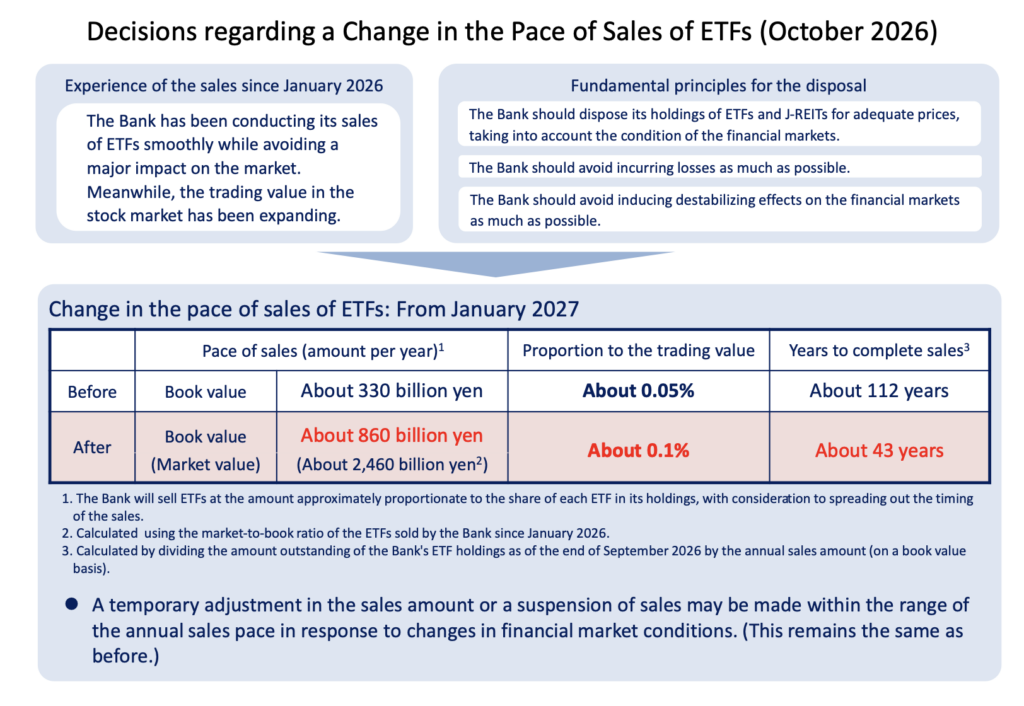
The BOJ announced that it will increase annual sales of exchange-traded funds to approximately ¥860 billion ($5.45 billion) at book value, up from ¥330 billion, beginning January 1, 2027. The increase cuts the estimated liquidation period from 112 years to 43 years.
That means a program introduced in 2010 as a temporary monetary-easing measure could take roughly six decades from its inception to disappear entirely from the central bank’s balance sheet.
 Sponsored · Cambria Gold Mines
The original intervention was considerably smaller than the portfolio Japan must now dismantle. In October 2010, the BOJ outlined a maximum ETF holding of ¥450 billion, with purchases intended to reach that level around the end of 2011.
The bank subsequently extended and expanded the program as part of successive monetary-easing campaigns.
By March 2024, when the BOJ discontinued ETF purchases, its holdings had reached approximately ¥37.2 trillion at book value, more than 80 times the original ceiling.
The expansion made the central bank an unusually significant participant in Japan’s equity market, leaving policymakers with the separate challenge of eventually returning those assets to private investors.
 Sponsored · Selkirk Copper Mines
The BOJ began selling its ETF holdings in January 2026 under a disposal framework approved in September 2025. Friday’s adjustment increases annual sales by approximately 161%, although the central bank intends to keep those transactions relatively small compared with overall market activity.
The new annual target represents approximately 0.1% of trading value on the Tokyo Stock Exchange’s Prime Market, compared with 0.05% under the previous arrangement.
At prevailing valuation ratios used by the BOJ, the ¥860 billion book-value target corresponds to approximately ¥2.46 trillion in annual sales measured at market value.
According to the BOJ, disposals conducted since January have proceeded without a major market impact, while trading activity has expanded sufficiently to support a faster pace.
Still, the central bank retains the authority to adjust or temporarily suspend sales when market conditions deteriorate.
The 43-year estimate assumes the newly authorized annual book-value disposal rate continues against holdings measured at the end of September 2026.
The ETF decision was unanimous, even as the BOJ separately voted 8-1 to maintain its policy interest rate at 1.25%.